Company & Robot DB
Tesla Full Self-Driving (FSD)
01Where FSD stands today
FSD (Supervised) is the software sold in Tesla's consumer cars. As of June 2026 the latest build is v14.3.4 (firmware 2026.14.6), with a lighter "FSD v14 Lite" build extended to older Hardware 3 cars later that month. Tesla starts the rollout of FSD v14.3.4 (teslaoracle.com) / Tesla starts the rollout of FSD v14 Lite for HW3 (teslaoracle.com)
Legally and technically, FSD (Supervised) is SAE Level 2: the driver is responsible for the car at all times and must keep supervising it, whatever the product name implies. Separately, Tesla runs a purpose-built robotaxi service — branded Robotaxi/Cybercab — that operates with no one behind the wheel at all, but only inside specific geofenced areas. By mid-2026 that means the entire Austin metro area, plus Dallas, Houston, and Miami. Tesla expands Unsupervised Robotaxi to the entire Austin metro area (teslaoracle.com) / Tesla expands Unsupervised Robotaxi service to two new cities (teslarati.com)
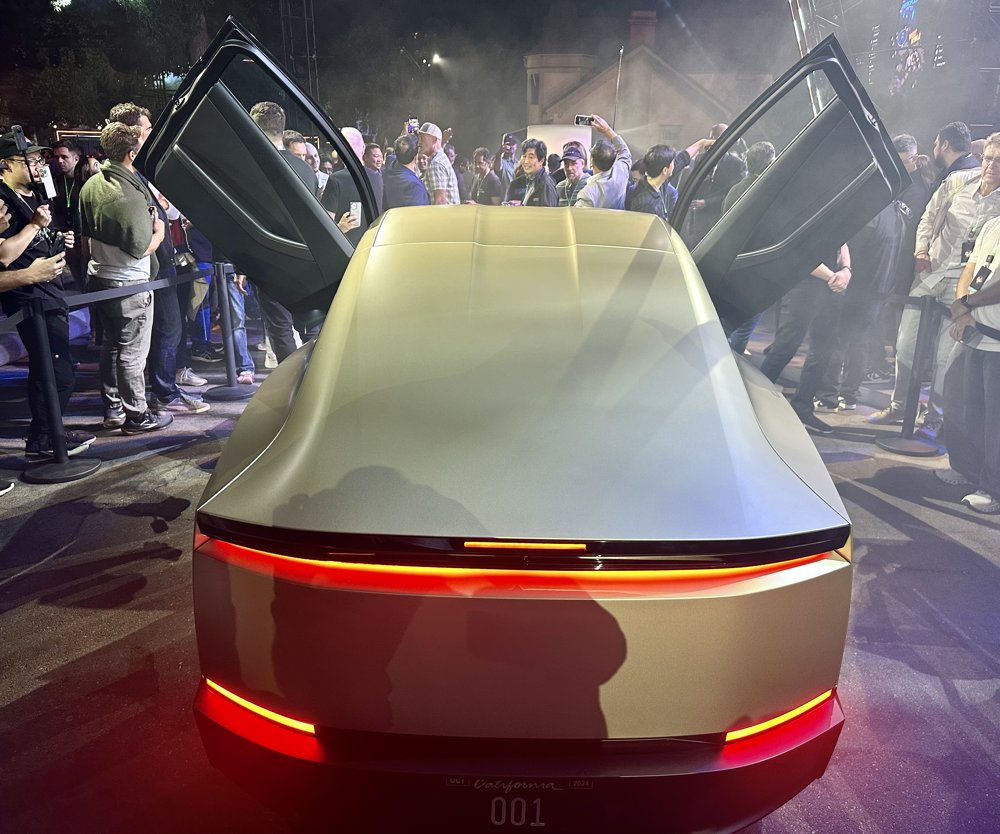
Cybercab, Tesla's purpose-built robotaxi, at its October 2024 unveiling. Cybercab is distinct from FSD (Supervised) in customer-owned cars — it's the vehicle behind Tesla's driverless Robotaxi service, which as of mid-2026 operates only in specific geofenced US cities.
Photo: Steve Jurvetson, CC BY 2.0, via Wikimedia CommonsTesla's official "We, Robot" Cybercab unveil (October 2024) — the event where Cybercab and the driverless Robotaxi concept were first shown publicly.
02The technical approach: vision-only, end-to-end
FSD's current architecture is usually described as vision-only and end-to-end: a single neural network takes in raw video from the car's eight cameras — no radar, no lidar — and outputs steering, acceleration, and braking directly, in place of the large hand-coded rule stacks earlier Autopilot versions relied on. Tesla trains that network on driving data pulled from its own consumer fleet.
In November 2025, Tesla's VP of AI software, Ashok Elluswamy, described a neural world simulator — a learned, generative environment that can render synthetic camera feeds, inject adversarial events such as a pedestrian stepping out, and replay past failures to check whether a new model fixes them. Tesla says the same simulator trains its Optimus humanoid program as well as FSD. Tesla AI chief details unified "world simulator" for FSD and Optimus (humanoidsdaily.com)
That's the same underlying idea covered in more depth in The Dynamics' World Model explainer: an AI's learned internal simulation of how the world responds to action, used to plan or train before — or instead of — real-world trial and error. Where general-purpose world models like Genie 3 or GAIA-1 are published with benchmarks other researchers can probe, Tesla's simulator is proprietary and tightly coupled to its own fleet data, so its actual capabilities are harder for outsiders to verify independently.
03Where it runs, and under whose supervision
FSD (Supervised) and driverless Robotaxi service are rolling out unevenly by country, and the regulatory picture is genuinely in flux rather than settled.
United States
- 2026Driverless Robotaxi: entire Austin metro, plus Dallas, Houston, Miami; ~12 states targeted by year-end
Europe
- 2026-04Netherlands (RDW) issues first EU type approval for FSD (Supervised); a few countries follow
- 2026-06EU-wide vote pending; larger markets (DE, FR, IT, ES) awaiting coordinated decision; Norway disputes safety rating
Japan
- 2025-08Public-road testing begins in Tokyo
- 2026Tesla's stated launch target — not yet certified; UN-R79-based standard lacks a hands-free-steering category
In the US, Tesla says it aims to have robotaxi service running in roughly 12 states before the end of 2026, pending state-by-state approval — a target, not a confirmed schedule. Can Tesla meet Musk's 2026 unsupervised robotaxi target? (finance.yahoo.com)
In Europe, the Netherlands' RDW became the first EU regulator to issue a type approval for FSD (Supervised) in April 2026, and a handful of countries (Lithuania, Estonia, Denmark, Belgium) have since recognized or separately approved it. Several larger markets — including Germany, France, Italy, and Spain — are reportedly holding off on their own national approval in favor of a coordinated EU-wide vote, and regulators in Norway have publicly disputed the Dutch safety assessment, which itself rated the system's net safety impact as only "marginally positive." When does FSD come to Europe? (jowua-life.com) / Tesla FSD cleared in the Netherlands, but EU approval far from certain (automotiveworld.com)
In Japan, Tesla has been testing FSD (Supervised) on public roads in Tokyo since August 2025 and has stated a goal of launching there in 2026, but as of mid-2026 public-road certification hasn't been finalized. The core obstacle isn't Tesla-specific: Japan's road-vehicle safety standard (based on UN-R79) has no certification category yet for continuous, hands-free automated steering on ordinary city streets — a gap that, as of this writing, no country has fully closed with an international standard. Tesla begins FSD testing in Tokyo ahead of 2026 Japan launch (teslanorth.com) / Tesla FSD is Level 2 — so why can't Japan approve it? UN-R79 explained (lounges.site)
04The safety dispute
Whether FSD is actually safer than an average human driver is one of the most contested questions in this space right now — Tesla, US regulators, and independent researchers do not agree.
FSD travels farther between crashes
Tesla has told investors, customers, and regulators — including in safety submissions to Sweden and the Netherlands — that FSD-equipped cars travel several times farther between crashes than the average human-driven car, with cited multiples reported as high as roughly 7–10x depending on the report and period.
Researchers call the comparison flawed
Ten of eleven independent traffic-safety researchers surveyed by Reuters called that comparison misleading: Tesla's numerator counts only crashes severe enough to deploy an airbag, while the human-driver baseline includes far more minor tow-away crashes. On an apples-to-apples airbag-to-airbag basis, researchers put the actual gap closer to roughly 3x, not 7–10x. Separately, seven of nine former Tesla data labelers told Reuters they personally would not trust FSD to drive them.
SourcePhil Koopman, new Tesla FSD safety data (substack.com)
US regulators have not endorsed Tesla's figures either. NHTSA opened a Preliminary Evaluation (PE25012) in December 2025 after 58 consumer complaints describing FSD running red lights, drifting into oncoming lanes, and crossing into wrong-way traffic. It escalated that in March 2026 to a formal Engineering Analysis (EA26002) covering roughly 3.2 million vehicles running FSD (Supervised), following nine documented crashes — including one fatality and at least two injury crashes — in which the system reportedly failed to handle reduced-visibility conditions such as sun glare, fog, and airborne dust. US Senators Ed Markey and Richard Blumenthal separately asked NHTSA to formally review Tesla's public safety claims. NHTSA Engineering Analysis EA26002 (static.nhtsa.gov, official filing) / NHTSA Preliminary Evaluation PE25012 (static.nhtsa.gov, official filing) / Senators' letter urging NHTSA to review Tesla's FSD safety claims (markey.senate.gov, official letter)
None of this means the investigations have concluded Tesla did anything wrong — they remain open. But it does mean Tesla's own safety marketing should be read as one contested claim among several, not as an independently settled fact.
05Where FSD fits in Tesla's strategy
Tesla increasingly pitches itself to investors as an AI and autonomy company rather than a traditional automaker, and FSD/Robotaxi sits at the center of that pitch. For 2026, Tesla has committed more than $25 billion in capital spending to robotics and autonomy — funding an expanded Optimus line in Fremont, a second Optimus factory at Giga Texas, the Cybercab production ramp, and an in-house semiconductor R&D fab. Tesla calls 2026 its biggest investment year since Model 3 (basenor.com)
On an earnings call in mid-2026, Elon Musk urged patience: "I don't think unsupervised FSD or Robotaxi revenue would be super material this year, but I do think it will be material probably in a significant way next year," while saying Tesla aims to have robotaxi service running in roughly 12 states before the end of 2026. Elon Musk tells investors to be patient with Optimus and Robotaxi (247wallst.com)
Markets appear to already be pricing in that bet: Tesla traded around a $1.41 trillion market capitalization in mid-2026 with a price-to-earnings ratio near 344 — a multiple that reflects investors valuing Tesla substantially as an autonomy and AI company rather than a car manufacturer. Tesla's stated rationale for training FSD and Optimus on one shared simulator architecture (see the previous section) is to spread the same fleet-data and simulation infrastructure across both product lines instead of building each in isolation. Is Tesla a buy in 2026? Why AI and robotaxis now define TSLA's valuation (tradingkey.com)
Tesla on the market
06Challenges ahead
Independent verification of safety is unresolved, not settled. NHTSA's EA26002 investigation covers 3.2 million vehicles and remains open, and the Reuters/Koopman dispute over Tesla's own crash-rate comparisons hasn't been reconciled either way. Until an independent body — not Tesla itself — publishes a methodology both sides accept, "is FSD safer than a human" will stay a contested claim rather than a settled fact.
Regulatory approval is a country-by-country grind, not a single global rollout. Japan has no certification category for continuous hands-free driving at all (the UN-R79 gap discussed above); the EU is still awaiting a coordinated vote with several large markets holding off on national approval; and Norway has publicly disputed the Dutch safety assessment that got FSD its first EU type approval. Each of those has its own timeline that Tesla doesn't control.
Tesla's vision-only, no-lidar architecture remains a genuinely contested engineering bet, not a settled one. Competing approaches (Waymo's sensor-redundant stack, for instance) trade Tesla's lower cost and faster fleet-wide iteration for extra sensing modalities meant to catch what cameras alone might miss in bad weather, low light, or other edge cases — and that tradeoff won't be judged until there's a much longer track record on both sides.
Finally, going from today's handful of geofenced robotaxi cities to Tesla's own stated goal of roughly 12 states by the end of 2026 is a big jump in scope, not just volume — every new city and state means new regulatory approval, new road conditions, and new edge cases the system hasn't seen. Given how far Tesla's 2025 Optimus targets missed reality, that same caution about company-stated timelines applies here too.
07FAQ
Is FSD actually "full" self-driving today?
Not in a consumer-owned car. FSD (Supervised) is SAE Level 2 software: the driver must stay alert and is legally responsible for the vehicle at all times, whatever the product name implies. Only Tesla's own purpose-built Robotaxi fleet, in a handful of geofenced US cities, currently runs with no one behind the wheel.
What's the difference between "FSD Supervised" and "Robotaxi"?
They share the same underlying software and camera-based approach, but different responsibility models. FSD (Supervised) ships in customer-owned cars with the driver legally in the loop at all times. Robotaxi (Unsupervised) is Tesla's own driverless ride-hailing service, running only in specific geofenced cities, where no one licensed to drive is required inside the car.
Are Tesla's FSD safety statistics trustworthy?
This is genuinely disputed, not settled. Tesla has published figures suggesting FSD is several times safer than average human driving, but a majority of independent researchers reviewed by Reuters called the underlying comparison methodologically flawed, and regulators in the US (NHTSA) and Europe have opened investigations or questioned Tesla's submissions rather than endorsing its numbers.
When will FSD be available in Japan?
Tesla has been testing FSD (Supervised) on Tokyo public roads since August 2025 and has stated a goal of launching there in 2026, but as of mid-2026 public-road certification hasn't been finalized. The underlying obstacle is that Japan's UN-R79-based standard has no certification category yet for continuous, hands-free automated steering — a gap that, as of this writing, no country has fully closed either.
08Sources
01. Where FSD stands today
Related articles
Company & Market Data
Company Deep Dives
Tesla
- ›Tesla Optimus
- ›Tesla Full Self-Driving (FSD)(this article)
Unitree
Figure AI
1X Technologies
Physical Intelligence
Skild AI
NVIDIA
- ›NVIDIA Isaac GR00T, Explained: What NVIDIA Actually Sells in Robotics
- ›NVIDIA DRIVE, Explained: The Automotive Platform Behind Mercedes-Benz, Uber, and a Dozen Other Automakers
- ›NVIDIA Jetson: The Decade-Old Hardware Lineage Behind Physical AI
- ›NVIDIA: A History of the GPU
- ›NVIDIA CUDA, Explained: The Software Behind NVIDIA's AI Moat
- ›Jensen Huang: From a Denny's Dishwasher to NVIDIA's CEO