Company & Robot DB
Tesla Optimus
01What Optimus is
Optimus is Tesla's humanoid robot program: a bipedal, roughly human-sized machine that Tesla says is meant to eventually do the kind of physical work — factory tasks, household chores, anything "monotonous or dangerous" — that today requires a person. Tesla's own framing goes well beyond a single product. Its 2025 strategy document, Master Plan Part IV, describes Optimus's mission as "changing not only the perception of labor itself but its availability and capability," positioning the robot as a pillar of the company's long-term identity alongside EVs and energy storage.
The robot was first shown, under the name "Tesla Bot," at Tesla's AI Day in August 2021 — at the time, literally a person in a robot suit standing in for hardware that didn't exist yet. Everything that followed is best read as a series of demonstrations of steadily increasing capability, not a continuous production run: Tesla has repeatedly shown Optimus doing something new on stage or in a video, then taken months or years to turn that demo into hardware running with any independence in one of its own factories.
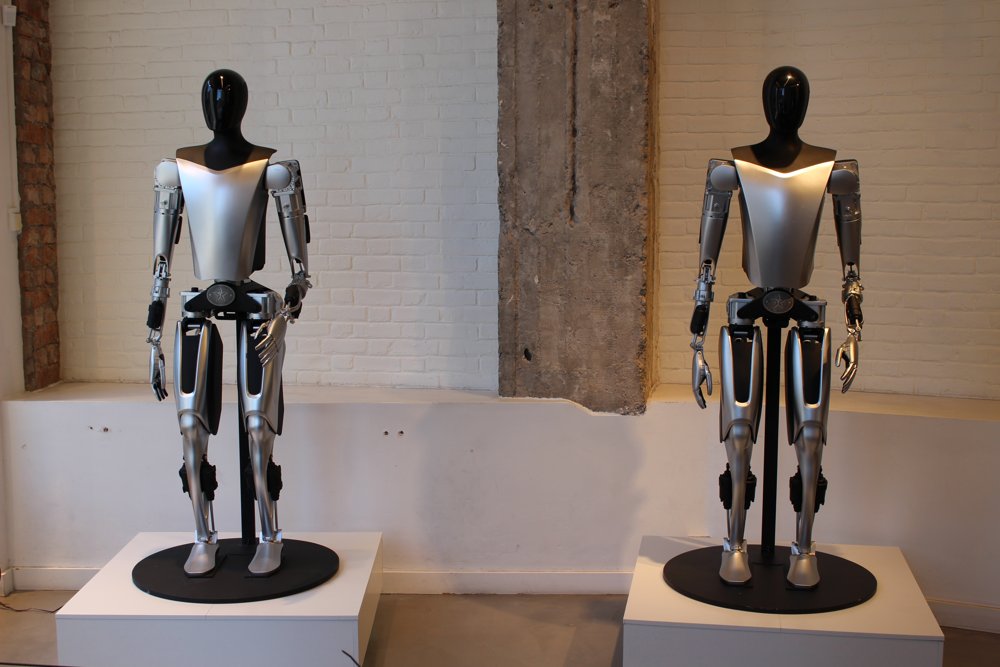
Optimus units on display (Stockholm, May 2024) — this is the physical, non-teleoperated hardware; see the timeline below for which capabilities were demoed this way versus shown live on stage.
Photo: Ulf Klingström, public domain, via Wikimedia Commons02Development timeline (2021–2026)
Optimus's public history is a series of unveilings, each significantly more capable than the last, interspersed with slower and less photogenic progress on manufacturing it at any volume. A recurring theme, and one worth tracking closely, is how much of each demo turned out to be teleoperated — remote-controlled by a human — rather than running autonomously, and how consistently the timelines Tesla announced slipped.
| Year | Event |
|---|---|
| 2021-08 | "Tesla Bot" concept unveiled at AI Day — a person in a robot suit stands in for hardware that doesn't exist yet |
| 2022-09 | First physical prototype shown at the second AI Day, walking and moving its arms on stage |
| 2023-12 | Optimus Gen 2 unveiled — Tesla-designed actuators/sensors throughout, ~10kg lighter, ~30% faster walk |
| 2024-10 | "We, Robot" event — Optimus serves drinks and chats with guests; Tesla later confirms much of it was teleoperated |
| 2024-11 | Upgraded hand revealed — 22 degrees of freedom, tendon-driven, tactile fingertips; teleoperation disclosed upfront this time |
| 2025-01 | Musk tells investors Tesla's internal plan calls for ~10,000 units in 2025, with a few thousand doing useful work by year-end |
| 2026-01 | Musk acknowledges no Optimus robots are doing productive work in Tesla's factories — still in R&D, not production |
| 2026-04 | Q1 earnings call: Fremont's former Model S/X line to become an Optimus Gen 3 line, output targeted for ~July–August 2026 |
| 2026-07 | Gen 3 public unveiling still repeatedly delayed; Musk maintains the initial production ramp will be "extremely slow" |
Tesla's official Gen 2 reveal (December 2023) — the generation that first moved to Tesla-designed actuators and sensors throughout the robot, discussed in the hardware section above.
Tesla's official "We, Robot" event video (October 2024) — the event where Optimus served drinks and chatted with guests, later disclosed as teleoperated rather than autonomous (see "Challenges ahead" below).
03What's technically distinctive
The most closely watched hardware change across Optimus's generations is the hand. Tesla's Gen 2 hands, shown in December 2023, moved to Tesla-designed actuators and sensors throughout the robot and cut roughly 10 kilograms of weight while increasing walking speed by about 30% over the original prototype.
In November 2024, Tesla showed a further hand redesign with 22 degrees of freedom in the hand itself, plus three more in the wrist and forearm, for 25 degrees of freedom per arm — approaching the roughly 27 degrees of freedom of a human hand. Rather than packing motors into the hand, Tesla moved the actuators into the forearm and drives the fingers through a tendon system, thin cables pulling the fingers the way tendons pull a human finger; the hands also carry tactile sensing across the fingertips, which Tesla demonstrated by having the robot hold objects as delicate as an egg without crushing them. Tesla disclosed upfront that this specific demo was teleoperated — a deliberate change after criticism of an earlier event (below) — while still presenting the mechanical hand design itself as the real engineering result.
This is the kind of hardware problem — a dexterous end-effector with dozens of small, precise actuators packed into a human-sized limb — that sits at the center of the wider humanoid-robotics industry's hardest open problems, not just Tesla's. It's covered in more depth in our explainer on humanoid actuators, tactile sensors, and dexterous hands, which looks at how actuators, tactile sensors, and dexterous hands are engineered across the industry, not only at Tesla.
The other distinctive piece of Tesla's approach is manufacturing, not the robot's design. Tesla is trying to carry its EV-era playbook — designing its own actuators and electronics in-house rather than buying them off the shelf, then re-using its car-assembly experience to scale a brand-new product line quickly — directly onto a humanoid robot. The clearest evidence of that bet: Tesla ended Model S and Model X production in 2026 and converted the dedicated assembly area at its Fremont, California factory into a production line for Optimus Gen 3, the first Optimus generation Tesla says was actually designed for mass manufacturing rather than as a research prototype.
Optimus by the generation
"Tesla Bot" / first prototype
Announced as a concept in a suit in 2021; a working (if slow, assisted) prototype walked on stage a year later. Proof of intent, not of a usable robot.
Optimus Gen 2
First generation with Tesla-designed actuators and sensors throughout, ~10kg lighter and ~30% faster walking than the prototype.
SourceElectrek, Dec 2023
Optimus Gen 3 (mass-production target)
22-DoF tendon-driven hands with tactile fingertips (revealed Nov 2024); the first generation Tesla says was designed for volume manufacturing, targeted to start production on Fremont's converted Model S/X line around mid-2026.
SourceElectrek, Apr 2026
Reported specs (Tesla's own public figures)
04Production status and the 2026 ramp
Tesla's stated production targets for Optimus have consistently been more optimistic than what has actually shipped. In January 2025, Elon Musk told investors Tesla's "normal internal plan" called for roughly 10,000 Optimus units in 2025, with a few thousand expected to be doing useful work in Tesla's own factories by year-end. A year later, on Tesla's Q4 2025 earnings call in January 2026, Musk acknowledged that no Optimus robots were doing productive work in Tesla's factories — the several hundred units deployed were, in his words, primarily for learning, still in R&D rather than production.
Tesla's official "Optimus Navigating Around" video (December 2024) — the robot moving through a factory floor, avoiding obstacles, taking stairs, and self-charging, the kind of everyday autonomy the production ramp below depends on.
Stated target vs. confirmed reality, one year apart
Fortune, Jan 2025 / Fortune, Jan 2026
On the Q1 2026 earnings call in April 2026, Tesla laid out the current plan: convert the former Model S/X line at Fremont into an Optimus Gen 3 production line, with output starting around July or August 2026 and an eventual planned capacity of roughly 1 million units a year at that single line. Musk was explicit that the initial ramp would not look like a car launch — he called the early rate "literally impossible to predict" given roughly 10,000 unique parts across an all-new line, and warned that "Optimus production will be extremely slow at first, as everything is new." As of this writing, Tesla has also repeatedly pushed back the public unveiling of the Gen 3 design itself, with Musk saying he'd rather show it close to the start of production than let competitors study it early — a pattern commentators covering Tesla closely have noted looks similar to previous rounds of delay.
None of the 2026 production-volume figures above should be read as confirmed output — they are Tesla's stated targets, not audited or independently verified shipment numbers, and Tesla's own track record over 2025 is the main reason for treating them cautiously.
05Where Optimus sits in Tesla's business today
However the 2026 ramp plays out, Optimus is a small part of Tesla's business right now: with no confirmed autonomous units in productive deployment as of early 2026, it is not yet a meaningful revenue line next to Tesla's car and energy businesses. The gap between that current state and Tesla leadership's stated ambition is unusually wide, even by Musk's standards. At Tesla's 2024 shareholder meeting, Musk suggested Optimus could eventually make Tesla a $25 trillion company — more than half the value of the entire S&P 500 at the time. In September 2025, alongside the release of Master Plan Part IV, he went further, telling investors that roughly 80% of Tesla's value would eventually come from Optimus — a claim made as Tesla's core EV sales were falling (down 13% year-on-year in the first half of 2025, with steeper declines in some markets).
That combination — a today's-business footprint close to zero, and a stated long-term thesis in the trillions — is the central tension in reading any Optimus news: it's simultaneously a very early-stage hardware program and, in Tesla leadership's own telling, the company's largest long-run bet.
Tesla on the market
06Challenges ahead
Manufacturing, not capability, is the immediate bottleneck. Tesla's own numbers illustrate the gap: an all-new assembly line with roughly 10,000 unique parts, an early production rate Musk himself called "literally impossible to predict," and a track record of missing its own targets by a wide margin every year since 2021. Getting from a few hundred R&D units to anything near the eventual 1-million-unit-a-year ambition means solving ordinary factory-scale manufacturing problems — supplier yield, part cost, assembly line uptime — for a machine far more complex than a car.
The demo-vs-autonomy gap is the second open question. Several of Optimus's most impressive public moments — the 2024 "We, Robot" bartending demo, the November 2024 hand reveal — were disclosed as teleoperated rather than running on the robot's own perception and decision-making. The December 2024 factory-navigation video is a genuine step toward closing that gap, but Tesla has not published independent, third-party-verifiable benchmarks of how much of Optimus's day-to-day work is autonomous versus remotely piloted.
Competition is real and moving fast. Figure AI, Agility Robotics, and Unitree are all racing toward the same general-purpose humanoid goal from different angles — Figure with a foundation-model partnership approach, Agility with an already-paid commercial deployment at Amazon and Ford, Unitree by undercutting on price while leading 2025 unit sales worldwide. See the Company & Robot DB for a fuller comparison. None of Tesla's competitors has solved general-purpose manufacturing at scale either, but Tesla is not competing in a vacuum, and its lead — if it has one — is in car-manufacturing experience and capital, not in a demonstrated hardware or software advantage today.
07FAQ
What is Tesla Optimus?
Optimus is Tesla's humanoid robot program, first shown in 2021, aimed at eventually performing general physical labor. Tesla's Master Plan Part IV describes its mission as changing the availability and capability of labor, positioning it as a long-term pillar of the company alongside EVs and energy.
Is Optimus already doing real work in Tesla's factories?
Not as of early 2026, by Tesla's own account. On the January 2026 earnings call, Musk said Tesla had several hundred units deployed but primarily for learning, not productive work — still R&D rather than production. Several of Tesla's public demos (the 2024 "We, Robot" event, the November 2024 hand reveal) were also confirmed to be teleoperated rather than autonomous.
When will Optimus reach mass production?
Tesla's April 2026 plan targets production starting around July–August 2026 on a converted Fremont assembly line, eventually reaching roughly 1 million units a year at that line. Musk has warned the initial ramp will be "extremely slow," and Tesla has repeatedly delayed the Gen 3 public unveiling — given how far Tesla's 2025 targets missed reality, these 2026 dates and volumes should be read as targets, not confirmed outcomes.
How big a part of Tesla's business is Optimus today?
A small one. With no confirmed autonomous units in productive deployment as of early 2026, Optimus is not yet a meaningful revenue line. That's a sharp contrast with Musk's stated long-term ambition — a $25 trillion valuation scenario in 2024, and a claim in September 2025 that roughly 80% of Tesla's eventual value would come from Optimus.
08Sources
01. What Optimus is
02. Development timeline (2021–2026)
03. What's technically distinctive
05. Where Optimus sits in Tesla's business today
Related articles
Articles
Company & Market Data
Company Deep Dives
Tesla
- ›Tesla Optimus(this article)
- ›Tesla Full Self-Driving (FSD)
Unitree
Figure AI
1X Technologies
Physical Intelligence
Skild AI
NVIDIA
- ›NVIDIA Isaac GR00T, Explained: What NVIDIA Actually Sells in Robotics
- ›NVIDIA DRIVE, Explained: The Automotive Platform Behind Mercedes-Benz, Uber, and a Dozen Other Automakers
- ›NVIDIA Jetson: The Decade-Old Hardware Lineage Behind Physical AI
- ›NVIDIA: A History of the GPU
- ›NVIDIA CUDA, Explained: The Software Behind NVIDIA's AI Moat
- ›Jensen Huang: From a Denny's Dishwasher to NVIDIA's CEO