Projects
The History of LeRobot
What LeRobot changed
Before LeRobot, training a robot for a specific physical task usually meant building a one-off data-collection rig, writing custom code for whatever hardware happened to be on hand, and hoping the result was of any use to the next lab.
LeRobot replaced that with one shared, open-source stack:
- A common way to teleoperate a robot and record what happened
- A common dataset format, now used across thousands of community-shared datasets
- One library that runs its own algorithms (ACT, SmolVLA) alongside outside models (Physical Intelligence's π0, NVIDIA's Isaac GR00T)
- Hardware starting under $100 — down from the tens of thousands a research-grade arm used to cost
In under two years, that turned real-world robot learning from a well-funded lab's private exercise into something a hobbyist with a 3D printer can reproduce, using the same software and the same public data.
The story so far, in four phases
- 2024
Origins
An ex-Tesla engineer launches a PyTorch-native robotics library at Hugging Face
- 2024–2025
Hardware gets cheap
Koch → SO-100 → SO-101 bring a teleoperated arm pair under $100
- 2025
Models and data scale up
π0, GR00T, and community-trained SmolVLA expand the model zoo; datasets reach millions of episodes
- 2025–2026
Ecosystem & imagination
Pollen Robotics joins Hugging Face, a worldwide hackathon draws thousands, and 0.6.0 teaches policies to imagine
01Origins: an ex-Tesla engineer's bet (2024)
LeRobot's earliest code traces to a single commit on January 26, 2024, by Rémi Cadène, a former staff research scientist at Tesla who had joined Hugging Face to work on robotics. A first package, versioned 0.1.0, reached the Python Package Index on March 9, 2024, already bundling an early imitation-learning baseline (TD-MPC) and, within days, the ACT and Diffusion Policy algorithms. By May 2024, Hugging Face's robotics team had turned that fast-moving codebase into a public launch: LeRobot, a PyTorch-native library for training and deploying real-world robot policies, released under the permissive Apache 2.0 license so any developer or researcher could use, modify, and redistribute it freely.
The bet was that robotics, like language modeling before it, would benefit more from an open, shared toolbox and shared datasets than from every team guarding its own stack — instead of every lab reinventing its own training pipeline from scratch.
"LeRobot is to robotics what the Transformers library is to NLP."
02Hardware gets cheap: Koch, SO-100, SO-101 (2024–2025)
LeRobot's first real-hardware support, added in July 2024, targeted the Koch v1.1, an open-source, servo-driven arm designed outside the project and already circulating in hobbyist and research circles. The project's own hardware milestone followed in October 2024: a collaboration with French robotics firm TheRobotStudio produced the SO-100, a 3D-printable leader/follower arm pair that could be built for around $100 in parts — turning the entry cost of collecting real-world manipulation data from thousands of dollars into a hobbyist budget. LeKiwi, a wheeled mobile base built to carry an SO-101 arm, followed in February 2025, extending the lineup from stationary arms toward mobile manipulation.
In April 2025, Hugging Face and TheRobotStudio — joined by WowRobo, Seeed Studio, and Partabot — followed up with the SO-101, priced from about $100 to $500 depending on assembly level and shipping:

A leader-follower SO-100 arm pair in action — the teleoperation setup LeRobot uses to collect the demonstration data its imitation-learning policies train on.
Animation: Hugging Face (LeRobot), Apache License 2.0, via GitHub- Easier to assemble — no more removing gears just to swap a motor
- Redesigned wiring harness
- Optimized leader-arm gear ratios
"The most popular robot arms ever? ... The first robot arms any AI builder should buy."
Hugging Face's own tutorial series walks through assembling and calibrating the SO-100 arm — part of the same "LeRobot Tutorials" series that lowered the hardware barrier to entry.
03The model zoo grows: from ACT to SmolVLA (2025)
LeRobot shipped with imitation-learning baselines from day one — ACT (Action Chunking Transformer), Diffusion Policy, and VQ-BeT among them — but through 2025 it became the default place to run other labs' robot foundation models too, not just its own. Physical Intelligence's π0 and π0.5 and NVIDIA's Isaac GR00T were integrated into the library's v0.4.0 release, letting any developer fine-tune a generalist vision-language-action (VLA) model on their own SO-100/SO-101 data instead of training one from scratch.
In June 2025, Hugging Face's own robotics team went a step further and released SmolVLA, a compact 450-million-parameter VLA pretrained only on the "LeRobot Community Datasets" — the demonstration recordings that hobbyists and labs upload to the Hub under the lerobot tag. Pretraining on that crowdsourced data alone lifted SmolVLA's success rate on the SO-100 arm from 51.7% to 78.3%, early evidence that the low-cost-hardware bet was starting to pay off as a data flywheel, not just a way to cut the price of an arm.
SmolVLA: trained on the community, not just the lab
A compact 450M-parameter VLA pretrained only on LeRobot Community Datasets. Pretraining on that crowdsourced data alone lifted its SO-100 success rate from 51.7% to 78.3%.
π0 / π0.5 and Isaac GR00T join the library
Physical Intelligence's π0/π0.5 and NVIDIA's Isaac GR00T were integrated into LeRobot's v0.4.0 release, so any developer can fine-tune a generalist VLA on their own SO-100/SO-101 data instead of training one from scratch.
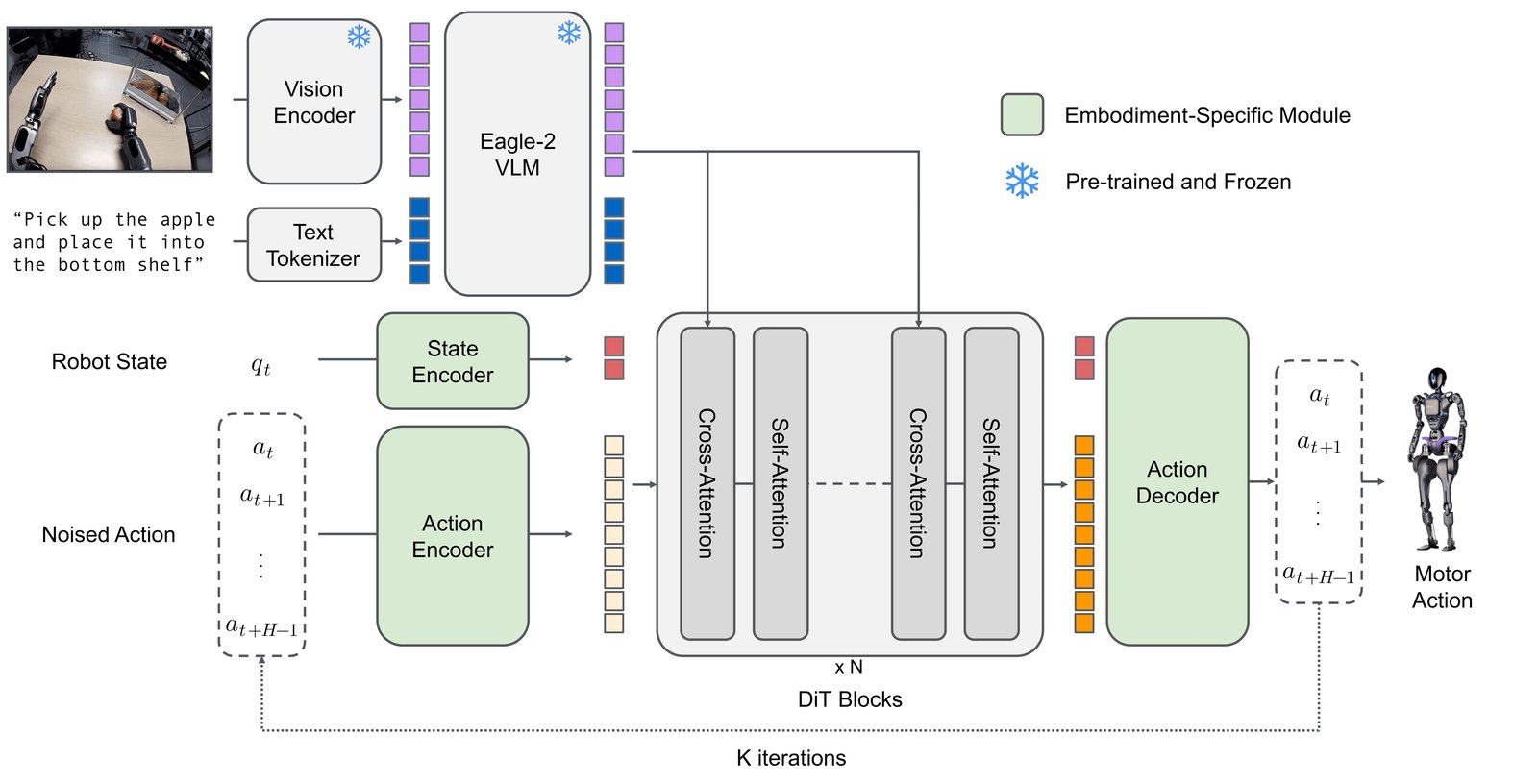
How a VLA model connects camera input, language instructions, and robot actions — the architecture pattern behind LeRobot's π0, GR00T, and SmolVLA integrations.
Diagram: Hugging Face (LeRobot), Apache License 2.0, via GitHubNVIDIA's own developer tutorial on post-training Isaac GR00T inside LeRobot — one of the robot foundation models the library integrates rather than builds from scratch.
04Datasets go big — and past the robot arm (2025)
As more labs and hobbyists uploaded episodes, the original LeRobotDataset format — one file per episode — started hitting filesystem limits once a dataset reached millions of episodes. In September 2025, Hugging Face published a new v3.0 format that packs many episodes into shared Parquet/MP4/JSON files and can stream a dataset on the fly instead of requiring a full local download; it shipped inside the library with the October 2025 v0.4.0 release.
That same year, LeRobot's scope stretched past robot arms entirely. In March 2025, Hugging Face partnered with German driving-data startup Yaak to release L2D, which Hugging Face billed at launch as the world's largest open-source dataset for end-to-end self-driving: footage and vehicle-state logs from 60 electric vehicles at German driving schools, growing in phased releases toward more than 5,000 hours and 1 million episodes by November 2025 — a bet that the same imitation-learning recipe built for tabletop manipulation could scale to a moving car.
05Hugging Face buys hardware: Pollen Robotics (April 2025)
In April 2025, Hugging Face made its fifth acquisition, buying French robotics company Pollen Robotics — a team of former Inria researchers, founded in 2016, that had already shipped hundreds of robot units to customers in more than 20 countries and taken second place at the 2022 ANA Avatar XPRIZE.
The acquisition gave LeRobot's software stack an in-house hardware flagship: Reachy 2, a wheeled, seven-degree-of-freedom humanoid torso priced at $70,000 and aimed at labs and universities — Cornell and Carnegie Mellon among its early adopters — rather than consumer hobbyists. Where SO-100 and SO-101 chased the cheapest possible entry point, Reachy 2 pointed the other way: a fully supported, higher-end research platform running on the same open-source software. Three months later, in July 2025, the same Hugging Face/Pollen team introduced a second, smaller sibling — Reachy Mini — aimed back at individual AI builders rather than labs, closer in spirit to the SO-100/SO-101 price range.
"Robotics could be the next frontier unlocked by AI — and it should be open, affordable, and private."
An official recap from Seeed Studio — one of the manufacturing partners on Reachy Mini, the smaller, consumer-priced sibling to the Reachy 2 humanoid Hugging Face gained through the Pollen Robotics acquisition.
06A worldwide community (2025–2026)
LeRobot's growth showed up first in raw numbers: the GitHub repository passed 25,000 stars and 5,000 forks by mid-2026 — unusually fast growth for a hardware-adjacent open-source project, where testing a change generally requires owning physical hardware, not just a compiler.
In June 2025, Hugging Face turned that growth into an event: the LeRobot Worldwide Hackathon ran across more than 100 local meetups on seven continents over a single weekend, drawing over 3,000 registered participants who trained and demoed policies on borrowed or self-built SO-100/SO-101 arms, with winning submissions published openly on the Hub.
Hugging Face's own kickoff video for the June 2025 LeRobot Worldwide Hackathon, which ran across 100+ local events on seven continents in a single weekend.
070.6.0: "Imagine, Evaluate, Improve" (July 2026)
By February 2026, LeRobot had grown formal enough to warrant an academic paper — "LeRobot: An Open-Source Library for End-to-End Robot Learning," with 17 credited authors including Cadène and Hugging Face co-founder Thomas Wolf — documenting the design decisions behind two years of fast iteration, alongside a steady cadence of point releases (v0.4.0 in October 2025, v0.5.0 in March 2026).
That cadence reached v0.6.0 on July 6–7, 2026, released under the theme "Imagine, Evaluate, Improve" — a release that marks a shift from simply running other labs' policies to giving them new capabilities. Three new "world model" policies arrived: VLA-JEPA and FastWAM both predict what a policy's next action will look like during training, then drop that prediction step at inference time so it doesn't add extra compute cost when actually running on a robot; LingBot-VA takes a different approach, predicting future video and actions together even at inference, trading that efficiency for a visualization of what the policy "imagines" will happen next.
The release also adds:
- A formal reward-models API (Robometer, TOPReward) for judging whether a policy actually succeeded at a task
- Six new simulation benchmarks for evaluating policies before real-world deployment
- A new lerobot-rollout command-line workflow for real-robot improvement loops, letting a human step in mid-task
It's the clearest sign yet that two years after launch, LeRobot's job has shifted from "make robot learning possible on a budget" to "make robot learning measurably better."
08Timeline at a glance
| Date | Partner | Event |
|---|---|---|
| 2024-01 | Hugging Face | Rémi Cadène's first commit to what becomes LeRobot |
| 2024-03 | Hugging Face | First package, v0.1.0, published to PyPI |
| 2024-05 | Hugging Face | LeRobot publicly launches under Apache 2.0 |
| 2024-07 | Hugging Face | Support added for the Koch v1.1 arm |
| 2024-10 | TheRobotStudio | SO-100 arm launches (~$100 in parts) |
| 2025-02 | Hugging Face | LeKiwi mobile base adds an SO-101 arm on a wheeled base |
| 2025-03 | Yaak | L2D self-driving dataset partnership announced |
| 2025-04 | Pollen | Hugging Face acquires Pollen Robotics; Reachy 2 humanoid announced |
| 2025-04 | TheRobotStudio | SO-101 arm launches ($100–$500) |
| 2025-06 | Hugging Face | SmolVLA released, pretrained on community datasets |
| 2025-06 | Hugging Face | LeRobot Worldwide Hackathon: 100+ events, 7 continents, 3,000+ participants |
| 2025-07 | Pollen | Reachy Mini, a smaller consumer-priced sibling to Reachy 2, launches |
| 2025-09 | Hugging Face | LeRobotDataset v3.0 format announced |
| 2025-10 | NVIDIA / Physical Intelligence | v0.4.0 ships Dataset v3.0, π0/π0.5, and Isaac GR00T support |
| 2026-02 | Hugging Face | LeRobot team publishes a formal paper on arXiv |
| 2026-03 | Hugging Face | v0.5.0 "Scaling Every Dimension" ships |
| 2026-07 | Hugging Face | v0.6.0 "Imagine, Evaluate, Improve" adds world models and a reward-models API |
09FAQ
What is LeRobot?
LeRobot is an open-source, Apache-2.0-licensed PyTorch library from Hugging Face for training and deploying real-world robot policies. It bundles imitation-learning and reinforcement-learning algorithms, pretrained models, community-shared datasets, and support for a growing list of low-cost robot hardware — aiming to be, in creator Rémi Cadène's words, "to robotics what the Transformers library is to NLP."
Who created LeRobot, and when?
Rémi Cadène, a former staff research scientist at Tesla, wrote LeRobot's first commit at Hugging Face on January 26, 2024. A first package (v0.1.0) reached PyPI on March 9, 2024, and Hugging Face's robotics team publicly launched the library in May 2024.
How much does the SO-101 robot arm cost?
Hugging Face and TheRobotStudio priced the SO-101 from about $100 to $500 depending on assembly level (fully DIY 3D-printing vs. pre-assembled) and shipping destination, when it launched in April 2025 alongside partners WowRobo, Seeed Studio, and Partabot.
What are the "world models" added in LeRobot 0.6.0?
VLA-JEPA, LingBot-VA, and FastWAM are policies that learn to predict — internally, during training — what the near future will look like before choosing an action, similar in spirit to the world-model concept used in other embodied-AI research. VLA-JEPA and FastWAM drop that prediction step at inference time on the real robot, so it doesn't cost extra compute there; LingBot-VA keeps predicting future video and actions together even at inference, which costs more compute but lets it visualize what the policy "imagines" will happen next.
Is LeRobot only for robot arms?
No. While robot arms (Koch, SO-100, SO-101) were LeRobot's first hardware milestone, the library's scope has broadened: it supports Hugging Face's own Reachy 2 humanoid (via the April 2025 Pollen Robotics acquisition) and, through the L2D dataset partnership with Yaak, has been applied to end-to-end self-driving as well.
Two years is a short history for a robotics project, and LeRobot's is still being written at a fast clip — roughly monthly point releases, a model zoo that now spans world models as well as VLAs, and a hardware lineup that runs from a $100 arm to a $70,000 humanoid. Whether that pace holds, whether the community-dataset flywheel keeps compounding the way SmolVLA's results suggest it can, and whether Hugging Face's hardware bet with Pollen Robotics pays off commercially are the open questions this project — and this site — will keep tracking.
10Sources
01. Origins: an ex-Tesla engineer's bet (2024)
02. Hardware gets cheap: Koch, SO-100, SO-101 (2024–2025)
04. Datasets go big — and past the robot arm (2025)
05. Hugging Face buys hardware: Pollen Robotics (April 2025)
06. A worldwide community (2025–2026)
Related articles
Projects
All Projects articles →Projects
- ›The History of LeRobot(this article)
- ›SO-101
- ›LeKiwi
- ›Amazing Hand
- ›Open Duck Mini
- ›OpenArm