History
The History of the Robot Industry
The big picture, in five eras
- 1961–1980s
Industrial arms scale up
The US invents it; Japan and Europe mass-manufacture it
- 1973–2000
The humanoid dream
Japan's WABOT-1 to ASIMO — capable demos, no deployment
- 1992–2015
Legs, cobots & warehouses
Boston Dynamics research; Universal Robots and Kiva make robots commercial
- 2012–2020
AI learns to move things
Deep learning and robot foundation models replace hand-coded control
- 2021–2026
The physical AI era
A humanoid funding boom across the US, Japan, Europe, and China
History by country and region
Robotics history usually gets told country by country. Line them up, though, and they overlap into one timeline:
United States
- 1961First industrial robot in production (Unimate, at GM)
- 1992Boston Dynamics founded
- 2021Tesla announces Optimus, igniting the funding boom
Japan
- 1969First Japanese industrial robot (Kawasaki)
- 1980sWorld's largest industrial-robot fleet — the "robot kingdom" era
- 2000Honda unveils ASIMO
Europe
- 1973–74Germany's KUKA and Sweden's ABB launch industrial robotics
- 2008Denmark's Universal Robots creates the "cobot" category
- 2026Germany's Neura Robotics raises ~$1.4B, among the largest robotics rounds ever
China
- 2013Becomes the world's largest market for industrial robots by annual installations, overtaking Japan
- 2016Unitree Robotics founded
- 2024Unitree launches the ~$16,000 G1 humanoid
- 2025World's top humanoid seller by units, first profitable year
01Origins: the first industrial arm (1954–1961)
The robot industry doesn't start with a humanoid — it starts with an arm. In 1954, American inventor George Devol filed a patent for a reprogrammable mechanical arm he called Unimate, short for "universal automation." Devol partnered with engineer Joseph Engelberger, often called the father of robotics, to found Unimation in 1956.
Their first customer was General Motors, which installed a Unimate arm at its die-casting plant in Trenton, New Jersey, in 1961. The roughly 1,900-kilogram machine lifted hot metal parts from a die-casting machine and stacked them — work too hot and repetitive for a human line worker. It wasn't glamorous, but it was the first time a programmable machine, rather than a fixed mechanism, did physical work on a factory floor. That distinction — programmable, general-purpose, reusable across tasks — is still roughly how the industry defines a robot today.
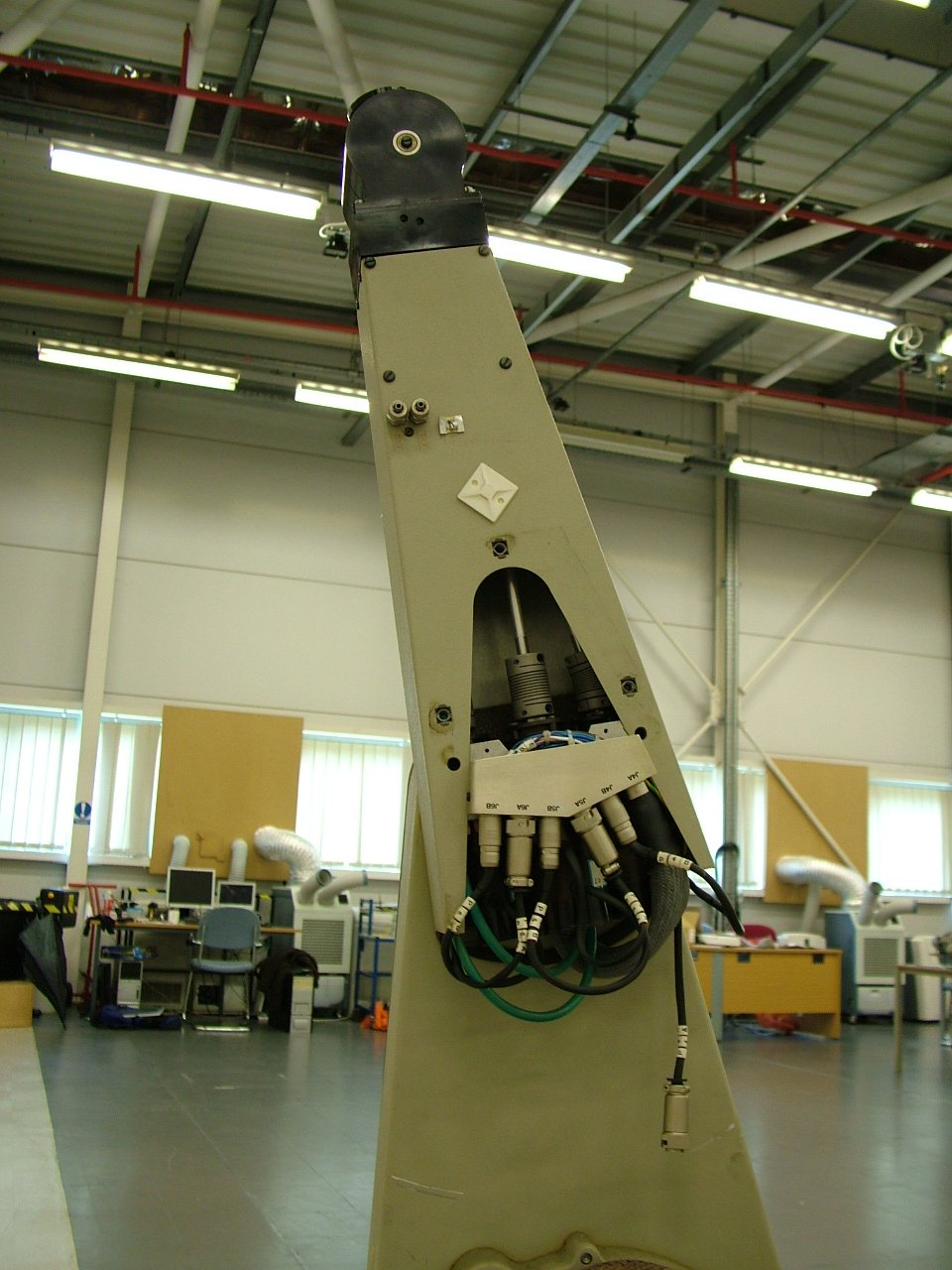
A later Unimation robot arm from the PUMA series — the same lineage that began with the 1961 Unimate at GM. No free-license photo of the original 1961 unit is known to survive.
Photo: Razor Robotics, CC BY 2.0, via Wikimedia Commons02Industrial robotics goes global (1968–1980s)
Unimation's technology spread quickly once its patents proved a factory could run one profitably. Kawasaki Heavy Industries licensed it in 1968 and built Japan's first industrial robot the following year. Sweden's ABB and Germany's KUKA moved just as fast with their own designs: ABB's IRB 6, launched in 1974, was the world's first industrial robot driven entirely by a microprocessor, and KUKA's FAMULUS (1973) was among the first robots built with six electromechanically driven axes — the arrangement still standard today. Within a decade, Japan, Northern Europe, and the US were each building serious industrial-robot industries in parallel, not one exporting to the others.
Japan's contribution was less about invention and more about scale: conglomerates — Kawasaki, Yaskawa, and Fanuc (spun out of Fujitsu's computer division in 1972) — turned the robot arm into a mass-manufactured product line, and by the 1980s Japan had installed more industrial robots than the rest of the world combined, giving rise to the domestic phrase robotto ōkoku, "robot kingdom." In 1978, Hiroshi Makino's team at Yamanashi University, working with Sankyo Seiki, added a genuine Japanese invention to the mix: the SCARA arm, a four-axis design optimized for fast, precise assembly that became a global standard in electronics manufacturing. Fanuc, Yaskawa, Kawasaki, ABB, and KUKA all remain among the world's largest robot-arm makers today, and Japanese suppliers Nabtesco and Harmonic Drive Systems still dominate the precision reduction gears that let any of these arms' joints move accurately, wherever they're built. Japan's volume lead itself didn't last, though: China overtook it in 2013 to become the world's largest market for industrial robots by annual installations, and has stayed there every year since — the manufacturing-scale story moved on well before humanoids ever entered the picture.
Kawasaki licenses Unimation
Builds Japan's first industrial robot, kicking off three decades of mass-manufacturing scale.
ABB's IRB 6
World's first industrial robot driven entirely by a microprocessor.
KUKA's FAMULUS
Among the first robots with six electromechanically driven axes — still the standard arrangement today.
03The humanoid dream: from WABOT to ASIMO (1973–2000)
While arms were conquering factories, a harder and far less commercially useful project was underway elsewhere: making a robot look and move like a person. Humanoid research surfaced in labs across the US, Europe, and Japan through the 1970s, but nowhere was the effort as sustained or well-funded as in Japan. Waseda University's WABOT-1, unveiled in 1973, is generally credited as the first full-scale anthropomorphic robot — it could walk on two legs, grip objects with its hands, and "see" and "converse" with primitive vision and speech systems.
Progress after that was slow and expensive. Honda began a secretive humanoid program in 1986 and spent 14 years and several prototypes — E0 through E3, then P1 through P3 — refining a stable, self-contained bipedal walk before unveiling ASIMO in 2000. ASIMO became the public face of humanoid robotics for a decade, but it was built for demonstrations, not deployment: it couldn't run at speed, climb stairs quickly, or work autonomously outside a scripted routine, and Honda quietly ended the program in 2018. Other Japanese manufacturers — Sony's QRIO, Toyota's Partner Robot — ran similar humanoid programs through the 2000s with the same basic outcome: capable demos, no deployment. The lesson the industry took, in Japan and everywhere it later tried, was blunt — walking convincingly on two legs is a genuinely hard control problem, and solving it does not automatically produce a robot that's useful for anything in particular.
- 1973
WABOT-1
First full-scale anthropomorphic robot (Waseda University)
- 1986–2000
Honda's E/P series → ASIMO
14 years and 8 prototypes to a stable, self-contained bipedal walk
- 2000–2010s
ASIMO era
Public face of humanoid robotics; Sony's QRIO and Toyota's Partner Robot follow
- 2018
Program ends
Honda quietly retires ASIMO — capable demos never became deployment
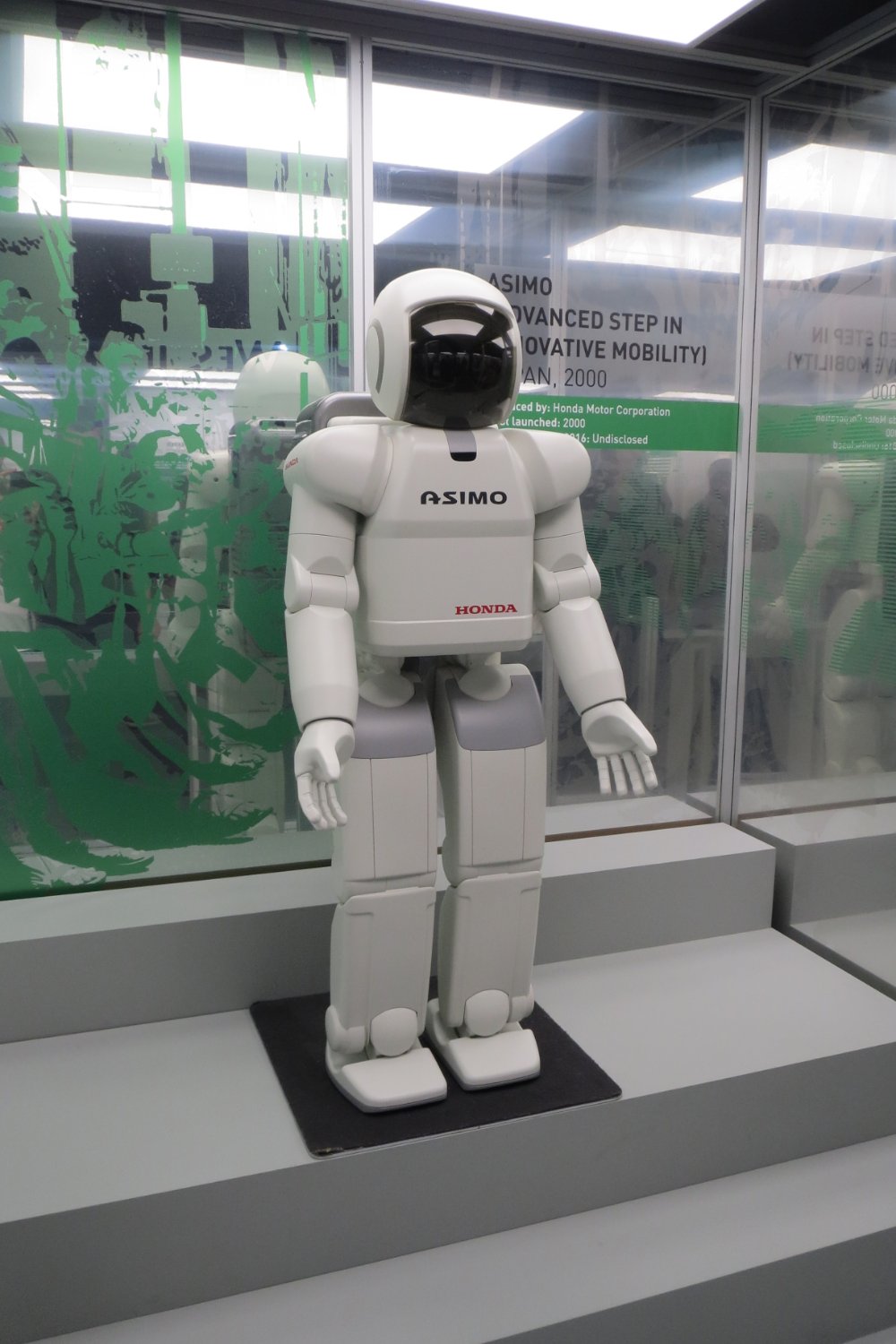
ASIMO on display, labeled with its 2000 launch year and manufacturer, Honda Motor Corporation.
Photo: Corsario CL, CC BY-SA 4.0, via Wikimedia Commons04Boston Dynamics and the legged-robot underground (1992–2021)
A different lineage of legged-robot research was happening in parallel, and it would eventually matter more. Marc Raibert's Leg Laboratory — first at Carnegie Mellon, then MIT — spent the 1980s building single-legged hopping machines to study balance and dynamics rather than aesthetics. Raibert spun that research out into Boston Dynamics in 1992.
For its first two decades the company worked mostly on DARPA-funded research prototypes — the quadruped BigDog (2005), built to carry military gear over rough terrain, and later Atlas — rather than a commercial product. Google's parent company acquired Boston Dynamics in 2013 as part of a short-lived robotics buying spree, sold it to SoftBank in 2017, and SoftBank in turn sold a majority stake to Hyundai Motor Group, with the deal completing in 2021. Only in the last few years, with viral videos of Atlas doing parkour and backflips, has Boston Dynamics' decades of balance-and-locomotion research become the reference point for the current generation of humanoid startups — several of which are staffed by Boston Dynamics or MIT Leg Lab alumni.
"Atlas | Partners in Parkour" (2021) — official Boston Dynamics footage of the viral parkour demonstrations referenced above.
05Cobots and the warehouse automation wave (2003–2015)
Not every useful robot needs legs or a face. Two quieter developments in the 2000s did more to put robots into daily commercial use than any humanoid did: the collaborative robot arm and the warehouse mobile robot. Universal Robots, founded in Odense, Denmark in 2005, launched the UR5 in 2008 — a robot arm designed to work directly alongside people on a factory floor without a safety cage, at a price small manufacturers could afford. It created the "cobot" category that is now standard across light manufacturing.
Around the same time, Kiva Systems (founded 2003) built orange mobile robots that carried entire shelving pods to warehouse workers instead of sending workers to the shelves. Amazon bought Kiva for roughly $775 million in 2012 and rebuilt its own fulfillment centers around the idea, renaming the unit Amazon Robotics; by the mid-2020s Amazon alone had deployed over a million robots on this model. Between cobots and warehouse AMRs, robotics quietly became a mainstream logistics and manufacturing technology years before "humanoid" was a boardroom word.
Universal Robots' UR5
The first cobot — a robot arm safe enough to work alongside people without a safety cage.
Kiva Systems → Amazon Robotics
Mobile robots that bring the shelf to the worker instead of sending the worker to the shelf; Amazon scaled it past a million units.
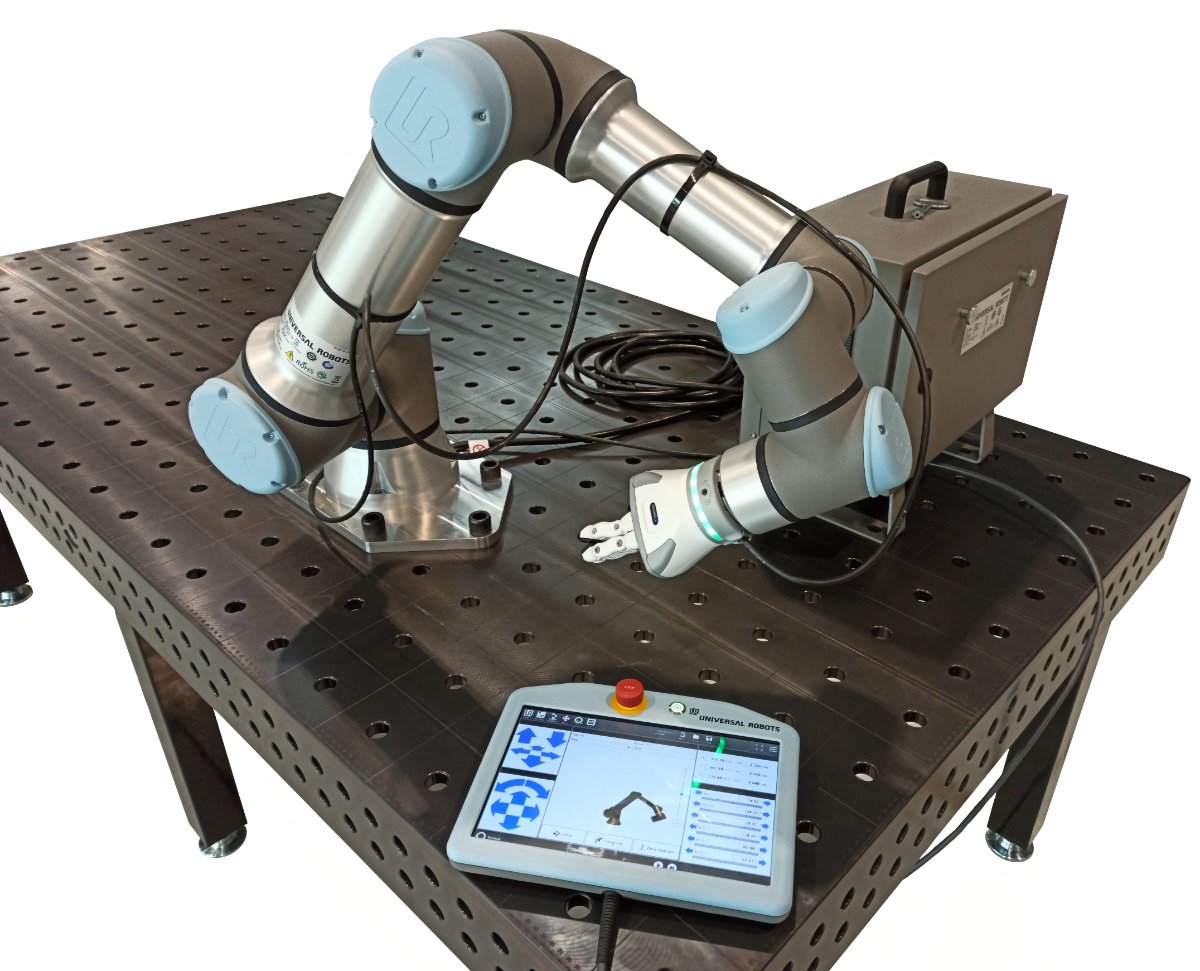
A Universal Robots cobot arm (UR16e, a later and larger sibling of the 2008 UR5) with its handheld teach pendant.
Photo: Auledas, CC BY-SA 4.0, via Wikimedia Commons06AI meets hardware: the foundation-model turn (2012–2024)
The next shift came from outside robotics entirely. The 2012 ImageNet result that kicked off the deep-learning boom had little to do with physical machines, but it changed what people building them assumed was possible. Through the 2010s, reinforcement learning let researchers train locomotion and grasping behavior in simulation rather than hand-coding it — visible in Boston Dynamics' own progress and in a wave of academic sim-to-real results.
The turn that mattered most for today's industry came from treating a robot's control policy the same way large language models treat text: as something a single big model, trained on enormous and varied data, could learn end-to-end. Google DeepMind's RT-2 (2023) showed a robot could follow instructions it had never explicitly been trained on by inheriting reasoning from a web-scale vision-language model. That kicked off a race to build "robot foundation models" — general-purpose control policies meant to transfer across many robot bodies and tasks, the way GPT transfers across writing tasks — with Physical Intelligence's π0 (2024) and Nvidia's Isaac GR00T (announced March 2024) among the most closely watched entrants. Nvidia's Jetson Thor and Isaac/Omniverse simulation stack turned this from a research bet into commodity infrastructure that any humanoid startup could buy rather than build.
07Three threads, one convergence
Zoom out and the last seventy years look less like one continuous humanoid story and more like three separate engineering lineages — arms, legs, and software — that only recently converged. Each grew for decades in relative isolation, in different countries, before today's humanoid boom pulled them together.
Industrial arms
- 1961US
First Unimate in production at GM
- 1974SE/DE
ABB and KUKA bring robots to Europe
- 2008DK
Universal Robots' UR5 creates the cobot
- 2013CN
China overtakes Japan as the world's largest market, by annual installations
Legged & humanoid robots
- 1973JP
Waseda's WABOT-1
- 1992US
Boston Dynamics founded
- 2000JP
Honda's ASIMO
AI & software
- 1966US
SRI's Shakey, first AI-driven mobile robot
- 2012CA/US
ImageNet deep-learning breakthrough
- 2023UK/US
RT-2, the first robot foundation model
Physical AI — arms, legs, and software become one industry
Industrial arms
- Unimate, Fanuc, KUKA
Legs & humanoids
- WABOT, ASIMO, Atlas
AI & software
- Deep learning, foundation models
Physical AI
08The humanoid funding boom and the physical AI era (2021–2026)
Foundation models gave the industry a plausible answer to the question that had stalled ASIMO for twenty years — not just how to make a robot walk, but how to make it generally useful — and venture capital responded accordingly. Tesla's August 2021 AI Day announcement of the Optimus humanoid, more a statement of intent than a working product at the time, is usually cited as the moment "humanoid" became a mainstream investment thesis rather than a research curiosity.
Figure AI (founded 2022), 1X Technologies, Skild AI, and Physical Intelligence each raised nine- or ten-figure rounds within a few years, while Agility Robotics' Digit — one of the earliest humanoids in actual paid pilot deployment — proved the category could reach a real warehouse floor, not just a stage. China took a different path to the same moment: Unitree, better known for its quadruped "robot dogs," launched the G1 humanoid at roughly $16,000 in 2024 — a fraction of the cost of Western competitors — and became the world's top humanoid seller by units in 2025, the same year it recorded its first profit.
Europe took yet another path: Germany's Neura Robotics raised roughly $1.4 billion in a single 2026 round — one of the largest robotics funding rounds ever — betting on cognitive humanoids built for European manufacturing rather than US-style software-first scaling or Chinese-style low-cost volume. And the ownership of the industry's oldest research lineage tells its own global story: Boston Dynamics, born from an MIT lab, passed through Google, then SoftBank, and finally to Hyundai Motor Group, a South Korean company betting that manufacturing know-how plus AI software is the winning combination. By 2026, the industry looks less like a handful of research labs and more like a multi-region, capital-intensive manufacturing race, with pilot deployments running at BMW, Mercedes-Benz, Amazon, and Ford, and the open question no longer whether a humanoid can walk, but whether any of it can be built, and sold, profitably at scale.
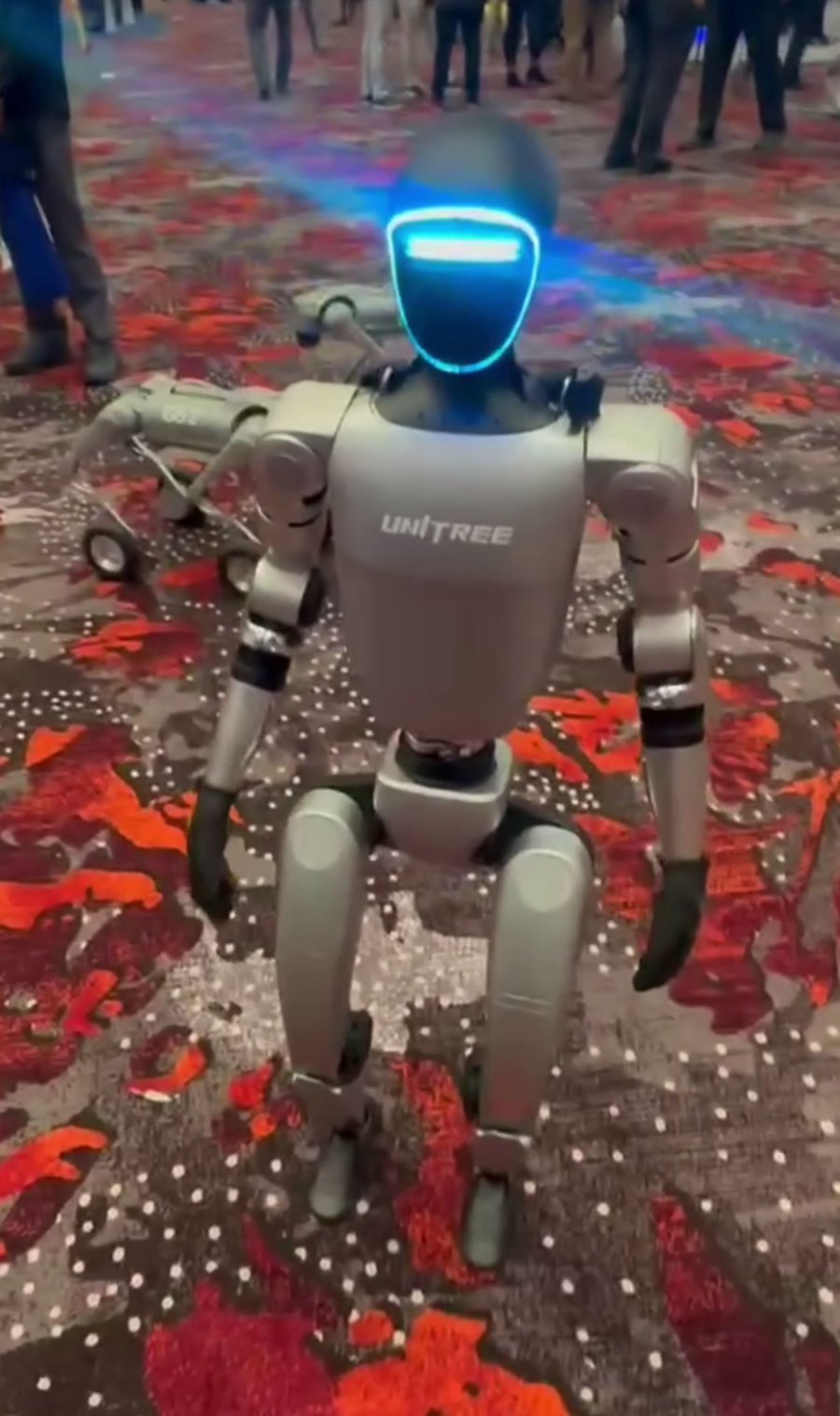
Unitree's G1 humanoid, the roughly $16,000 model that helped make Unitree the world's top humanoid seller by units in 2025.
Photo: Sayanesy, CC0, via Wikimedia Commons09Timeline at a glance
| Year | Region | Event |
|---|---|---|
| 1954 | US | George Devol files the Unimate patent |
| 1956 | US | Unimation founded (Devol & Engelberger) |
| 1961 | US | First Unimate installed at GM's Trenton plant — first industrial robot in production use |
| 1966 | US | SRI's Shakey — first AI-driven mobile robot |
| 1968–69 | JP | Unimation licenses tech to Kawasaki; Kawasaki builds Japan's first industrial robot |
| 1972 | JP | Fanuc spun out of Fujitsu's computer division |
| 1973 | JP | Waseda's WABOT-1 — first full-scale anthropomorphic robot |
| 1973 | DE | KUKA's FAMULUS — among the first six-axis electromechanical robots |
| 1974 | SE | ABB launches the IRB 6, first microprocessor-controlled industrial robot |
| 1978 | JP | SCARA arm developed (Sankyo Seiki / Yamanashi University) |
| 1992 | US | Boston Dynamics founded (Marc Raibert) |
| 2000 | JP | Honda unveils ASIMO |
| 2003 | US | Kiva Systems founded |
| 2005 | DK | Universal Robots founded |
| 2005 | US | Boston Dynamics unveils BigDog |
| 2008 | DK | Universal Robots launches UR5, creating the "cobot" category |
| 2012 | US | Amazon acquires Kiva Systems (~$775M) → Amazon Robotics |
| 2012 | CA | ImageNet deep-learning breakthrough (University of Toronto) |
| 2013 | CN | China overtakes Japan as the world's largest market for industrial robots by annual installations |
| 2013 | US | Google acquires Boston Dynamics |
| 2017 | JP | SoftBank acquires Boston Dynamics from Google/Alphabet |
| 2018 | JP | Honda ends the ASIMO program |
| 2021 | US | Tesla announces Optimus at AI Day |
| 2021 | KR | Hyundai completes majority acquisition of Boston Dynamics |
| 2022 | US | Figure AI founded |
| 2023 | UK/US | Google DeepMind unveils RT-2 robot foundation model |
| 2024 | US | Nvidia announces Isaac GR00T; Physical Intelligence unveils π0 |
| 2024 | CN | Unitree launches ~$16,000 G1 humanoid |
| 2025 | CN | Unitree becomes world's top humanoid seller by units, records first profit |
| 2026 | DE | Neura Robotics raises ~$1.4B Series C, among the largest robotics rounds ever |
| 2026 | Global | Pilot humanoid deployments run at BMW, Mercedes-Benz, Amazon, Ford amid a continuing physical AI funding boom |
10FAQ
What was the first industrial robot?
Unimate, developed by George Devol and commercialized by Unimation (founded 1956 with Joseph Engelberger). The first unit went into production at General Motors' Trenton, New Jersey die-casting plant in 1961, lifting and stacking hot metal parts.
Was industrial robotics only a US and Japan story?
No — Europe was there from nearly the start. Sweden's ABB launched the IRB 6 in 1974, the first industrial robot driven entirely by a microprocessor, and Germany's KUKA built the FAMULUS in 1973, among the first robots with the six electromechanically driven axes still standard today. ABB and KUKA remain two of the world's largest robot-arm makers alongside Fanuc and Yaskawa.
Why did Japan dominate industrial robotics for so long?
Japanese conglomerates — Kawasaki (licensed Unimation's technology in 1968), Yaskawa, and Fanuc (spun out of Fujitsu in 1972) — treated the robot arm as a mass-manufactured product rather than a custom installation, and Japan had installed more industrial robots than the rest of the world combined by the 1980s. Fanuc, Yaskawa, and Kawasaki remain among the largest robot-arm makers today, alongside Europe's ABB and KUKA, and Japanese suppliers like Nabtesco and Harmonic Drive Systems still dominate the precision-reducer components those arms depend on. But "for so long" is the operative phrase: China overtook Japan in 2013 to become the world's largest market for industrial robots by annual installations, and has led every year since.
Is Boston Dynamics' Atlas a product companies can buy?
Not historically — for most of its history Atlas was a research prototype funded largely by DARPA, not a commercial product. Boston Dynamics changed ownership several times (Google 2013, SoftBank 2017, majority stake to Hyundai Motor Group in 2021) and has increasingly moved toward commercializing humanoid work, but its public fame has mostly come from research demonstrations rather than paid deployments — unlike, for example, Agility Robotics' Digit or Unitree's G1.
What changed to make humanoid robots a hot investment category around 2021–2022?
Two things converged. First, deep-learning-derived robot foundation models (following Google DeepMind's RT-2 in 2023 and others) offered a plausible path to general-purpose usefulness that decades of hand-coded control hadn't. Second, Tesla's August 2021 announcement of the Optimus humanoid signaled to investors that humanoids were a mainstream bet, not a research curiosity — triggering large funding rounds for Figure AI, 1X Technologies, Skild AI, Physical Intelligence, and others within a few years.
How is China's approach to humanoids different from the US, Europe, and Japan's?
Chinese makers like Unitree have prioritized low cost and rapid unit shipment over research spectacle — Unitree's G1, launched at roughly $16,000 in 2024, costs a fraction of Western and Japanese humanoid programs and helped make Unitree the world's top humanoid seller by units in 2025, the same year it turned its first profit. It's a volume-manufacturing strategy rather than a foundation-model-first strategy, though the two approaches are converging as Chinese makers adopt more capable AI "brains."
11Where this goes next
Seventy years separate George Devol's patent filing from today's humanoid funding rounds, and for most of that span, "robot" meant a fixed arm bolted to a factory floor, not a walking, reasoning machine. What changed the trajectory wasn't a single breakthrough in one country — it was arms (US, Japan, Europe), legs (Japan, US), and software (US, Canada, UK) developed on separate continents for decades, then pulled together by borrowing the scaling logic of large AI models and pointing it at physical control. Whether that turns into a durable industry, the way industrial robot arms did in the 1970s and 80s, or into another cycle of the hype that stalled after ASIMO, is the open question this series will keep tracking.
Related articles
History
All History articles →History
- ›The History of the Robot Industry(this article)
- ›From Robot Dogs to Humanoids