Projects
Amazing Hand
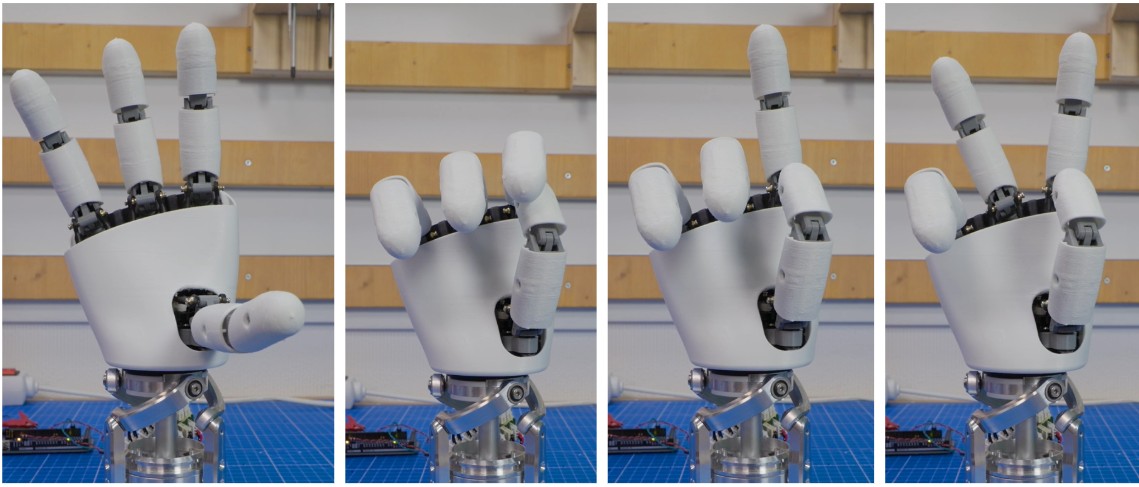
The assembled hand, from the project's own GitHub repository.
Pollen Robotics, AmazingHand GitHub repository, CC BY 4.0 (mechanical design)What Amazing Hand changed
High-performance anthropomorphic robot hands have historically meant one of two trade-offs: expensive research-grade hardware with actuators mounted in a bulky external forearm, or cheap grippers with too few degrees of freedom to grasp much beyond a box.
Amazing Hand's design fits every actuator inside the hand itself:
- 8 DOF across 4 fingers, driven by 2 Feetech SCS0009 servos per finger — no external electronics box or forearm-mounted actuators
- Fully 3D-printable, weighs 400g, and costs under €200 in parts
- Dual-licensed: Apache 2.0 for the control code, CC BY 4.0 for the mechanical design
The result: a hand cheap and simple enough to be a class project, but articulated enough to be a real research platform — sold assembled by Seeed Studio for hobbyists who'd rather skip the print queue.
01Where it came from: simplifying a research hand
Amazing Hand's design lineage traces back to December 2021, when a team at Ajou University in South Korea, led by Uikyum Kim, published the "ILDA hand" — a 15-degree-of-freedom anthropomorphic hand capable of 34 newtons of fingertip force — in Nature Communications. It was a capable piece of research hardware, but like most academic dexterous hands, not something a hobbyist could casually build.
In July 2025, Pollen Robotics — the French robotics company behind the Reachy humanoid, and by then part of Hugging Face following its April 2025 acquisition — open-sourced a radically simplified take on the same idea. The team's own announcement was explicit about the lineage and the goal:
"The main inspiration for this project comes from the 'ILDA hand' research project... we are releasing a robot hand... which simplifies the ILDA hand concept in order to lower the entry cost."
02Design: everything fits inside the hand
Amazing Hand's central design choice is self-containment. Where many research hands mount their actuators in a bulky forearm unit connected by cables, every servo driving Amazing Hand's fingers lives inside the hand itself.
That constraint shapes everything else about the design:
On the software side, there's no proprietary controller to buy: the hand is driven over a standard serial bus, and the project documents two ready-made control paths.
- 4 fingers, each driven by a parallel mechanism using 2 Feetech SCS0009 servos for flexion/extension and abduction/adduction
- Flexible TPU shells 3D-printed over a rigid frame — no external cabling or control box
- Wrist interface designed for Reachy 2's Orbita wrist, adaptable to other robots
- Two supported control paths: Python via a Waveshare serial bus driver, or an Arduino running Feetech's TTLinker firmware
- Servos report torque enable/disable state, torque feedback, position, and temperature — no separate sensor wiring needed
- Requires an external power supply to drive all 8 actuators — none of the electronics run off the control computer's own power
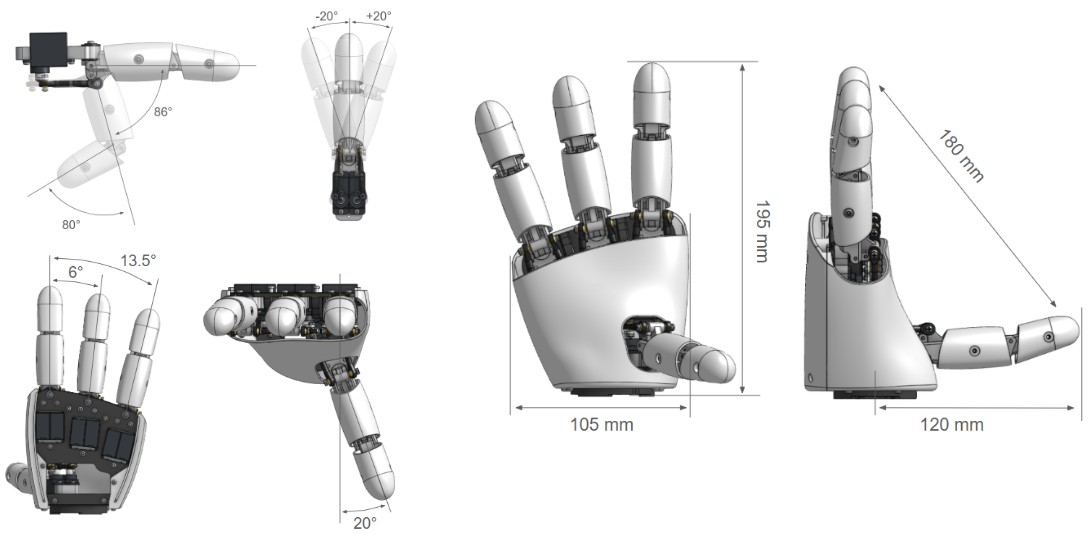
Official CAD reference from the project's GitHub repository, showing finger joint ranges and the hand's overall dimensions.
Pollen Robotics, AmazingHand GitHub repository, CC BY 4.0 (mechanical design)Bill of materials — about €115.69 (~$134.20) per hand
| Component | Qty | Price per hand |
|---|---|---|
| Feetech SCS0009 servo | 8 | €56.00 |
| Ball joint M2 | 16 | €17.60 |
| M2 threaded rod (L300mm) | 1 | €1.71 |
| Axis D2×10mm | 8 | €4.00 |
| Axis D2×16mm | 8 | €6.40 |
| Bushing (6mm / 8mm, GFM 0608-04) | 8 | €12.80 |
| Thermoplastic screw 2.5×6mm | 16 | €0.16 |
| Thermoplastic screw 2.5×8mm | 30 | €0.30 |
| Washer M2.5 (8mm, large series) | 4 | €1.72 |
| 3D-printed parts (full set) | 1 | €15.00 |
| Total (one hand) | €115.69 | |
03Where it's landed: kits, a stable release, a hackathon prize
Coverage followed quickly: Japanese tech outlet GIGAZINE wrote up the release on July 18, 2025, ten days after the Hugging Face announcement. The repository itself wasn't formally tagged as a stable release until v1.0, "Amazing Hand initial stable version," shipped in April 2026 — nine months of iteration between the initial open-source drop and a version the project's own maintainers called stable.
By mid-2026, Amazing Hand had grown from a GitHub repository into a small hardware ecosystem. Seeed Studio — the Shenzhen-based hardware manufacturer that also builds kits for LeRobot's SO-101 arm and Reachy Mini — began selling assembled left- and right-hand kits directly from its own store, for hobbyists who'd rather buy than print. The project was also featured as a team prize at Seeed's 2026 Embodied AI Hackathon in Santa Clara (March 21–22, 2026), an event co-organized with NVIDIA, Hugging Face, and Pollen Robotics itself.
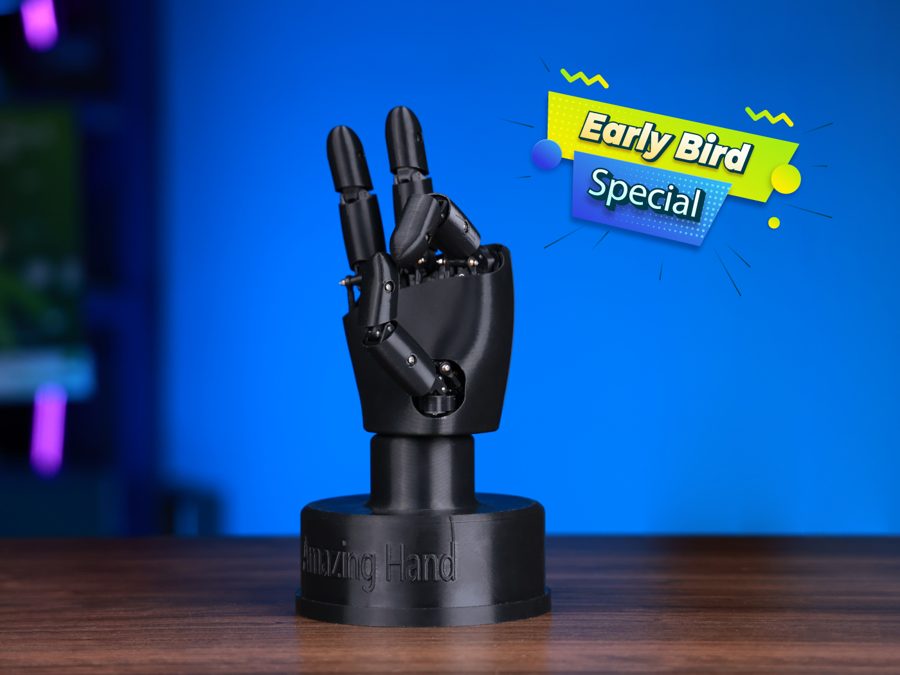
Seeed Studio sells Amazing Hand as an assembled developer kit — right and left hands sold separately.
Seeed Studio, official product photo04Where it fits: a hand for Reachy, and for anyone else
Amazing Hand was designed around Reachy 2's Orbita wrist, and Pollen Robotics' own demos show it doing exactly that job — giving Hugging Face's humanoid a dexterous end effector without the cost of a research-grade hand. But the wrist interface is documented as adaptable, and the dual license (Apache 2.0 for code, CC BY 4.0 for the mechanical design) means nothing stops another project from bolting it onto a different arm entirely.
That makes it a small but telling data point in the same broader story this site has covered with LeRobot: robot hardware that used to require a well-funded lab — DOF-rich hands, low-cost arms, community-scale datasets — increasingly ships as something a single engineer can publish, and a hobbyist can print.
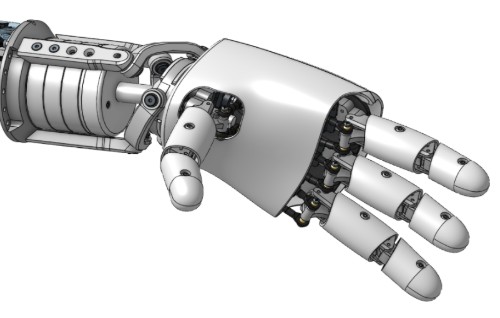
The wrist interface Amazing Hand was originally designed around — Pollen Robotics' Reachy 2 Orbita actuator.
Pollen Robotics, AmazingHand GitHub repository, CC BY 4.0 (mechanical design)An official demo from Pollen Robotics' own channel — Amazing Hand mounted on Reachy 2's wrist, showing the interface the hand was originally designed for.
05Timeline at a glance
| Date | Partner | Event |
|---|---|---|
| 2021-12 | Ajou University | ILDA hand research published in Nature Communications |
| 2025-04 | Hugging Face | Hugging Face acquires Pollen Robotics |
| 2025-07 | Pollen Robotics | Amazing Hand open-sourced under a dual Apache 2.0 / CC BY 4.0 license |
| 2025-12 | Seeed Studio | Assembled Amazing Hand kits go on sale |
| 2026-03 | Seeed Studio | Amazing Hand featured as a prize at Seeed's Embodied AI Hackathon |
| 2026-04 | Pollen Robotics | v1.0 "initial stable version" tagged on GitHub |
06FAQ
What is Amazing Hand?
Amazing Hand is an open-source, 8-degrees-of-freedom anthropomorphic robot hand from Pollen Robotics (part of Hugging Face). It's fully 3D-printable, weighs 400g, costs under €200 in parts, and — unlike most research-grade dexterous hands — houses all of its actuators inside the hand itself, with no external control box or forearm unit.
Who created it, and when?
Pollen Robotics engineers, including Steve Nguyen and Jeremy Laville, announced Amazing Hand on the Hugging Face blog in July 2025. Its design simplifies a 2021 academic project called the "ILDA hand," published by a team at Ajou University in South Korea.
How much does it cost, and what license is it under?
Parts cost under €200. The control code is licensed under Apache 2.0, and the mechanical (CAD) design is licensed under CC BY 4.0. Seeed Studio also sells pre-assembled hands for hobbyists who'd rather not 3D-print and assemble it themselves.
Does it only work with Pollen Robotics' Reachy 2?
It was designed around Reachy 2's Orbita wrist and that's the pairing shown in Pollen Robotics' own demos, but the wrist interface is documented as adaptable to other robots, and its open license doesn't restrict what it's attached to.
07Sources
01. Where it came from: simplifying a research hand
02. Design: everything fits inside the hand
03. Where it's landed: kits, a stable release, a hackathon prize
Related articles
Articles
Company & Market Data
Projects
All Projects articles →Projects
- ›The History of LeRobot
- ›SO-101
- ›LeKiwi
- ›Amazing Hand(this article)
- ›Open Duck Mini
- ›OpenArm