Projects
Open Duck Mini
Google's own "Gemma Playground: Robot Duck" demo, posted by Google for Developers — two Open Duck Mini v2 robots running Gemma 4 fully on-device.
What Open Duck Mini is
Disney's BDX droids — expressive, free-roaming robots that use reinforcement learning to balance and move — are proprietary hardware built by a large studio's R&D team. Open Duck Mini set out to answer a narrower question: how much of that could one engineer, working mostly alone, reproduce as something anyone could 3D-print and afford?
The project's core ingredients:
- A target build cost under $400, entirely 3D-printed and Raspberry-Pi-powered
- Walking learned via reinforcement learning in simulation, then transferred to the real robot (sim-to-real)
- Apache 2.0 license, an active Discord community, and a companion repo for generating reference walking motions
01What it is: a mini BDX droid
Open Duck Mini is the work of Antoine Pirrone, an R&D engineer at Pollen Robotics — the same French robotics company, now part of Hugging Face, behind the Amazing Hand project and the Reachy humanoid — and a member of the Rhoban robotics team based in Bordeaux, France.
The project's own README states its inspiration plainly: a miniature, open-source version of Disney's BDX droid, the expressive, reinforcement-learning-driven robot that Disney's own R&D team has shown off everywhere from Disneyland Resort to NVIDIA's GTC developer conference. Where Disney's droid is proprietary studio hardware, Pirrone set out to build something anyone could 3D-print and afford.
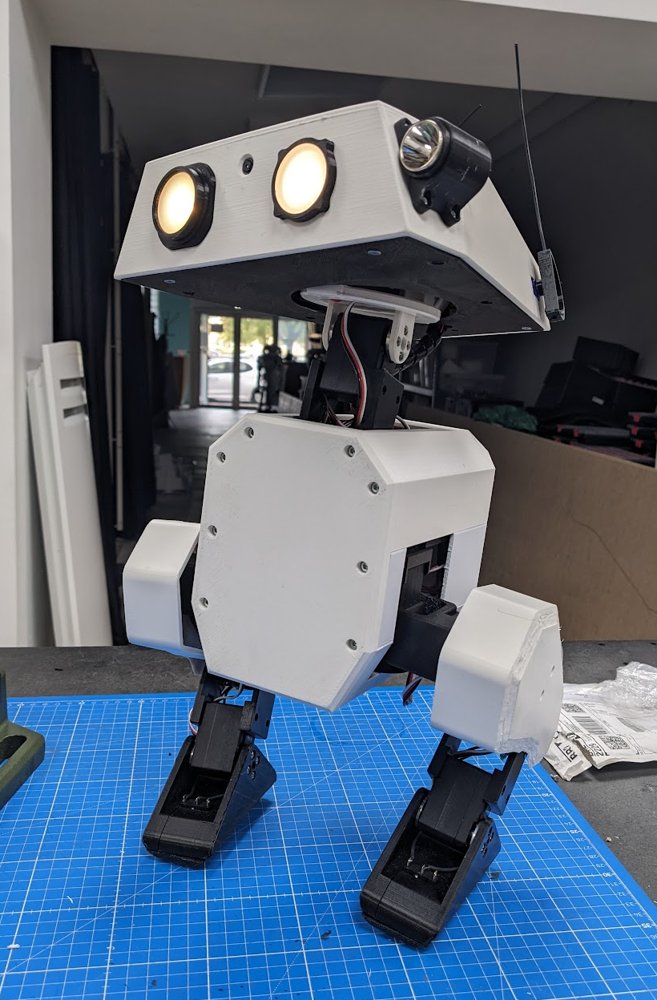
The v2 prototype — 3D-printed shell, U2D2 power board, and a Raspberry Pi Zero 2W inside the torso.
Antoine Pirrone, Open_Duck_Mini GitHub repository, Apache License 2.0Open Duck Mini is standing up using a policy learned with RL in simulation!
— Antoine Pirrone (@antoinepirrone) September 16, 2024
We are still pushing locomotion, so if you have some knowledge of Isaac Gym and want to help feel free to join us! https://t.co/MjeppD4QAI https://t.co/Aj9gAtIKzV@Thom_Wolf pic.twitter.com/mDMG29honT
Antoine Pirrone's own post from September 2024, an early milestone: Open Duck Mini standing up using a policy trained with reinforcement learning in simulation.
02Hardware: v1 to v2
The first version, roughly 35cm tall, was explicitly a work in progress — a platform for testing whether the walking approach worked at all before investing in a more refined build. By December 2024, Pirrone had begun work on v2: a taller, sturdier redesign aimed at a bill of materials under $400.
A separate runtime package — kept apart from the training code — handles what runs on the robot itself:
- v2 stands about 42cm tall with its legs extended, targeting a full bill-of-materials cost under $400
- A Raspberry Pi Zero 2W runs onboard, with actuators characterized using Pirrone's Rhoban robotics team's own BAM tool
- v1 used Dynamixel XL330 servos; the project has iterated on the actuator lineup since
- Onboard software runs on Raspberry Pi OS Lite (64-bit), installed on the Raspberry Pi Zero 2W
- The runtime is a Python 3 package (installed via pip install -e .), separate from the training code
- Talks to hardware over I2C (IMU), USB serial (motor controllers), and Bluetooth (Xbox controller for teleoperation)
| Component | Qty | Price |
|---|---|---|
| Power | ||
| 18650 cell | 2 | €10.00 |
| 18650 cell holder | 1 | €4.99 |
| 2S BMS | 1 | €8.40 |
| 5V regulator | 1 | €4.00 |
| Small power switch | 1 | €4.49 |
| USB-C charger | 1 | €9.99 |
| 2.1mm barrel jack | 2 | €2.00 |
| XT30 connector pair | 1 | €8.00 |
| Servos, control & sensors | ||
| IMU (BNO055) | 1 | €40.00 |
| Raspberry Pi Zero 2W | 1 | €26.08 |
| SD card | 1 | €10.00 |
| Servo control board (Waveshare) | 1 | €5.00 |
| Feetech STS3215 7.4V servo | 14 | €196.00 |
| Feet contact switches (SS-10) | 4 | €4.00 |
| 9g servos | 2 | €6.66 |
| Misc. | ||
| 3D-printing M3 inserts | 1 | €5.99 |
| PLA filament (~500g) | 1 | €20.00 |
| Cable sheath | 1 | €9.00 |
| 15cm micro-USB to USB-C cable | 1 | €7.00 |
| 50cm micro-USB to USB-C cable | 1 | €6.00 |
| Bearing | 3 | €10.50 |
| Total (v2, core BOM) | €398.10 | |
03Teaching a duck to walk: sim-to-real
Open Duck Mini doesn't walk on hand-tuned gait logic — it walks on a policy trained almost entirely in simulation, then transferred to the real robot. That approach evolved between versions:
- v1 trained in NVIDIA Isaac Gym with the AWD framework, then validated sim-to-sim in MuJoCo
- v2 moved training to MuJoCo Playground, adapted from K-Scale Labs' open-source framework
- A companion repo, Open_Duck_reference_motion_generator, generates imitation-learning reference gaits using the Placo IK library
- Trained policies export to ONNX for on-robot inference
Open Duck Mini v2 can (almost) walk !
— Antoine Pirrone (@antoinepirrone) March 26, 2025
Repo : https://t.co/Aj9gAtIKzV
Editing credits : @Almasy_CM
Cameraman: Augustin Crampette pic.twitter.com/H0YqyfHonx
Creator Antoine Pirrone's own post showing Open Duck Mini v2's first walking attempts, filmed by Augustin Crampette (March 2025).
04Where it's landed: a community, and a Google I/O cameo
By mid-2026, Open Duck Mini had grown well past a solo project — an active Discord community shares builds and troubleshooting, and the GitHub repository's star and fork counts put it among the more visible open-source humanoid-adjacent projects on the platform.
That visibility led to an unexpected spotlight: at Google I/O 2026 (May 2026), Google's own developer team used two Open Duck Mini v2 robots to demo "Gemma Playground: Robot Duck" — running Gemma 4, Google's on-device AI model released that April, fully locally rather than in the cloud. It's a rare case of a hobbyist-scale open-source robot becoming the physical prop for a Big Tech keynote demo.
05Timeline at a glance
| Date | Partner | Event |
|---|---|---|
| 2024 | Antoine Pirrone | Open Duck Mini v1 in active development, inspired by Disney's BDX droid |
| 2024-12 | Antoine Pirrone | Work begins on v2, targeting a sub-$400 build |
| 2026-04 | Gemma 4 released under Apache 2.0 | |
| 2026-05 | Two Open Duck Mini v2 robots demo on-device Gemma 4 at Google I/O 2026 |
06FAQ
What is Open Duck Mini?
Open Duck Mini is an open-source, 3D-printable bipedal robot inspired by Disney's BDX droid, built by Pollen Robotics engineer Antoine Pirrone. It learns to walk via reinforcement learning trained in simulation and transferred to the real robot, with a target build cost under $400.
Who created it?
Antoine Pirrone, an R&D engineer at Pollen Robotics (the Hugging Face-owned company behind Reachy and Amazing Hand) and a member of the Bordeaux-based Rhoban robotics team, created and maintains Open Duck Mini.
How does it learn to walk?
Walking policies are trained in simulation — v1 used NVIDIA Isaac Gym, v2 moved to MuJoCo Playground — using reference gaits generated by a companion tool built on the Placo IK library, then exported to ONNX and run on the robot's onboard Raspberry Pi.
What was the Google I/O 2026 demo?
Google's own developer team used two Open Duck Mini v2 robots in a demo called "Gemma Playground: Robot Duck," showing Google's Gemma 4 model running fully on-device rather than in the cloud.
07Sources
01. What it is: a mini BDX droid
02. Hardware: v1 to v2
03. Teaching a duck to walk: sim-to-real
04. Where it's landed: a community, and a Google I/O cameo
Related articles
Articles
Company & Market Data
Projects
All Projects articles →Projects
- ›The History of LeRobot
- ›SO-101
- ›LeKiwi
- ›Amazing Hand
- ›Open Duck Mini(this article)
- ›OpenArm