Fundamentals
Robot Teaching & Offline Programming
01Teach pendant / online (playback) programming
A teach pendant is the handheld device — buttons or a touchscreen, plus an emergency stop — used to jog the robot's joints and record specific points and poses directly on the real machine. The operator moves the robot through the motion the task requires, saving waypoints as they go; the controller then replays that recorded sequence during production. This is called teach/playback, or online, programming because it happens on the physical robot itself, which is unavailable for production while it's being taught. (KUKA's smartPAD product page)
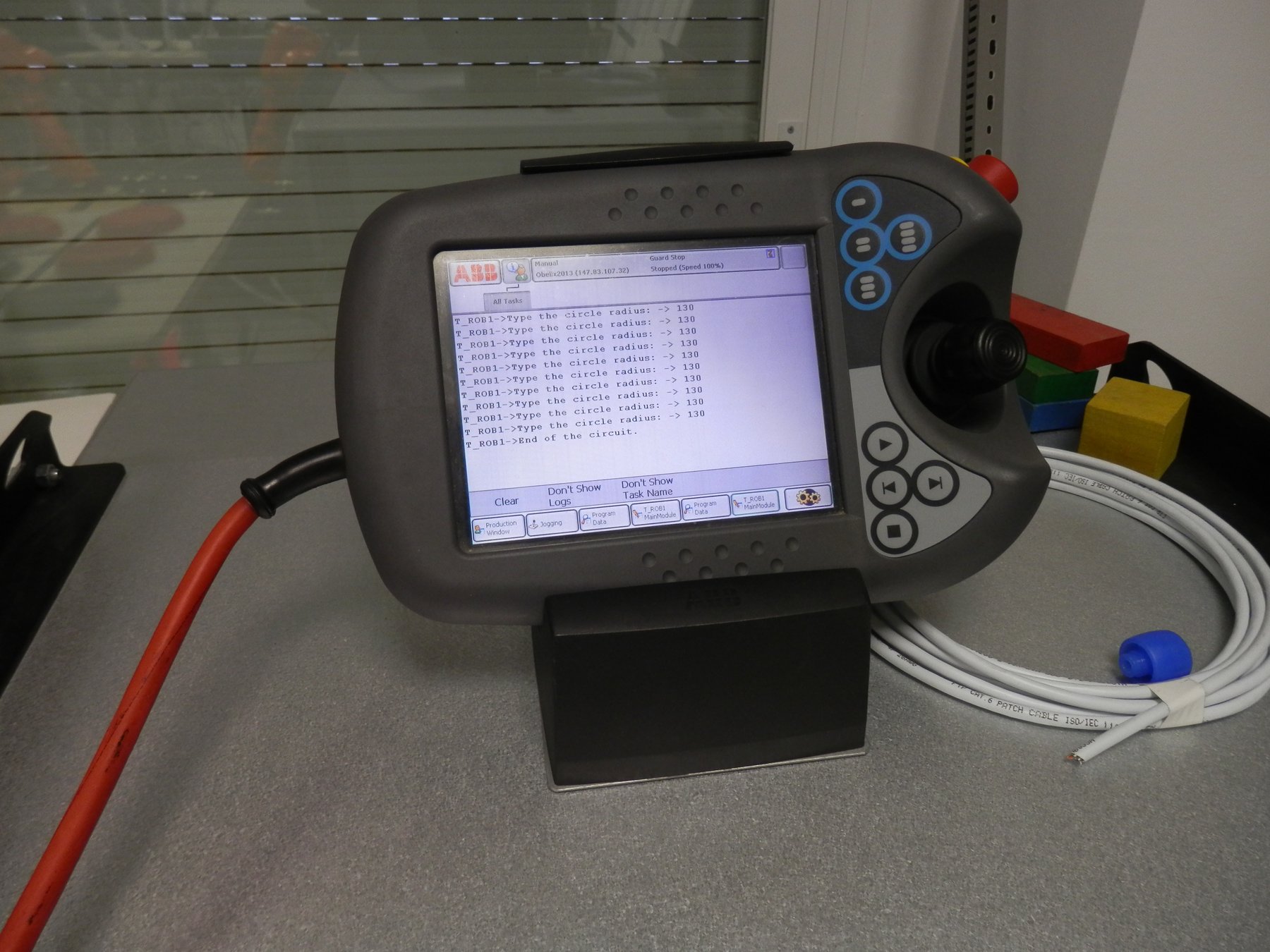
An ABB IRB140 teach pendant — the handheld device operators use to jog, position, and program an industrial robot arm without writing code directly on a PC.
Photo: Auledas, CC BY-SA 4.0, via Wikimedia CommonsA related but distinct method is hand guiding — physically grasping and moving the robot's arm to record a path, rather than jogging it via pendant buttons. It's also one of the four collaborative operating modes covered in Collaborative Robot (Cobot); KUKA's ready2_pilot system, shown below, is a commercial example built specifically for this kind of hand-guided teaching.
Official KUKA video demonstrating ready2_pilot, a wireless hand-guiding device that lets an operator physically move the robot's arm to teach it a path.
02Offline programming (OLP)
Offline programming authors the same kind of motion program on a separate computer, using a 3D CAD model and simulation of the robot cell, without touching or occupying the physical robot at all. The finished program is validated in simulation, then downloaded to the real controller — production only stops for final verification and minor calibration, not for the whole programming process. (Visual Components' OLP guide)
OLP software
OLP is done with dedicated simulation software rather than general-purpose CAD tools:
RoboDK
Simulation and OLP software that supports robots from most major manufacturers rather than locking a user into one brand's ecosystem.
SourceRoboDK
ABB RobotStudio / FANUC ROBOGUIDE
Each major manufacturer also ships its own OLP tool tuned to its own controllers and robot models — RobotStudio for ABB, ROBOGUIDE for FANUC, and equivalents from Yaskawa and KUKA.
SourceABB RobotStudio
Webots
An open-source robot simulator maintained by Cyberbotics — not purpose-built for industrial OLP the way RoboDK or RobotStudio are, but a free, brand-agnostic option often used in robotics education and research.
SourceWebots
03Teach/playback vs. OLP
Teach / playback (pendant)
Simple to learn for straightforward tasks and needs no CAD data, but the robot is offline from production for the whole session, and reprogramming for a new part means re-teaching from scratch.
Offline programming (OLP)
Production keeps running while the program is authored and simulated, and complex multi-robot cells are easier to plan in 3D — at the cost of needing accurate CAD models and simulation software, plus final on-site calibration.
04Japan's teaching qualification
In Japan, personnel who teach or otherwise operate an industrial robot within its motion range — without a fully certified fenced or fixed safety measure in place — are legally required to complete a specific course of special education (特別教育) under the Industrial Safety and Health Regulation before doing so, separate from the fence/enclosure requirement covered in Collaborative Robot (Cobot). The requirement applies to the person doing the teaching, not just the employer — training centers and prefectural labor-standards associations across Japan run the course, typically combining classroom instruction on relevant regulations and robot mechanics with hands-on practice.
It's a recurring, real search query for this topic in Japan, and a practical constraint any team deploying industrial robots there needs to plan around.
05Where AI is starting to replace both
Both teach/playback and OLP are ways of hand-authoring a fixed motion program. A growing share of physical AI research is aimed at replacing that hand-authoring step entirely: instead of programming exact waypoints, a robot foundation model learns a policy — often from human demonstrations — that generalizes to variation the original program never anticipated. Sim2Real covers how those policies get trained in simulation (much like OLP simulates a cell) before running on real hardware, and Physical AI covers the broader perceive-reason-act loop this fits into.
06FAQ
Do I need a license to teach an industrial robot in Japan?
If you're operating within the robot's motion range without a fully certified fenced/fixed safety setup, yes — Japan's Industrial Safety and Health Regulation requires completing a specific special-education course covering industrial robot teaching before doing so.
Is OLP only worth it for large, complex installations?
It pays off fastest there, since keeping a big line running while programming matters most at scale — but the core benefit (not tying up the physical robot) applies to smaller cells too, especially when a robot needs to be reprogrammed frequently for different parts.
Can AI actually replace teaching today, or is this still research?
It's an active transition, not yet the default. Learned policies work well for specific, well-demonstrated tasks and are moving into production in some warehouse and logistics settings, but hand-teaching and OLP remain the standard for most precision industrial work — welding tolerances and assembly precision, in particular, still generally rely on explicit programming rather than learned policies.
Is hand guiding the same thing as teaching?
They overlap but aren't identical. Hand guiding is one specific method — physically moving the robot's arm by hand — that can be used for teaching, and it's also, separately, one of ISO/TS 15066's four collaborative operating modes. "Teaching" more broadly covers any method (pendant jogging, hand guiding, or OLP) of getting a motion program onto the controller.
Should I use a manufacturer-specific OLP tool or a multi-brand one like RoboDK?
It mostly comes down to whether your cell uses one robot brand or several. A manufacturer's own tool (RobotStudio, ROBOGUIDE) tends to model that brand's specific controller behavior most accurately; a multi-brand tool like RoboDK trades some of that precision for the ability to plan and compare cells across different manufacturers in one place.
Fundamentals
All Fundamentals articles →Industrial Robot Fundamentals
- ›Industrial Robot
- ›Types of Industrial Robots
- ›Collaborative Robot (Cobot)
- ›Robot Teaching & Offline Programming(this article)