Fundamentals
Industrial Robot
01Definition
ISO 8373:2021 defines an industrial robot as an automatically controlled, reprogrammable, multipurpose manipulator, programmable in three or more axes, which can be either fixed in place or mounted on a mobile platform, for use in automation applications in an industrial environment. The International Federation of Robotics (IFR) — the industry body that tracks global installation data — bases its own definitions page on this same ISO wording. (IFR's definitions page)
That wording isn't just an international abstraction — most major robot-producing markets publish an equivalent national or regional edition of it, rather than each region defining the category on its own terms:
JIS B 0134
Japan's national adoption of ISO 8373. The Japan Robot Association (JARA) says it was revised in 2024 to track ISO 8373:2021.
SourceJARA — glossary
EN ISO 8373
Adopted by CEN as an identical regional standard; national bodies publish matching editions, such as Sweden's SIS as SS-ISO 8373.
SourceSIS — SS-ISO 8373:2021
GB/T 12643
China's national vocabulary standard, administered by TC591; the 2025 revision equivalently adopts ISO 8373:2021.
SourceSAMR — GB/T 12643
KS B ISO 8373
South Korea's KATS-published edition, harmonized with ISO 8373 and revised in 2024 to track the 2021 revision.
SourceKSSN — KS B ISO 8373
The US is the exception: ANSI resells ISO 8373 directly rather than issuing its own national edition. What the US does standardize separately is safety, not vocabulary, via ANSI/A3 R15.06. (ANSI's ISO 8373 listing)
Two words in that definition do a lot of work. "Reprogrammable" rules out fixed-automation machines, like a single-purpose stamping press, that can't be retasked without rebuilding the hardware. "Multipurpose" rules out dedicated single-function devices. What's left is a broad category: everything from a six-axis welding arm on a car line to a tabletop pick-and-place unit qualifies, as long as it's automatically controlled and reprogrammable across three or more axes.
02How it differs from a service robot
"Industrial robot" and "service robot" are the two top-level categories IFR uses to split the field. The distinction is about deployment context, not hardware: the same arm-shaped manipulator counts as industrial when it's automating a factory task, and as a service robot when it's performing tasks for humans or equipment outside a manufacturing environment (cleaning, delivery, inspection). Collaborative Robot (Cobot) is a further subdivision within industrial use — a safety classification, not a separate machine type.
Industrial robot
Automates a task inside a manufacturing/production environment — welding, assembly, palletizing, material handling.
Service robot
Performs tasks for humans or equipment outside a manufacturing context — cleaning, delivery, inspection, logistics.
03Anatomy: the parts that make up the definition
Every industrial robot, regardless of its physical shape, is built from the same functional pieces:
Manipulator (the arm)
The mechanical structure itself — a series of links and joints (axes). Its geometry (how the joints are arranged) is what defines the robot's "type"; see Types of Industrial Robots.
Axes / degrees of freedom
Each axis is one independent way a joint can move (rotating or sliding). ISO 8373 requires three or more programmable axes; six axes — enough to place a tool at any position and orientation in 3D space — is the most common configuration for general-purpose work.
End-effector
The task-specific tool mounted at the wrist — a gripper, a welding torch, a spray gun, a suction cup — swapped out depending on the job. It's usually not included when a robot's own specs are quoted.
Controller
The cabinet that runs the motion program and safety logic, and drives the motors at each joint. It's a separate unit from the arm, usually installed nearby on the factory floor.
Payload, reach & repeatability
The three specs used to compare models: payload (maximum weight the wrist can carry), reach (maximum radial distance from the base), and repeatability (how consistently the robot returns to the same taught point cycle after cycle — a different measure from accuracy, which is how close it gets to a truly commanded position; both are formally defined by ISO 9283).
04What they're used for
Four classic factory-automation tasks remain the biggest deployment categories. Each favors a different mechanical configuration and payload class — covered in depth in Types of Industrial Robots.
Welding
Spot welding (joining sheet-metal panels with fused points) and arc welding (continuous seams) in automotive body shops are among the earliest and largest industrial robot deployments — the task the original Unimate itself performed at GM in 1961, on die castings.
Material handling & palletizing
Moving parts between processes, and stacking finished cases onto pallets in a set pattern for shipping — high-repetition tasks that favor Cartesian and vertical articulated robots with large work envelopes and heavy payloads.
Assembly
Fitting, fastening, and inserting parts together — from mounting components on circuit boards (a SCARA specialty) to assembling larger mechanical products with vertical articulated arms.
Painting & coating
Applying an even coat of paint or sealant — a task that benefits from a robot's exact, repeatable path even more than most, since visible finish defects are costly to rework.
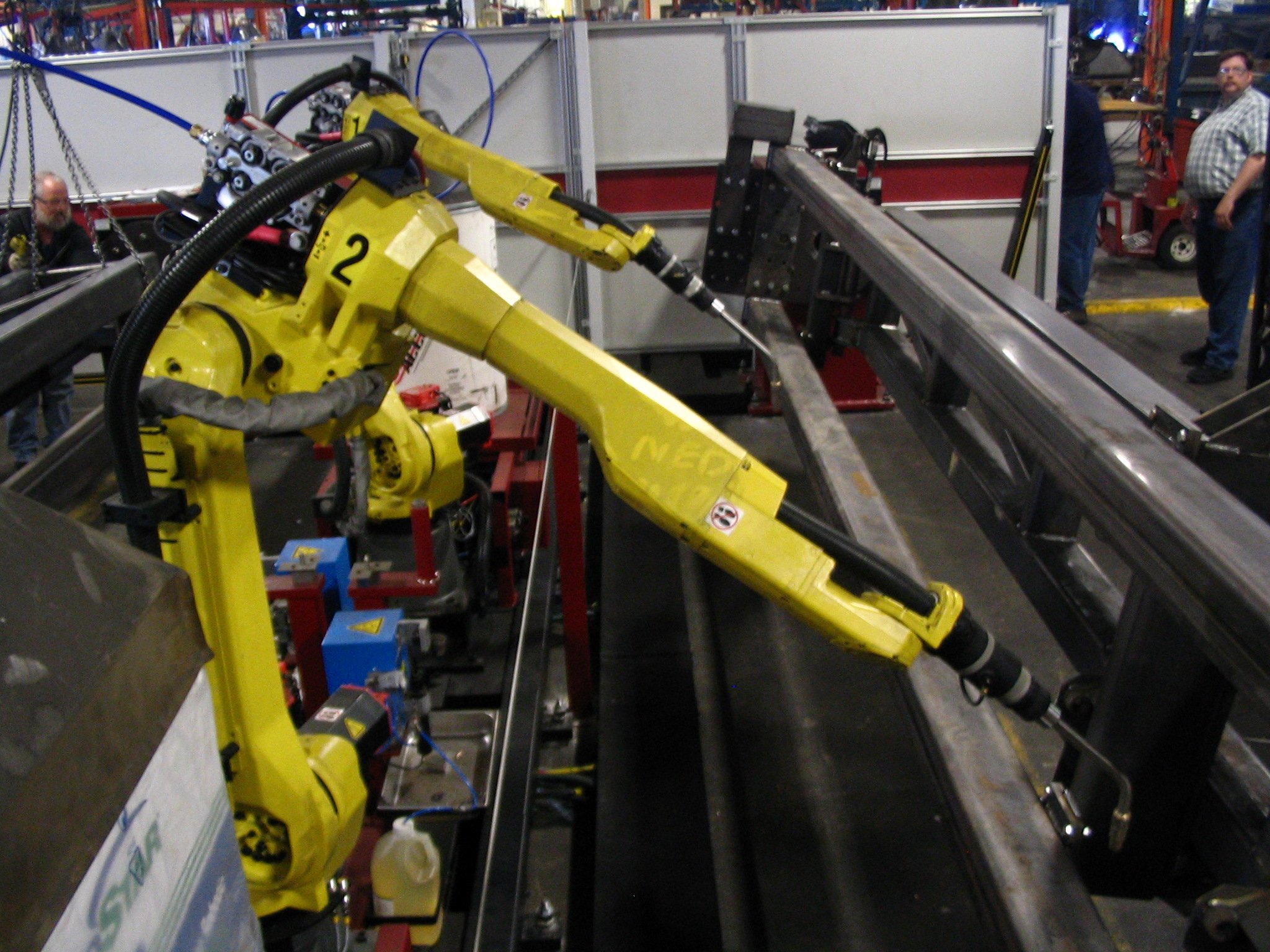
FANUC ARC Mate 120iC/10L six-axis robots preparing to weld a steel part — the six-electromechanical-axis layout is the same basic arrangement KUKA's FAMULUS introduced in 1973.
Photo: Phasmatisnox, CC BY 3.0, via Wikimedia CommonsOfficial KUKA footage of an orange KUKA industrial robot arm handling automotive body components inside a production cell at a BMW plant — the kind of welding/material-handling cell described above.
05Who makes them
Industry coverage often refers to FANUC, ABB, Yaskawa, and KUKA as the "big four" general-purpose industrial robot manufacturers — together holding roughly three-quarters of unit shipments, though the term itself is informal shorthand rather than an official IFR category. Each sells across most of the configurations covered in Types of Industrial Robots, not a single specialty. One of the four is in flux: ABB agreed to sell its robotics division to SoftBank Group for $5.375B in a deal expected to close in mid-to-late 2026 — see the Investment Tracker for how that reshapes ABB's and SoftBank's public-market robotics exposure.
FANUC
Spun out of Fujitsu's computer division in 1972; one of the world's largest industrial robot makers by installed base, spanning nearly every configuration covered above.
SourceFANUC — robots
ABB
Introduced the IRB 6, one of the world's first commercial all-electric microprocessor-controlled industrial robots, in 1974 — today also known for the YuMi and IRB 360 FlexPicker lines covered elsewhere in this cluster. Its robotics division is being sold to SoftBank Group, expected to close in 2026.
SourceABB — robotics
Yaskawa
Sells industrial robots under the Motoman brand; among the world's largest by cumulative units shipped, with particular strength in welding and general-purpose articulated arms.
SourceYaskawa — robotics
KUKA
Built the FAMULUS in 1973, among the first six-axis electromechanical robots; acquired by China's Midea Group in 2016, a deal often cited as a milestone in China's push into advanced robotics manufacturing.
SourceKUKA — industrial robots
Beyond the big four, regional depth varies by market. Japan is home to several additional major manufacturers with strong domestic and export positions — Kawasaki Heavy Industries (Japan's first industrial robot maker, back in 1969), Denso Wave, and Mitsubishi Electric — reflecting Japan's position as the world's second-largest installer. China, now the largest market by volume, has built up its own domestic suppliers as Chinese-made robots' share of the country's installations has grown from roughly 28% to 57% over the past decade (IFR — World Robotics 2025) — Estun Automation, which acquired Germany's welding-robot maker Cloos in 2019 (deal coverage), and EFORT Intelligent Equipment (company profile) among them. South Korea, which leads the world in robot density, is anchored by HD Hyundai Robotics (company history), whose robotics unit traces back to Hyundai Heavy Industries' in-house robot team in 1984.
06Market scale, in numbers
The IFR's World Robotics 2025 report — covering 2024 installation data — puts the scale of the category in context:
Of that 542,000-unit global total, China alone accounted for 295,000 installations — more than the next four markets (Japan, the US, South Korea, and Germany) combined — and now supplies 57% of its own domestic demand from Chinese manufacturers, up from roughly 28% a decade earlier. IFR — World Robotics 2025 Robot density data is from the same report.
07Where this fits into physical AI
Industrial robots are the oldest and most mature branch of what the industry now calls physical AI — the perceive-reason-act loop described in Physical AI has been running, in a simpler form, on factory floors since the 1960s. Today's humanoid funding boom traces directly back to this lineage — the history of the robot industry covers how the first arms on GM's assembly line led to today's legged and dexterous machines. And the newest wave of robot foundation models — the AI "brains" behind physical AI — are increasingly being trained and deployed on industrial arms as well as humanoids, not just the latter; see the Company & Robot DB for who's building both.
08FAQ
Are humanoid robots industrial robots?
It depends on deployment, not shape — a humanoid automating a factory task (like Agility Robotics' Digit handling totes in a warehouse) would count as industrial under IFR's definition; the same robot running a demo or a research task wouldn't. IFR's category split is about what the robot is doing, not its physical form.
What's the minimum number of axes for something to count as an industrial robot?
Three, per ISO 8373 — a two-axis or fixed-motion device (like a simple pick-and-place cylinder) doesn't qualify, even if it's automated, because it isn't a multipurpose manipulator in the standard's sense.
Is a CNC machine an industrial robot?
No — CNC machines are automatically controlled and reprogrammable, but they're purpose-built for machining (cutting, milling) rather than being a general-purpose manipulator that can be retasked to grip, weld, or move parts. ISO 8373 and IFR both classify machine tools separately from industrial robots.
Which country installs the most industrial robots?
China, by a wide margin — 295,000 of the 542,000 units installed worldwide in 2024, more than Japan, the US, South Korea, and Germany combined, per the IFR's World Robotics 2025 report. Japan is the next-largest single market, and remains a major exporter even as its share of new installations has fallen behind China's.
Fundamentals
All Fundamentals articles →Industrial Robot Fundamentals
- ›Industrial Robot(this article)
- ›Types of Industrial Robots
- ›Collaborative Robot (Cobot)
- ›Robot Teaching & Offline Programming