Fundamentals
Types of Industrial Robots
01Overview
The International Federation of Robotics (IFR) classifies industrial robots into six mechanical structures. One of them, polar/spherical, was the very first industrial robot geometry — the original 1961 Unimate used it — and the other five each later specialized in a different trade-off of work envelope, speed, and precision. Here's what each one looks like and where it fits.
02The six configurations
Vertical articulated
Three or more rotary joints in series, moving like a human arm — the largest, most flexible work envelope of any configuration. Typically 6-axis. Dominant configuration for welding, material handling, and general assembly.
SourceYaskawa — robot types
SCARA (horizontal articulated)
Two parallel horizontal rotary joints plus a vertical stroke — typically 4-axis. Rigid in the horizontal plane but compliant vertically, which suits fast, repetitive placement work like mounting components on circuit boards.
SourceYaskawa — robot types
Cartesian / gantry
Three linear axes (X/Y/Z) moving in straight lines instead of rotating — mechanically simple, scalable to very large work envelopes, and able to carry heavy loads. Common for large-area handling and palletizing.
Cylindrical
A rotary base joint plus linear vertical and radial joints, tracing a cylindrical work envelope. Needs less floor space than an articulated arm for a given reach.
SourceYaskawa — robot types
Parallel / delta
Several light arms connect a fixed base to a shared end-effector platform through parallelogram linkages, keeping the motors off the moving arm for very high acceleration. ABB's IRB 360, for example, is rated up to 150 picks per minute at light payloads.
SourceABB — delta robots
Polar / spherical
A rotary base joint and a rotary shoulder joint, plus a linear arm that telescopes in and out, tracing a spherical work envelope — the geometry of the 1961 Unimate, the first industrial robot ever put into production.
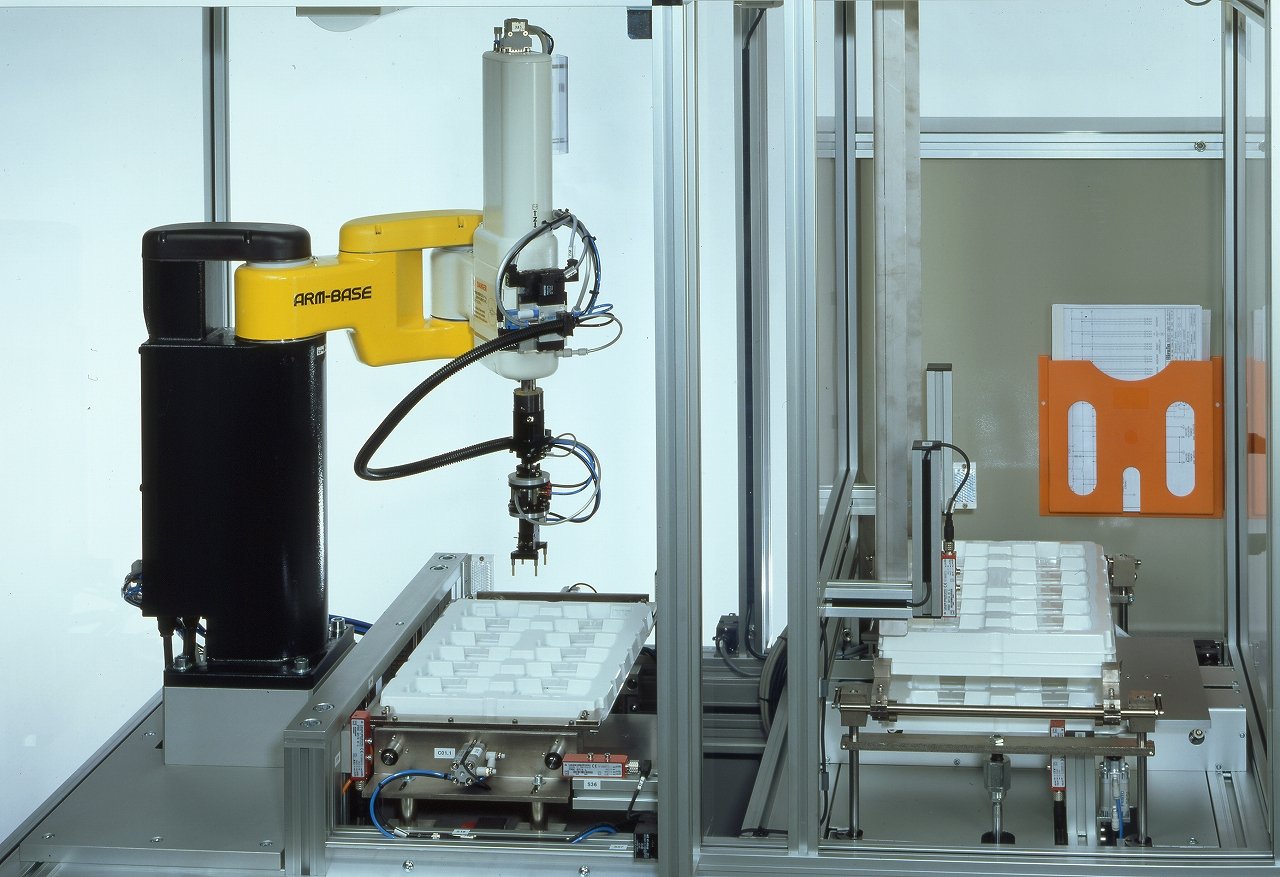
A SCARA robot in a palletizing work cell — the two horizontal rotary joints plus a straight vertical stroke are the defining geometry Hiroshi Makino's team developed with Sankyo Seiki in 1978.
Photo: Hirata Robotics GmbH, CC BY-SA 3.0 DE, via Wikimedia Commons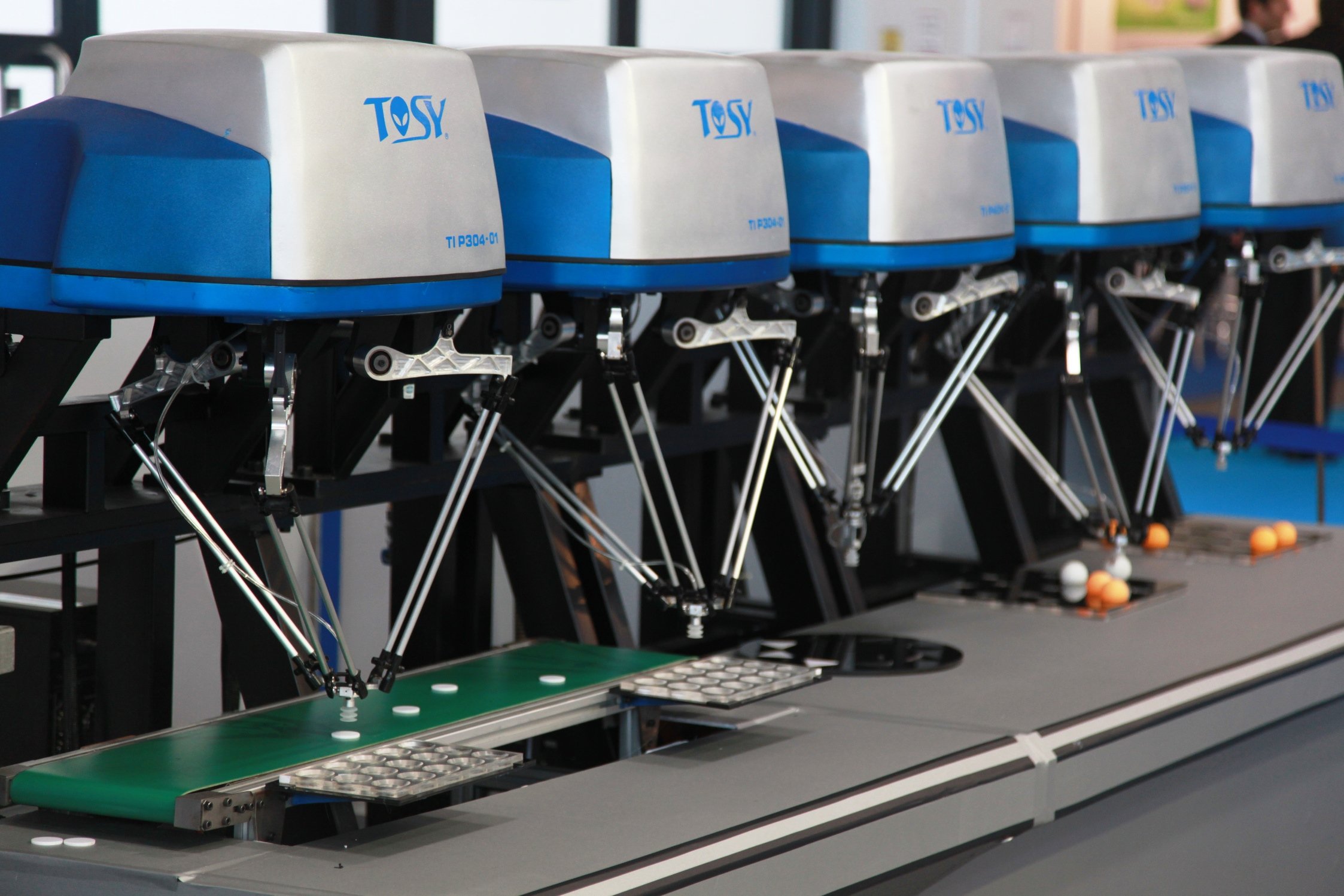
TOSY delta robots on display at Automatica 2010 in Munich — the three parallel arms and overhead-mounted motors are what let delta robots pick and place at speeds ordinary six-axis arms can't match.
Photo: Humanrobo, CC BY-SA 3.0, via Wikimedia CommonsOfficial ABB Robotics demo of the IRB 365 FlexPicker, a delta robot performing very fast picking, reorienting, and packing of lightweight products — the acceleration advantage described above, visualized.
03A quick decision guide, by task
As a starting point (not a strict rule — real cells often combine configurations), the task at hand tends to point toward one configuration first:
- Welding a car body panelVertical articulated
- Mounting components on a circuit boardSCARA
- Moving large, heavy loads over a wide areaCartesian / gantry
- Fitting a compact cell with a limited footprintCylindrical
- Picking very light, small items at very high speedParallel / delta
04How manufacturers frame the trade-off
None of these geometries is strictly "better" — each trades work-envelope shape, speed, and payload against footprint and cost. A cell designer typically starts from the task (weld a car door vs. pick small parts off a conveyor at high speed) and the space available, then picks the configuration that fits both.
05A cross-cutting category: collaborative robots
Any of the six configurations above can be built and safety-certified as a collaborative robot (cobot) — collaborative status is a safety/deployment classification, not a seventh kinematic type. Collaborative Robot (Cobot) covers what makes a robot "collaborative" and how that differs from these mechanical structures.
06FAQ
What's the actual difference between SCARA and vertical articulated?
SCARA's two main joints both rotate around vertical axes, keeping the arm rigid side-to-side but compliant up-and-down — ideal for fast, flat, repetitive placement. A vertical articulated robot's joints let it reach and orient a tool in almost any direction in 3D space, at the cost of being generally slower for simple, repetitive, flat-plane motion.
Why are delta robots so much faster than other configurations?
Because their motors stay fixed at the base instead of riding on the moving arm, the arm itself is very light — there's much less mass to accelerate and decelerate on every cycle, which is what lets delta robots hit very high pick rates at light payloads.
Is the polar/spherical configuration still used today?
It remains part of IFR's classification, but the original 1961 Unimate's job — general-purpose material handling and machine tending — is now covered mainly by vertical articulated and Cartesian robots in current product lineups. Its historical significance as the first industrial robot geometry, rather than current sales volume, is why it's still worth knowing.
"Pick and place robot" — which configuration is that?
It's a task description, not a kinematic type — delta robots are the classic choice for very fast, light pick-and-place, but SCARA and Cartesian robots perform the same basic task at different speed and payload points. Which configuration a given "pick and place robot" actually uses depends on the item's weight and the required cycle time.
Fundamentals
All Fundamentals articles →Industrial Robot Fundamentals
- ›Industrial Robot
- ›Types of Industrial Robots(this article)
- ›Collaborative Robot (Cobot)
- ›Robot Teaching & Offline Programming