Fundamentals
Collaborative Robot (Cobot)
01Definition
A collaborative robot, or cobot, is an industrial robot designed and safety-certified to work directly alongside people, in the same space, without a full physical safety fence around it. It's a deployment and safety classification — any of the mechanical configurations covered in Types of Industrial Robots can be built or certified as collaborative; it isn't a separate kinematic type.
02The standards behind the classification
ISO 10218 — "Robotics — Safety requirements" — is the base standard covering industrial robot safety, split into Part 1 (the robot itself) and Part 2 (the robot cell/application it's installed in). Both parts were substantially revised, with ISO 10218-1:2025 and ISO 10218-2:2025 superseding the 2011 editions. Collaborative operation specifically has its own technical specification, ISO/TS 15066, which defines the biomechanical force and pressure limits a robot must stay under when it can contact a person — the methodology industry sources report has now been folded into the ISO 10218-2:2025 revision as a normative part, rather than remaining a separate document. ISO 10218-1:2025 · ISO 10218-2:2025
03How collaboration is actually achieved
ISO/TS 15066 describes four collaborative operating modes a robot cell can use, alone or combined. PFL is the mode most people picture when they hear "cobot," but a given installation might combine two or more of the four.
Safety-rated monitored stop
The robot halts the instant a person enters its monitored space — the simplest mode, effectively pausing collaboration rather than enabling simultaneous work.
Hand guiding
An operator manually guides the robot through a motion by physically moving it — used both as a collaborative mode and, per the terminology note below, as a way to record a motion program.
Speed and separation monitoring
Sensors track the distance between the robot and a person; the robot slows or stops as that distance shrinks, rather than stopping the moment any presence is detected.
Power and force limiting (PFL)
The robot's own motors and structure are limited so that even direct contact stays under ISO/TS 15066's biomechanical thresholds — the mode most people picture when they hear "cobot," and the only one of the four that tolerates actual contact by design.
One terminology note worth flagging: "hand guiding" (an ISO/TS 15066 term) and "direct teaching" are sometimes used interchangeably in Japanese-language industry material, even though hand guiding technically refers to the collaborative operating mode itself, while direct teaching refers to using that same physical guidance to record a motion program — a distinction covered in more depth in Robot Teaching & Offline Programming.
04Notable cobots
Universal Robots shipped the UR5 in 2008, widely credited as the product that made "fence-free" collaborative robots commercially mainstream rather than a research curiosity — it's now owned by Teradyne. ABB's single-arm YuMi and FANUC's CR series followed as major manufacturers built PFL-certified lines of their own. Teradyne, ABB, and FANUC are all tracked in the Investment Tracker as publicly traded companies with cobot exposure.
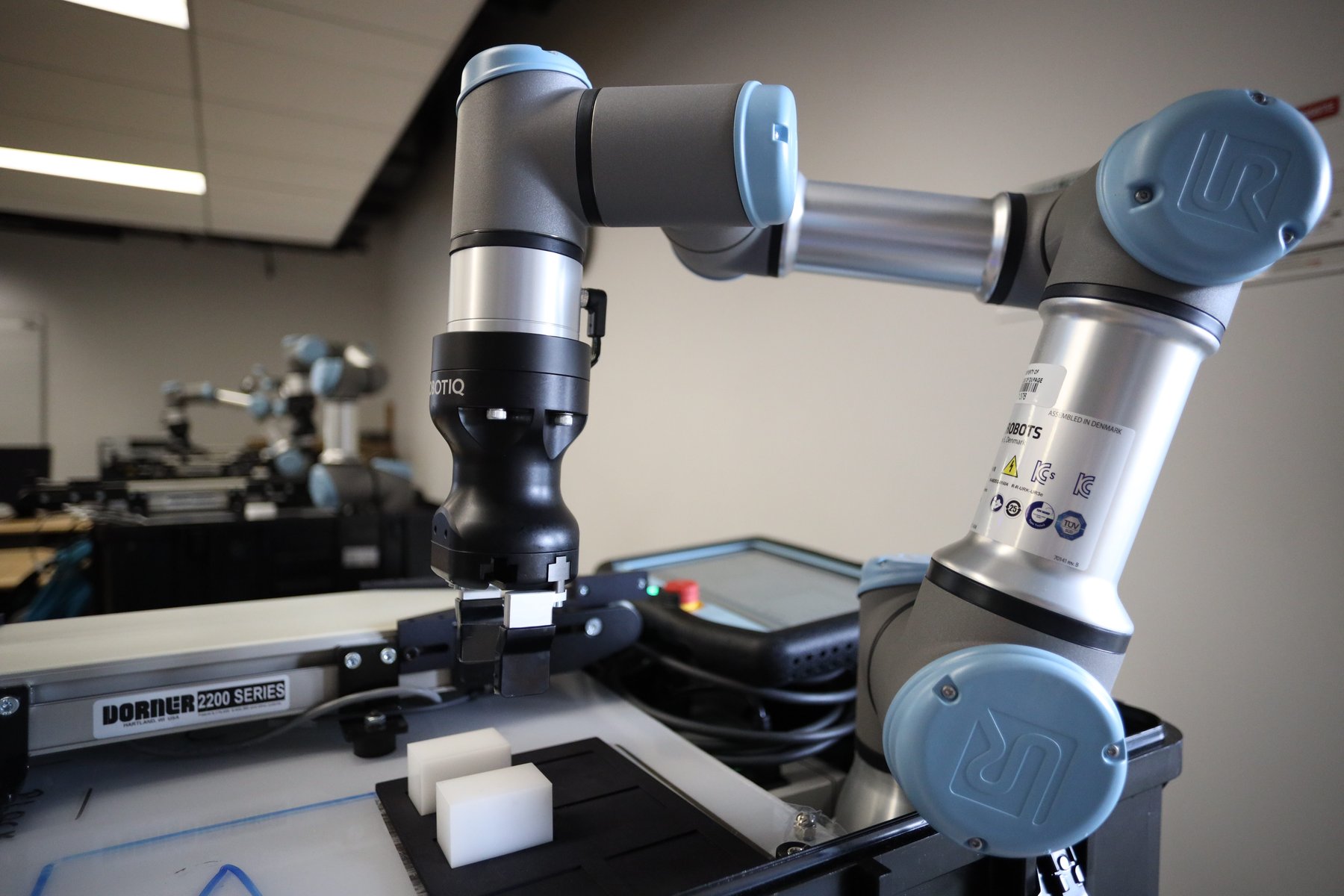
A Universal Robots cobot arm fitted with a Robotiq gripper, photographed in a manufacturing-technology lab — the same safety-cage-free design philosophy Universal Robots pioneered with the UR5 in 2008.
Photo: COD Newsroom, CC BY 4.0, via Wikimedia CommonsOfficial ABB Robotics video in which a presenter demonstrates and explains the built-in safety features that let the single-arm YuMi cobot work directly alongside a person without a safety cage.
05Cobots vs. traditional industrial robots
Traditional industrial robot
Usually faster and stronger, operating behind a physical safety fence or light curtain that stops all access while it runs. Optimized for throughput, not proximity to people.
Collaborative robot (cobot)
Deliberately limited in speed and/or force so a person can share its workspace under one of ISO/TS 15066's four collaborative modes, without a full enclosure. Usually slower and lower-payload than a fenced robot of similar size, in exchange for that proximity.
06Japan's fence rule, and its 2013 relaxation
Japan's Industrial Safety and Health Regulation has long required an enclosure or fence around an operating industrial robot wherever contact with it could endanger a worker — a rule that, on its own, would have ruled out fence-free collaborative operation entirely. MHLW's official notice index confirms a December 2013 notice that relaxed this: fence-free operation became permitted where the robot is designed, manufactured, and installed in line with ISO 10218-1 and ISO 10218-2, and a documented risk assessment shows the resulting risk is acceptable. Separately, robots whose drive motor is rated at 80W or less have long been treated as exempt from some of the same regulation's operator-training requirements — a detail worth confirming against the current statute text if you're making a compliance decision, since the exact rule numbering behind it is inconsistently reported.
That legal change is what made large-scale cobot deployment viable in Japanese factories in the first place.
07FAQ
Cobots vs. robots — what's actually different?
Every cobot is an industrial robot — "cobot" just adds a safety certification (typically PFL, per ISO/TS 15066) that lets it share space with a person without a fence. A traditional fenced robot isn't disqualified from ever being near people; it just isn't certified to operate near them without one.
Are all collaborative robots slow?
Not necessarily at all times — a cobot can move at full speed when no person is in its immediate vicinity, and only slow down, stop, or limit its force as a person approaches, per speed-and-separation monitoring or PFL logic. "Slower" describes its behavior near people, not a fixed speed cap.
Does a cobot need zero safety measures?
No — "fence-free" doesn't mean unregulated. A cobot deployment still requires a documented risk assessment covering the specific task, workspace, and end-effector (a blunt gripper and a sharp cutting tool pose very different risks even on the same certified cobot arm), and compliance with ISO 10218-1/-2.
Is Universal Robots the only company that makes cobots?
No — it pioneered the category commercially with the UR5 in 2008, but ABB (YuMi), FANUC (CR series), KUKA, and Yaskawa all now sell PFL-certified collaborative lines alongside their traditional fenced robots, among many other manufacturers.
Fundamentals
All Fundamentals articles →Industrial Robot Fundamentals
- ›Industrial Robot
- ›Types of Industrial Robots
- ›Collaborative Robot (Cobot)(this article)
- ›Robot Teaching & Offline Programming