Projects
SO-101
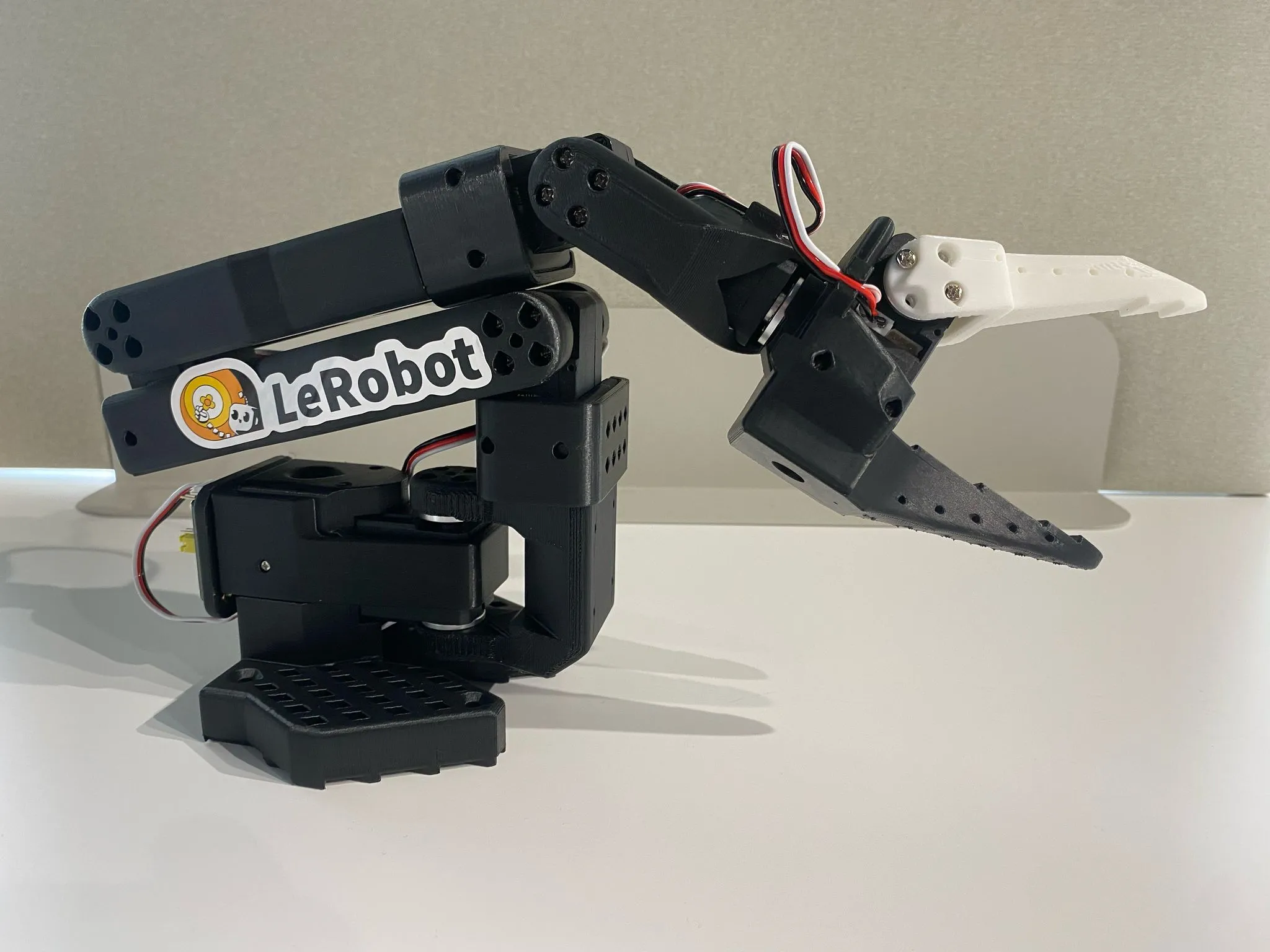
The follower arm — the half of the SO-101 pair that does the physical work, driven by six uniformly high-torque servos.
TheRobotStudio, SO-ARM100 GitHub repository, Apache License 2.0What SO-101 changed
Collecting real-world manipulation data for robot learning research used to mean building a custom rig around whatever hardware a lab already owned — expensive, one-off, and hard for anyone else to reproduce.
SO-101 replaced that with a standard, low-cost reference design:
- 6 DOF driven by Feetech STS3215 bus servos — a strong, high-torque follower arm paired with a lighter leader arm built to be moved by hand
- Fully 3D-printable in PLA+, with official DIY parts costing $121.94 for one arm or $229.88 for the full leader-follower pair
- Apache 2.0 licensed end to end — code and mechanical design both, under a single license
The result: a $100-class arm good enough to be the default hardware for a 3,000-person worldwide hackathon, and to show up as the reference platform in NVIDIA's own robot-learning tutorials.
01Where it came from: Koch, SO-100, and a rethink of assembly
SO-101's lineage runs through two predecessor arms. LeRobot's first real hardware support, added in July 2024, targeted the Koch v1.1 — an open-source, Dynamixel-servo arm designed by Alexander Koch of Tau Robotics, built outside the project and already circulating among hobbyists. Three months later, in October 2024, TheRobotStudio — a Lyon-based robotics company founded in 2006 by Rob Knight, a former Robot Wars/BattleBots competitor who has spent nearly two decades building humanoid robots — partnered with Hugging Face on the project's own hardware milestone: the SO-100, a fully 3D-printable leader-follower arm pair that swapped Koch's Dynamixel motors for cheaper Feetech STS3215 bus servos, buildable for around $115 in parts.
SO-101 followed on April 28, 2025, adding two more manufacturing partners — Seeed Studio and Partabot, alongside WowRobo — and a round of assembly fixes rather than a full redesign. Hugging Face co-founder and CEO Clément Delangue announced it on X:
"Super excited to introduce SO-101 today from Hugging Face, in collaboration with The Robot Studio, Wowrobo, Seeedstudio & Partabot. Building on top of the insanely successful SO-100 (the most popular robot arms ever?), SO-101 are the first robot arms any AI builder should buy. It's fully open-source hardware and software... It costs from $100 to $500 depending on how much you want it assembled and your country of shipping."
02Design: one servo family, tuned two different ways
SO-101 keeps SO-100's core recipe — two identical-looking six-servo arms, one built to be strong, one built to be moved by hand — while fixing the step that made SO-100 fiddly to build. SO-100's leader arm required physically removing the internal gears from each of its six motors before installation; SO-101 replaces that with three purpose-picked gear ratios, so every servo can be used as-is. LeRobot lead Rémi Cadène put the result at about 20 minutes to assemble, down from the roughly hour-plus SO-100's own docs describe for a first build.
Every joint on both arms is driven by the same Feetech STS3215 bus-servo family, but the follower and leader are geared differently for their different jobs:
Controlling either arm means installing Hugging Face's open-source `lerobot` Python package rather than writing serial-protocol code from scratch:
Follower arm — built to be strong
All six STS3215 servos share the same 1/345 gear ratio (rated 5kg·cm, stall 19.5kg·cm), so the arm can support its own weight and whatever's in its gripper. Ends in a two-jaw parallel gripper claw.
SourceSO-101 official docs
Leader arm — built to be back-driven
Three different gear ratios (1/191, 1/345, 1/147) across its six servos, chosen so a human can move each joint by hand without fighting the motors. Ends in a molded handle and trigger instead of a claw, for teleoperating the follower's gripper.
SourceSO-101 official docs
- Controlled via Hugging Face's `lerobot` Python package (Python ≥3.12) plus the Feetech SDK extra (`pip install -e ".[feetech]"`) for the STS3215 servo bus
- Dedicated CLI tools cover the whole workflow: `lerobot-setup-motors`/`lerobot-calibrate` for one-time setup, `lerobot-teleoperate` and `lerobot-record`/`lerobot-replay` for data collection, `lerobot-train`/`lerobot-rollout` for training and deploying a policy
- Calibration means moving every joint through its full range once, so the leader and follower — and any two SO-101 units — agree on the same coordinate frame, which is what lets a policy trained on one arm run on another
- Officially documented on Linux, macOS (Apple Silicon and Intel), and Windows (including WSL)
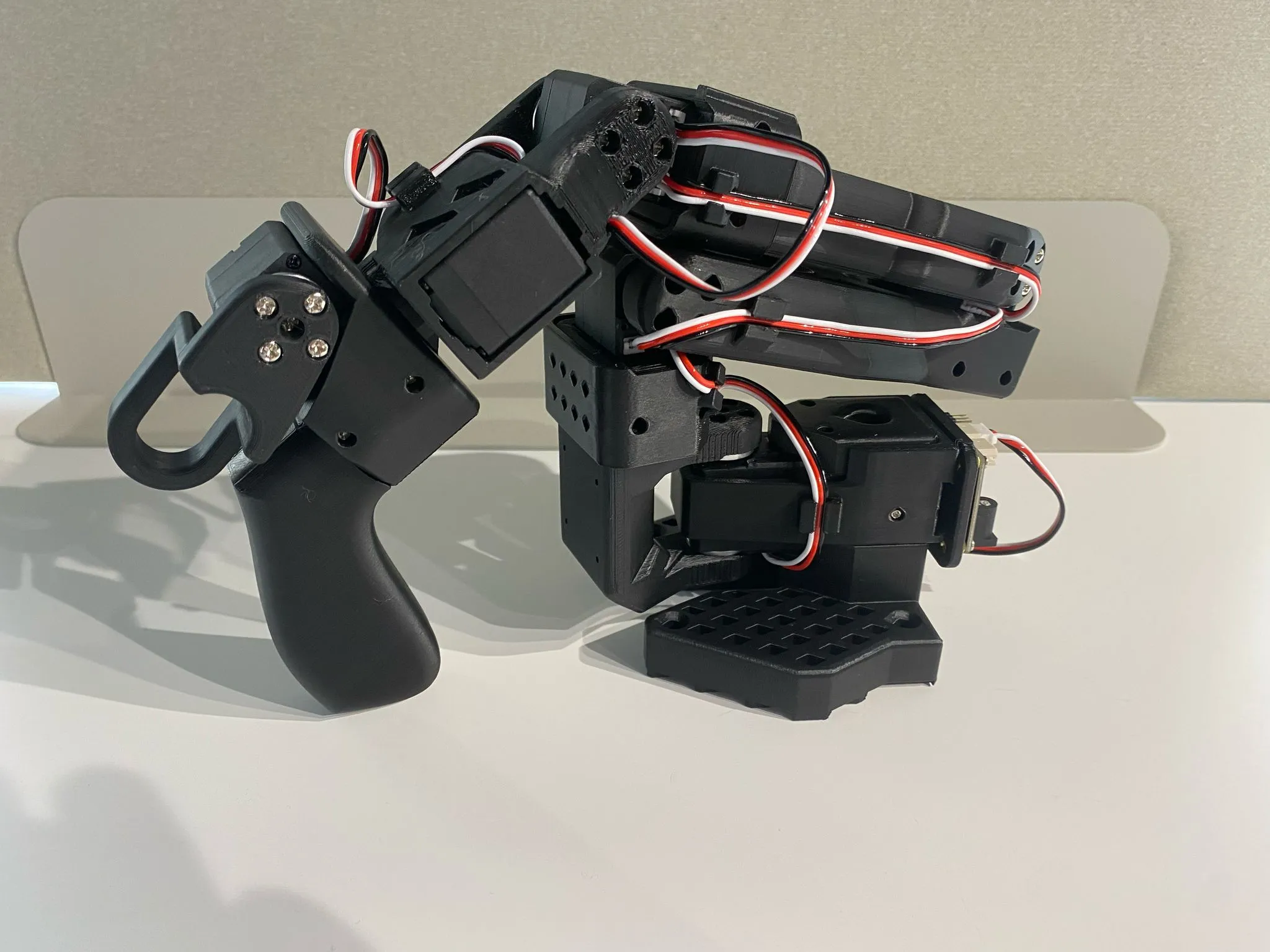
The leader arm — lower-torque, easier-to-back-drive servos and a handle/trigger grip instead of a claw, so it can be moved by hand to teleoperate the follower.
TheRobotStudio, SO-ARM100 GitHub repository, Apache License 2.0Bill of materials — about $229.88 for the leader+follower pair
| Component | Qty | Total (pair) |
|---|---|---|
| Feetech STS3215 servo (3 gear-ratio variants) | 12 | $166.68 |
| Motor control board (Waveshare bus adapter) | 2 | $21.20 |
| USB-C cable (2-pack) | 1 | $7.00 |
| Power supply (5V) | 2 | $20.00 |
| Table clamp (4-pack) | 1 | $9.00 |
| Screwdriver set | 1 | $6.00 |
| Total (pair) | $229.88 | |
Both the code and the mechanical design (CAD/STL) are covered by a single Apache License 2.0 — unlike some open hardware projects that split the two under separate licenses.
03Where it's landed: kits, price drift, and a worldwide hackathon
Pricing spans a wide range depending on how much assembly you're paying someone else to do. The project's own bill of materials puts electronics-only parts at $121.94 for one follower arm or $229.88 for a full pair — TechCrunch's launch-day coverage attributed the wider $100–$500 street-price spread partly to U.S. tariffs on Chinese-made components. Vendor kits fill in the space between: Seeed Studio's electronics-only kit rose from $220 at launch to $240 by mid-2026, and fully assembled pairs from PartaBot and WowRobo run $299–$479.
SO-101 got its biggest single showcase on June 14–15, 2025, when Hugging Face ran the LeRobot Worldwide Hackathon — over 100 local events on every continent in a single weekend, drawing more than 3,000 registered participants who built and trained policies on SO-101 arms paired with SmolVLA, with winning submissions published openly on the Hub.
Official DIY (GitHub BOM)
The project's own bill of materials: $121.94 in electronics for one follower arm, $229.88 for a full leader+follower pair, sourced part by part. Excludes 3D-printer filament.
WowRobo kits
From $199 for 3D-printed parts plus 12 servos (self-assembly) up to $299 for a fully assembled leader+follower pair with a camera.
SourceWowRobo official store
Seeed Studio / PartaBot
Seeed Studio's electronics-only kit rose from $220 at launch to $240 by mid-2026 (plus ~$35 for printed parts); PartaBot's fully assembled pair tops out at $479.
04Where it fits: the reference arm for a growing stack
Hugging Face's own SO-101 assembly guide calls it "our flagship robot" — and the ecosystem built on top of it backs that up. SmolVLA's own training data drew partly on SO-100/SO-101 community datasets, NVIDIA's Isaac GR00T documentation uses the SO-101 as its reference arm for sim-to-real tutorials, and community builders have extended it into new form factors:
No numbered successor (an "SO-102") has been announced as of this writing. Instead, 2026's hardware news has moved outward rather than iterating the arm itself: a $2,500 open-source bipedal "LeRobot Humanoid" in May 2026, and deeper integration of NVIDIA's Isaac GR00T 1.7 and Isaac Teleop into LeRobot in July 2026. SO-101 keeps its role as the project's low-cost, easy-to-reproduce entry point.
- SmolVLA, Hugging Face's compact vision-language-action model, was pretrained in part on SO-100/SO-101 community datasets
- XLeRobot, a community-built dual-arm mobile home robot using two SO-100/SO-101 arms on a cart base, passed 4,800+ GitHub stars within a year of its May 2025 launch
- NVIDIA's own Isaac GR00T documentation uses the SO-101 as its reference arm for sim-to-real robot-learning tutorials
Hugging Face's own kickoff video for the June 2025 LeRobot Worldwide Hackathon, which ran across 100+ local events on seven continents — the event that made SO-101 the default hardware for 3,000+ participants.
05Timeline at a glance
| Date | Partner | Event |
|---|---|---|
| 2024-07 | Hugging Face | LeRobot adds support for the Koch v1.1 arm, its first real hardware milestone |
| 2024-10 | TheRobotStudio | SO-100 launches — a 3D-printable leader-follower pair for about $115 in parts |
| 2025-04-28 | Hugging Face | SO-101 announced with TheRobotStudio, WowRobo, Seeed Studio, and Partabot, priced $100–$500 |
| 2025-06 | Hugging Face | SmolVLA released, pretrained in part on SO-100/SO-101 community datasets |
| 2025-06-14 | Hugging Face | LeRobot Worldwide Hackathon: 100+ events, 7 continents, 3,000+ participants building on SO-101 |
| 2026-02 | Hugging Face | LeRobot core-library paper published on arXiv |
| 2026-05 | Hugging Face | LeRobot Humanoid, a $2,500 open-source bipedal robot, announced |
| 2026-07 | NVIDIA | Isaac GR00T 1.7 and Isaac Teleop integrated into LeRobot |
06FAQ
What is SO-101?
SO-101 is an open-source, 6-degrees-of-freedom robot arm from Hugging Face and TheRobotStudio, sold as a matched leader-follower pair for teleoperated data collection. It's fully 3D-printable in PLA+, driven by Feetech STS3215 bus servos, and priced from about $100 to $500 depending on how assembled a kit you buy.
Who created it, and when?
TheRobotStudio (founded by Rob Knight) and Hugging Face's LeRobot team announced SO-101 on April 28, 2025, as a refined successor to their October 2024 SO-100 arm.
How much does SO-101 cost?
Officially, parts alone run $121.94 for one follower arm or $229.88 for a full leader+follower pair, per the project's own bill of materials. Assembled kits from vendors like WowRobo, Seeed Studio, and PartaBot range from about $199 to $479.
What software does it run on?
Hugging Face's open-source `lerobot` Python library (Apache 2.0), via dedicated command-line tools for calibration, teleoperation, dataset recording, and policy training — the same stack used across LeRobot's other supported hardware.
Is SO-101 the only robot arm the LeRobot library supports?
No. LeRobot also supports the Koch v1.1 arm SO-101 descends from, Hugging Face's own Reachy 2 and Reachy Mini humanoids from Pollen Robotics, and a growing list of other hardware. SO-101 is documented as the project's own "flagship" reference arm, not its only one.
07Sources
01. Where it came from: Koch, SO-100, and a rethink of assembly
02. Design: one servo family, tuned two different ways
03. Where it's landed: kits, price drift, and a worldwide hackathon
04. Where it fits: the reference arm for a growing stack
Related articles
Articles
Company & Market Data
Projects
All Projects articles →Projects
- ›The History of LeRobot
- ›SO-101(this article)
- ›LeKiwi
- ›Amazing Hand
- ›Open Duck Mini
- ›OpenArm