Projects
LeKiwi
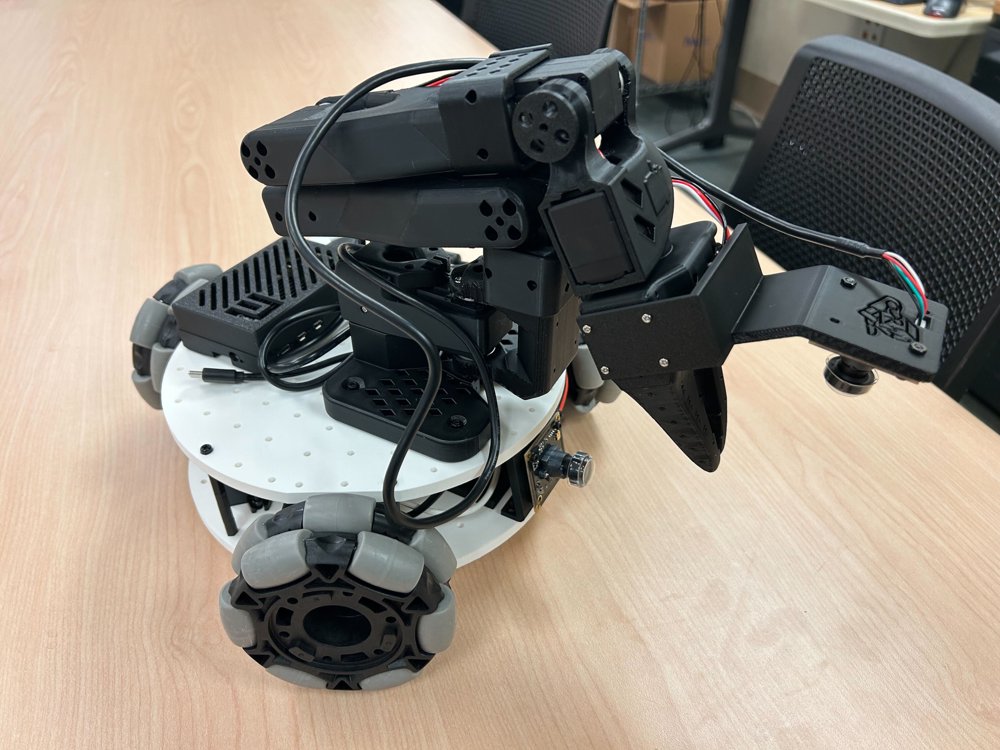
A completed LeKiwi build: an SO-arm-family robot arm and its onboard Raspberry Pi, mounted on the three-wheel omnidirectional base.
SIGRobotics-UIUC, LeKiwi GitHub repository, Apache License 2.0What LeKiwi changed
SO-101 gave LeRobot a cheap, capable robot arm — but a stationary one, bolted to a desk. Whatever task it learned had to be brought to it.
LeKiwi replaced that constraint with a low-cost mobile base:
- A three-wheel "Kiwi" omnidirectional drive built from off-the-shelf 4-inch omni wheels, adding holonomic movement to a stationary SO-100/SO-101 arm
- As little as $184 for a wired, base-only build, or $482–$499 for a complete battery-powered robot with a Raspberry Pi 5 and two cameras, per the project's own bill of materials
- Apache 2.0 licensed hardware and software, folded into Hugging Face's own `lerobot` package as a supported robot type (`--robot.type=lekiwi`)
The result: a mobile-manipulation add-on cheap enough for one university student team to design and build, now installed via the same `lerobot` package as SO-101 and reused in community projects that range from LiDAR-equipped mapping robots to vision-language-action policy research.
01A university robotics club's answer to "now make it move"
LeKiwi began inside SIGRobotics-UIUC, a student robotics organization at the University of Illinois Urbana-Champaign, whose GitHub repository for the project dates to February 2025 — a few months after Hugging Face and TheRobotStudio's SO-100 arm had made 3D-printed robot arms a hobbyist-budget proposition, but while that arm could still only work within reach of wherever it was bolted down. The team's answer was a wheeled base sized to carry the arm and its own onboard compute, reusing the same Feetech STS3215 bus servos already driving the arm to drive the base's wheels too — one part family, one firmware stack, one supply chain.
LeKiwi's own documentation explains where the second half of the name comes from directly: the base is a three-wheel "Kiwi drive," the term roboticists use for a three-omni-wheel holonomic configuration that can move in any direction without turning first. Contributors credited in the project's README span both disciplines — CAD design by Manav Chandaka, Bhargav Chandaka, and Pepijn Kooijmans; software by Pepijn Kooijmans, Gloria Wang, Bhargav Chandaka, and Advait Patel. A week after the team's own announcement, Hugging Face's LeRobot lead, Rémi Cadène, amplified the project on X:
Meet the game-changer: LeKiwi 🥝
— Remi Cadene (@RemiCadene) March 3, 2025
Crafted by @sigrobotics and @huggingface
At 1/10 the cost of the best alternative out there, it's the most accessible mobile base for $300. Easier DIY to automate chords at home!
1/ 🧵 Link and details in thread 👇 pic.twitter.com/VG9GvHvb5y
Rémi Cadène, LeRobot lead at Hugging Face, amplifying LeKiwi on X a week after SIGRobotics-UIUC's own announcement.
02Design: one arm, three wheels, one Raspberry Pi
LeKiwi is deliberately built from parts LeRobot users are already likely to have or source: an SO-100 or SO-101 arm, the same one documented for stationary use, mounted on a 3D-printed turntable above the three-wheel omnidirectional base. The base's three 4-inch omni wheels are driven by the same Feetech STS3215 servos as the arm — the arm's six servos keep motor IDs 1 through 6, and the three wheel servos take IDs 7, 8, and 9, all on one shared motor-control board and serial bus.
Onboard compute is a Raspberry Pi 5 in the reference build, documented as swappable for "any PC that can run on 5V and has enough USB ports." It runs Hugging Face's `lerobot` package and streams camera and joint-position data to a laptop over the network. Two USB RGB cameras cover the workspace and the gripper's own point of view, and builders choose one of three power setups depending on how much lifting torque and mobility range they need.
All of the base's structural parts are 3D-printed in PLA — the project's own guide documents roughly 34 hours of total print time across the base plates, wheel hubs, camera mounts, and Raspberry Pi case — and its assembly guide estimates about two hours to put the printed parts and electronics together. Code and mechanical design are both released under the Apache License 2.0, the same license SO-101 uses.
- Same servo family throughout: the arm's six Feetech STS3215 servos keep motor IDs 1–6, and the base's three wheel servos take IDs 7, 8, and 9, all on one shared motor-control board and serial bus
- Onboard compute is a Raspberry Pi 5 in the reference build, documented as swappable for "any PC that can run on 5V and has enough USB ports"
- Two USB RGB cameras — one covering the workspace, one mounted at the wrist — stream to a laptop over the network alongside joint-position data
- Three power options: a 12V lithium battery for more lifting torque, a 5V USB-C power bank for an easier first build, or a wired, battery-free version that trades mobility range for the lowest price
- Runs Raspberry Pi OS or Ubuntu on the Pi, connected over SSH from a laptop running the same `lerobot` Python package documented for SO-101 — no separate firmware or OS image specific to LeKiwi
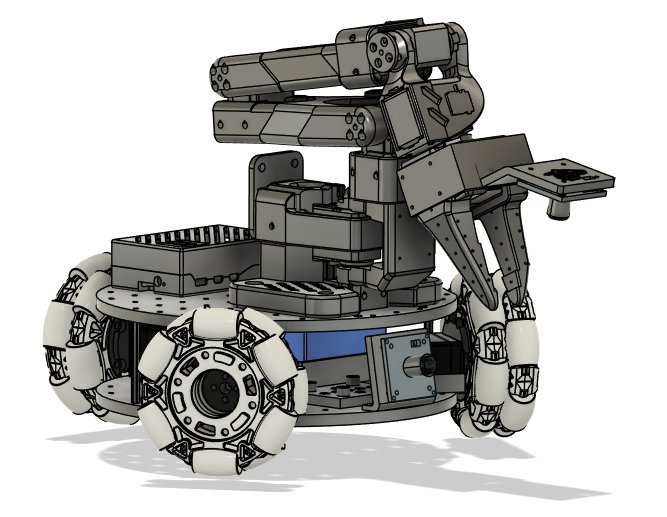
The official LeKiwi v1 CAD design — the arm mounts on a turntable above the three omni-wheel drive.
SIGRobotics-UIUC, LeKiwi GitHub repository, Apache License 2.003What it costs: $184 to $499, plus a growing list of kit vendors
The project's own bill of materials prices five build variants, with 3D-printing filament costed separately in every case. Three "base only" variants exclude the arm entirely: a battery-free wired build runs $184, a 5V power bank pushes that to $248, and a 12V battery to $251.50. Two "full robot" variants add a complete SO-101 teleoperation arm pair to the base, costing $499 with the 5V setup or $482 with the 12V one.
A small number of vendors now sell LeKiwi as a component kit rather than a from-scratch, part-by-part build — though assembling it is still up to the buyer either way. ROBOTIS, the Korean servo maker behind the Dynamixel motors used in LeKiwi's alternate hardware variant, sells a "LeKiwi Bundle" of official hardware components for $530.44, crediting SIGRobotics-UIUC as the original designer; a 3D printer is still needed for the structural parts, or buyers can pay $50 extra for ROBOTIS to print them. Seeed Studio's "LeKiwi Full Kit" goes a step further, bundling pre-printed 3D parts and a battery alongside the electronics.
| Build variant | Cost (US) | Notes |
|---|---|---|
| Base only — wired | $184.00 | No battery, no motorized arm servos |
| Base only — 5V | $248.00 | 20,000mAh USB-C power bank |
| Base only — 12V | $251.50 | 12V 5A lithium battery |
| Full robot — 12V | $482.00 | Base + full SO-101 teleoperation pair |
| Full robot — 5V | $499.00 | Base + full SO-101 teleoperation pair |
ROBOTIS LeKiwi Bundle
A components bundle for the Dynamixel-servo variant of LeKiwi, sold by Korean servo maker ROBOTIS, which credits SIGRobotics-UIUC as the original designer. A 3D printer is still needed for the structural parts, or buyers can pay $50 extra for ROBOTIS to print them.
SourceROBOTIS official store
Seeed Studio LeKiwi Full Kit
A self-assembly kit for the 12V build that goes a step further than ROBOTIS's bundle: the 3D-printed parts and a battery are included pre-made, alongside the electronics, so builders don't need to run a printer themselves.
04Software: a supported robot type, not a bolt-on hack
LeKiwi isn't a community patch bolted onto LeRobot from outside — it's documented as one of the library's own supported robot types. Running `pip install -e ".[lekiwi]"` on both the Raspberry Pi and a laptop pulls in the Feetech SDK and the ZeroMQ networking the split compute setup needs; from there, the same calibration and data-recording CLI tools LeRobot uses for SO-101 — `lerobot-find-port`, `lerobot-setup-motors`, `lerobot-calibrate` — work for LeKiwi by passing `--robot.type=lekiwi`.
Driving the base itself uses a dedicated keyboard scheme layered on top of arm teleoperation: W/A/S/D drives forward, left, back, and right; Z and X turn in place; and R/F step through three preset speeds.
Community builders have taken the design in a few directions since. Foxglove, a robotics-visualization company, documented adding LiDAR-based mapping to a LeKiwi base in February 2026. In June 2026, a researcher publishing on Hugging Face's community blog documented training a vision-language-action policy (SmolVLA) on a LeKiwi paired with Pollen Robotics' PincOpen gripper for mobile pick-and-place tasks, arguing that "a vast amount of impactful physical-world tasks are mobile ... you need to move to the task, rather than it coming to you." As of this writing, LeKiwi has no numbered successor and remains LeRobot's primary reference mobile base — its role in the lineup is to answer "how do I make my arm mobile," the same way SO-101 answers "how do I get a cheap arm at all."
- Fast — 0.4 m/s linear, 90°/s rotation
- Medium — 0.25 m/s linear, 60°/s rotation
- Slow — 0.1 m/s linear, 30°/s rotation
- Foxglove, a robotics-visualization company, documented adding LiDAR-based mapping to a LeKiwi base in February 2026
- A separate ROBOTIS-hardware variant in the same repository swaps in Dynamixel servos and a Koch v1.1 arm for builders already invested in that ecosystem
05Timeline at a glance
| Date | Who | Event |
|---|---|---|
| 2025-02 | SIGRobotics-UIUC | LeKiwi's GitHub repository launches, pairing an SO-100 arm with a 3D-printed, three-wheel omnidirectional base |
| 2025-04-28 | Hugging Face | SO-101 launches; LeKiwi's official docs standardize on it as the recommended arm |
| 2025-06-14 | Hugging Face | LeRobot Worldwide Hackathon — at least one published dataset documents a LeKiwi-based entry |
| 2025-10 | Hugging Face | The `lerobot` CLI adds a dedicated command for launching the LeKiwi host process on the Raspberry Pi |
| 2026-02 | Foxglove | Foxglove documents adding LiDAR-based mapping to a LeKiwi base |
| 2026-06 | Hugging Face community | A community blog post documents training a SmolVLA policy on a LeKiwi paired with a PincOpen gripper for mobile manipulation |
06FAQ
What is LeKiwi?
LeKiwi is an open-source, 3D-printed mobile robot base — a three-wheel omnidirectional "Kiwi drive" — designed to carry a Hugging Face SO-100 or SO-101 robot arm, turning it into a mobile manipulator. It's built by SIGRobotics-UIUC and is a supported robot type in Hugging Face's `lerobot` library.
Who created it, and when?
SIGRobotics-UIUC, a student robotics group at the University of Illinois Urbana-Champaign, published LeKiwi's GitHub repository in February 2025.
How much does LeKiwi cost?
Per the project's own bill of materials, a wired, battery-free base costs $184 to build; a complete robot with a full SO-101 arm pair, battery, Raspberry Pi 5, and two cameras runs $482–$499. Self-assembly kits from vendors like ROBOTIS ($530.44) and Seeed Studio are also available, though a 3D printer (or an extra fee for pre-printed parts) is still needed in both cases.
What robot arm does LeKiwi use?
LeKiwi is designed around Hugging Face's SO-arm family — originally the SO-100, with official docs now standardized on the newer SO-101 as the recommended arm.
Is LeKiwi officially part of the LeRobot library?
Yes. LeKiwi is documented as a supported robot type in Hugging Face's `lerobot` Python package, with its own installation extra (`pip install -e ".[lekiwi]"`), dedicated CLI commands, and official setup guide.
07Sources
01. A university robotics club's answer to "now make it move"
02. Design: one arm, three wheels, one Raspberry Pi
03. What it costs: $184 to $499, plus a growing list of kit vendors
04. Software: a supported robot type, not a bolt-on hack
Related articles
Articles
Company & Market Data
Projects
All Projects articles →Projects
- ›The History of LeRobot
- ›SO-101
- ›LeKiwi(this article)
- ›Amazing Hand
- ›Open Duck Mini
- ›OpenArm