Projects
OpenArm
What OpenArm is
Robot-learning research has a hardware problem: even when two labs publish the same benchmark, they're rarely running it on the same arm, in the same lighting, at the same camera angle — so "Model A beats Model B" claims are hard to actually check. OpenArm's pitch is to remove that variable entirely.
The core of the platform:
- 7 DOF per arm (16 DOF across the bimanual system with grippers), QDD backdrivable Damiao motors, 606mm reach and 5.5kg per arm, 6.0kg peak payload — $6,500 for a complete bimanual system
- Fully open-source: Apache 2.0 for every software repository, CERN-OHL-S-2.0 for the mechanical CAD
- OpenArm 2.0 adds OpenArm Cell (a standardized evaluation booth) and OpenArm KER (a motorless wearable teleoperation arm), and OpenArm itself is now natively supported in Hugging Face's LeRobot
The result: a bimanual research arm cheap enough for an individual lab to buy outright, backed by a company whose own commercial roadmap — a care-facility humanoid called Ena — depends on the same physical-AI research OpenArm is meant to accelerate.
01Where it came from: a voice-AI lab pivots to robotics
OpenArm's roots trace back to Reazon Holdings' in-house R&D division, the Human Interaction Lab, which spent its early years building Japanese speech-recognition models rather than robots. As the lab's research focus shifted toward robotics, Reazon spun that work out into a dedicated subsidiary — Enactic, Inc. — founded in Tokyo on July 23, 2025, under co-founder and CEO Hiroto Yamamoto.
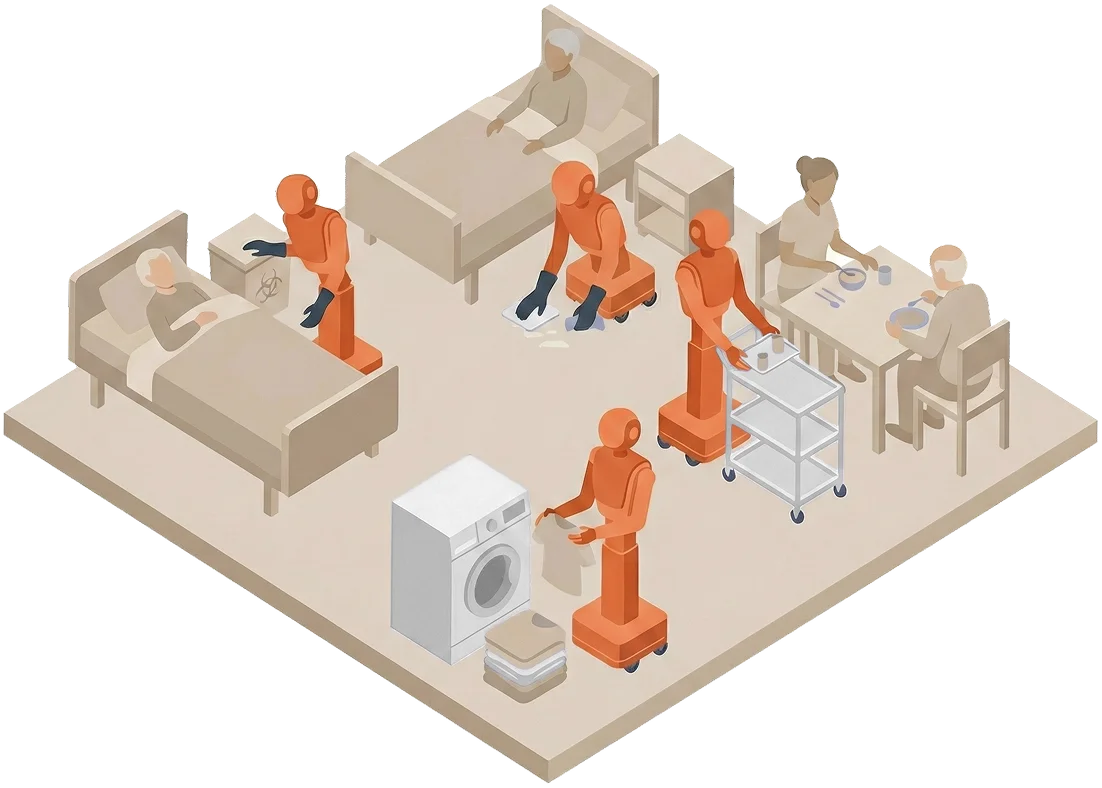
Enactic's own illustration of Ena's target tasks inside a care facility — resident monitoring, cleaning, laundry, and meal service.
Illustration: Enactic, Inc. (enactic.ai)Enactic's own long-term product is Ena, a humanoid robot aimed at Japan's caregiving-labor shortage, targeted for a late-2026 launch. In care facilities, it's meant to:
- Folding laundry
- Collecting meal trays
- Tidying resident rooms
- Monitoring resident wellbeing
But before Ena, the company needed real-world manipulation data and a hardware platform other researchers could reproduce on. OpenArm's first release, v0.1, had already shipped quietly as a beta in February 2025; the full public launch — alongside Enactic's own announcement — followed on July 23, 2025, with an unveiling event two days later.
"We've finally released OpenArm 01 🦾🎉 A fully open-source bimanual robot arm built for physical AI. Go check it out."
We’ve finally released 𝐎𝐩𝐞𝐧𝐀𝐫𝐦 𝟎𝟏 🦾🎉
— Hiroto Yamamoto | 山本 泰豊 (@hiro_yams) July 25, 2025
A fully open-source bimanual robot arm built for physical AI.
Go check it out at https://t.co/6ld59pRqzA#OpenSource #Robotics #Humanoid #PhysicalAI https://t.co/vy6fx75zeN
Hiroto Yamamoto's original announcement post on X, July 25, 2025 — the full, unedited text (the Pullquote above trims the hashtags for readability).
02Design: a research-grade arm meant to be rebuilt exactly
Hardware design
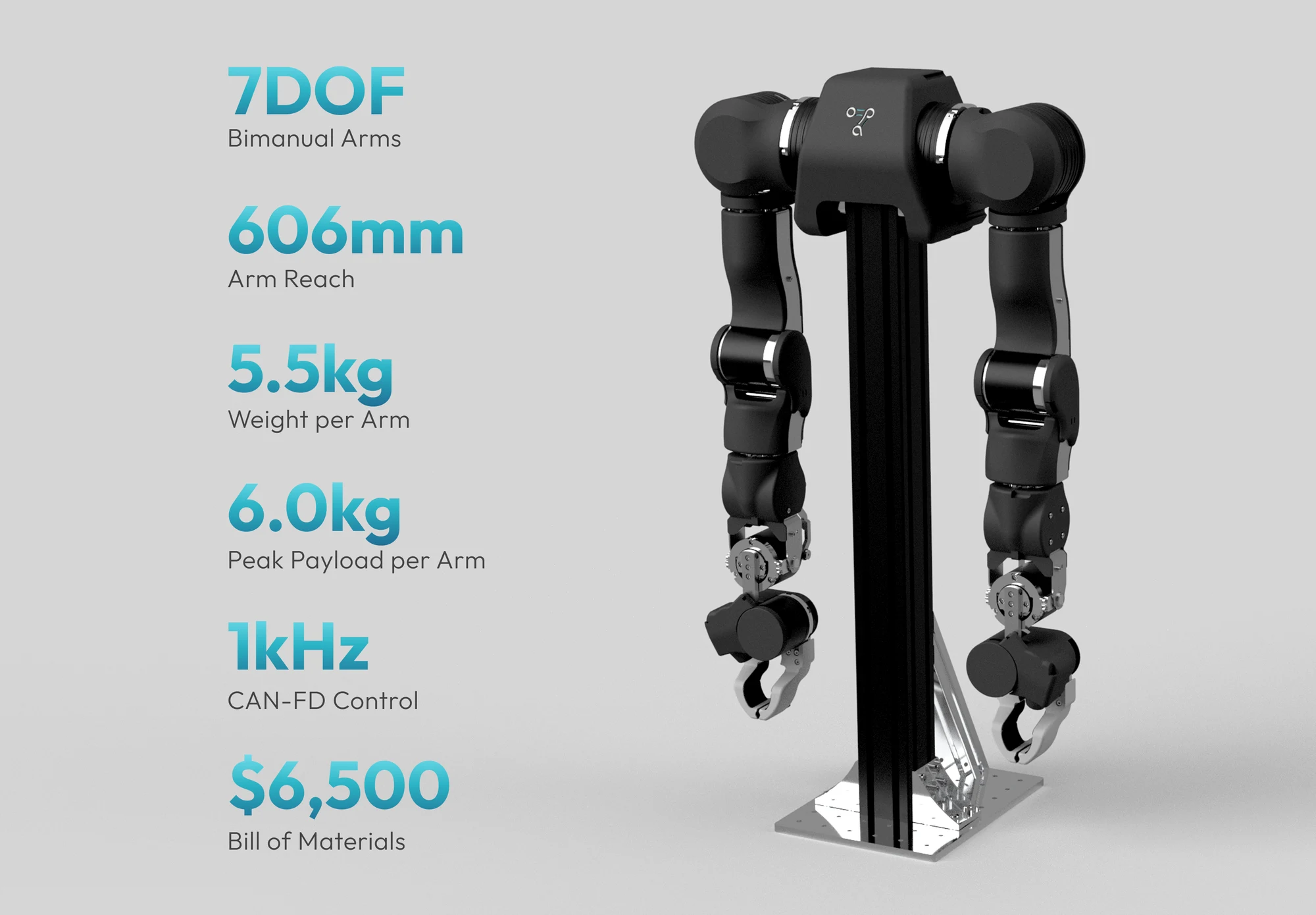
OpenArm 2.0's official spec sheet, rendered alongside the assembled bimanual arm on its MISUMI aluminum-frame stand.
Enactic, Inc., OpenArm GitHub repository (website assets), Apache License 2.0OpenArm's design brief is different from a hobbyist arm like SO-101: it targets labs that need heavier real-world manipulation and true bimanual coordination, not a $100 entry point.
Every joint on both arms runs on a Damiao QDD motor, chosen for the same reason many low-cost legged robots use it — backdrivability that keeps the arm safe to work near, without sacrificing payload.
That combination of compliance and strength is engineered joint by joint:
- Human-scale proportions, designed for a person roughly 160–165cm tall; aluminum and stainless-steel structural components on a modular MISUMI aluminum-extrusion frame
- Every joint uses a Damiao QDD motor: DM8009 for the two shoulder joints, DM4340 for shoulder rotation and elbow flex, DM4310 for the three wrist joints and the gripper
- Payload figures include whatever end-effector is attached — nominal 4.1kg (held for 1 minute in a fully extended posture), peak 6.0kg (moved over 3 seconds, held for 1 second)
- OpenArm 2.0's redesigned end-effector is a compact 2-finger parallel gripper with an integrated in-hand camera and swappable fingers
Software
The software side is documented as thoroughly as the hardware, spanning motion planning, simulation, teleoperation, and dataset tooling:
- Native ROS2 packages (`openarm_ros2`) with MoveIt2 motion-planning support for the physical bimanual hardware, plus simulation environments for NVIDIA Isaac Lab and MuJoCo
- Dedicated teleoperation (`openarm_teleop`, unilateral and bilateral force-feedback control) and dataset-recording (`openarm_dataset`) packages, plus Dora dataflow nodes (`dora-openarm`) including a WebXR/Meta Quest 3 VR teleoperation path
- CAN-FD control implemented on STM32 microcontrollers, at a 1kHz control loop (1Mbps nominal bitrate, 5Mbps data bitrate) — officially documented on Linux only, with no macOS/Windows driver for the CAN-bus USB adapter
- NVIDIA's Isaac GR00T N1 foundation model was deployed on physical OpenArm hardware as of the v0.3 release (May 2025), per the project's own release notes
Licensing
Licensing follows the same split as most open-hardware projects: permissive for the code, more restrictive for the physical design.
Software — every repository but one
`openarm_description` (URDF/xacro), `openarm_can`, `openarm_ros2`, `openarm_teleop`, `openarm_isaac_lab`, `openarm_mujoco`, `openarm_dataset`, and `dora-openarm` are all licensed Apache-2.0.
Mechanical CAD — openarm_hardware
The complete CAD data — STL files, STEP files, and Fusion 360 assemblies — is licensed under CERN-OHL-S-2.0, a strongly reciprocal open-hardware license that requires derivative hardware designs to stay open.
03Where it's landed: a launch, a vendor scramble, and an enterprise adopter
Vendors and certification
OpenArm's manufacturing ecosystem grew fast enough to get ahead of the project itself. By October 2025, multiple third-party manufacturers were already selling arms at very different price points and quality levels, prompting the OpenArm team to post a public notice that it had "not officially certified any vendors yet" and to warn against vendors falsely claiming official status.
That gap has since closed: the project's purchase page now runs a three-tier system — a "Certified" manufacturer (WowRobo, in Shenzhen), a Japan-based official supplier working by quotation (RT Corporation, in Tokyo), and a longer list of "Evaluating" and "Not Evaluated" vendors at varying prices.
WowRobo — Certified ★★★
The project's sole "Certified" manufacturer (Shenzhen). OpenArm 2.0 bimanual system $6,500, prior-generation OpenArm V1.1 $5,400, OpenArm Cell $6,200, OpenArm KER $2,599. Worldwide shipping, 20–40 day lead time.
RT Corporation — official JP supplier
Tokyo-based official supplier for OpenArm 2.0 Leader/Follower, Cell, and upgrade kits. Pricing by quotation; includes setup and testing, a JP-spec AC adapter, and an optional 1-year warranty.
"Evaluating" tier — VLAI, Cereboto, Anvil, and others
A longer list of manufacturers across Shenzhen, Dongguan, Taipei, and Hangzhou, not yet certified, with prices and lead times that vary widely by vendor — the price spread the October 2025 vendor-confusion notice was meant to address.
Enterprise adoption
The clearest sign OpenArm has moved beyond a hobbyist audience came in May 2026, when ACCESS Corporation — a listed Tokyo software company — published a technical column describing its own adoption of a bimanual OpenArm set for physical-AI research: leader-follower teleoperation, imitation-learning dataset collection, and simulation, framed as "step one" toward its own sim-to-real research roadmap.
Separately, drone manufacturer FoxTech began selling "Agility A1," a lower-cost derivative arm ($3,580–$5,800) explicitly built on the OpenArm platform — evidence that the open hardware license is already being used as intended, by outside companies building their own products on top of it.
04Where it fits: turning an arm into a reproducible research loop
OpenArm Cell and OpenArm KER
OpenArm 2.0, which arrived in May 2026, reframes the project around the same idea that motivated it from the start: for physical-AI benchmarks to mean anything, the hardware and the evaluation conditions both need to be identical across labs. Alongside the redesigned arm, two companion products complete that loop.
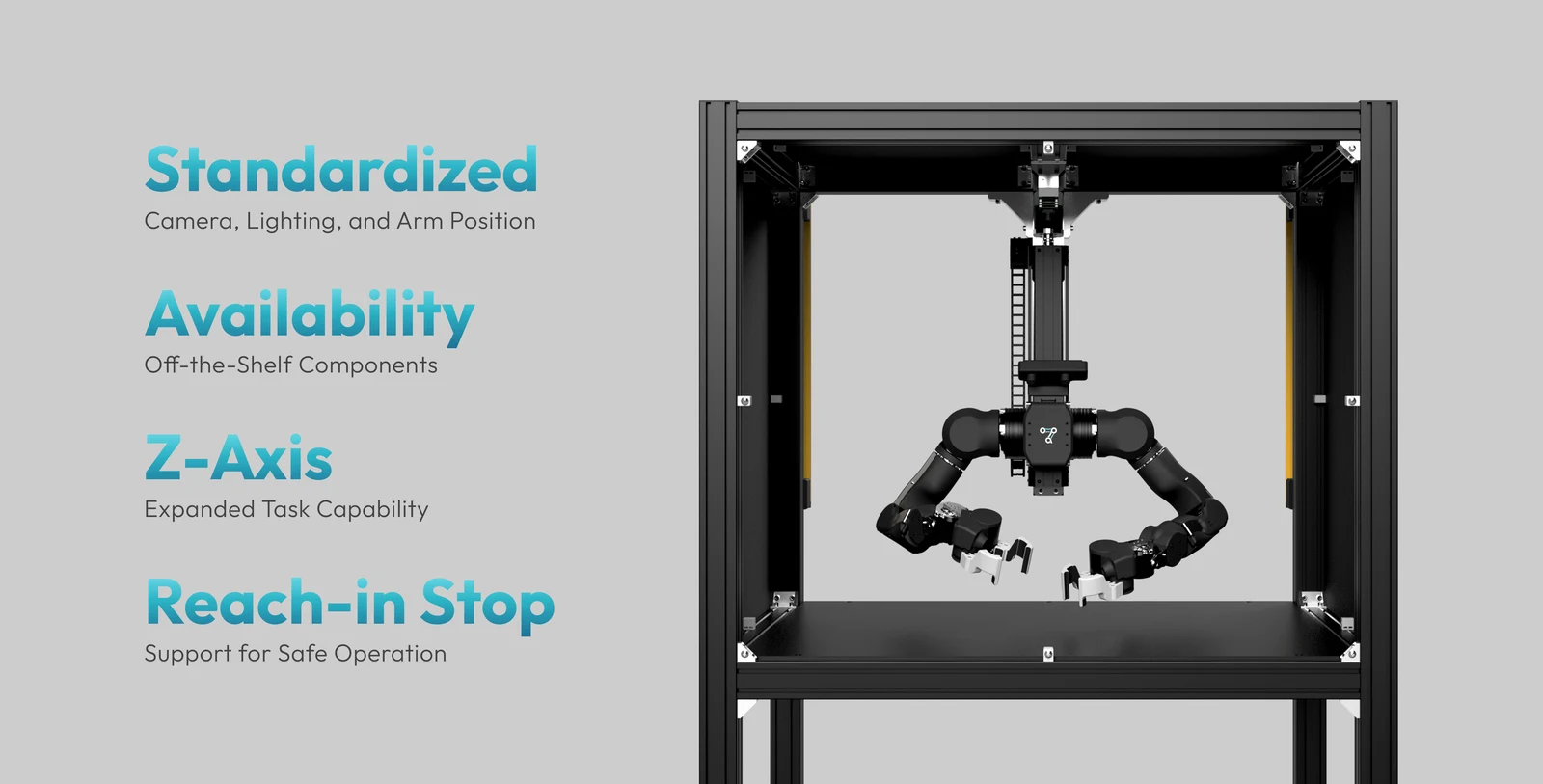
OpenArm Cell: fixed lighting, camera placement, and arm position, with a Z-axis lift and a light-curtain reach-in stop.
Enactic, Inc., OpenArm GitHub repository (website assets), Apache License 2.0OpenArm Cell is a standardized evaluation booth — fixed lighting, camera placement, and arm position, plus a Z-axis lift and a light-curtain reach-in stop for safety — meant to let different research teams run the same automated benchmark under identical physical conditions.
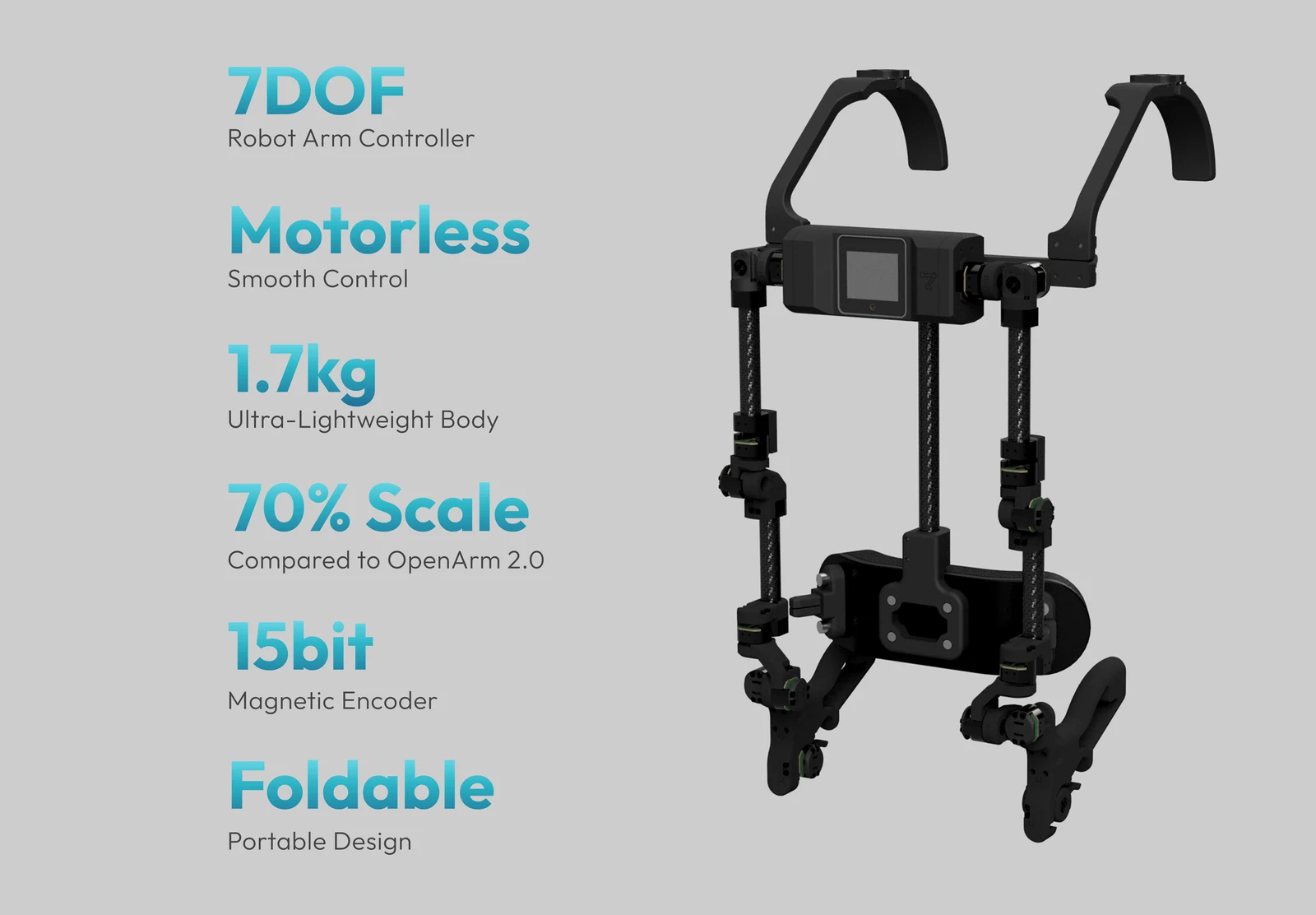
OpenArm KER: a 1.7kg, motorless, shoulder-worn leader arm at 70% of OpenArm 2.0's scale, using magnetic encoders instead of motors.
Enactic, Inc., OpenArm GitHub repository (website assets), Apache License 2.0OpenArm KER (Kinematic Equivalent Replica) is a motorless, 1.7kg wearable leader arm at 70% of OpenArm 2.0's scale, using 15-bit magnetic encoders instead of motors for low-fatigue teleoperation during long data-collection sessions; it shipped as KER v0.2.0 on June 26, 2026.
LeRobot integration
OpenArm's software ecosystem also gained a significant new door in March 2026, when Hugging Face's LeRobot library added native support for OpenArm — both as a follower robot and as a leader, in single-arm and bimanual configurations — in its v0.5.0 release.
That same release introduced a separate, lower-cost teleoperator called "OpenArm Mini," built around cheaper Feetech bus servos rather than OpenArm's own Damiao motors — a second, less expensive path into OpenArm teleoperation distinct from Enactic's own KER hardware.
Between the official LeRobot integration and the NVIDIA Isaac Lab and MuJoCo simulation packages the project ships itself, OpenArm has become one of a small number of open-source arms with a documented path from teleoperated data collection straight through to policy training.
OpenArm 2.0's data-collection loop
A researcher wears the motorless KER leader arm to control OpenArm 2.0 remotely, demonstrating a task.
The same fixed lighting, camera angle, and arm position every time, so the recorded data stays comparable across labs.
The standardized dataset feeds straight into OpenArm's own simulation packages or Hugging Face's LeRobot.
05Timeline at a glance
| Date | Partner | Event |
|---|---|---|
| ~2021 | Reazon Holdings | Human Interaction Lab founded as an R&D division, initially focused on speech recognition |
| 2025-02-19 | OpenArm | v0.1, first public (beta) release |
| 2025-07-23 | Enactic | Enactic, Inc. founded; OpenArm 01 formally launched |
| 2025-10-31 | OpenArm | "OpenArm 01: Release No.2" (v1.1) — reliability fixes, official purchase page introduced |
| 2026-03-09 | Hugging Face | LeRobot v0.5.0 adds native OpenArm support and the "OpenArm Mini" teleoperator |
| 2026-05 | Enactic | OpenArm 2.0 launches with a redesigned gripper, OpenArm Cell, and OpenArm KER |
| 2026-05-22 | ACCESS Corporation | Publishes a technical column on adopting OpenArm for its own physical-AI research |
| 2026-06-26 | OpenArm KER | v0.2.0 ships |
06FAQ
What is OpenArm?
OpenArm is a fully open-source, 7-degrees-of-freedom-per-arm bimanual humanoid arm from Enactic, Inc., a Tokyo robotics company. It's built for physical-AI research and contact-rich manipulation, priced from $6,500 for a complete bimanual system, and licensed under Apache 2.0 (software) and CERN-OHL-S-2.0 (mechanical CAD).
Who makes it, and when did it launch?
Enactic, Inc. — a Tokyo subsidiary of Reazon Holdings founded on July 23, 2025 by CEO Hiroto Yamamoto, spun out of Reazon's speech-AI-turned-robotics research division. OpenArm's first beta release shipped in February 2025, with the formal public launch on July 23, 2025, and a larger "OpenArm 2.0" system arriving in May 2026.
How much does it cost, and what license is it under?
The certified manufacturer WowRobo sells a complete OpenArm 2.0 bimanual system for $6,500, OpenArm Cell (the evaluation booth) for $6,200, and OpenArm KER (the teleoperation leader arm) for $2,599. All software is Apache 2.0; the mechanical CAD is CERN-OHL-S-2.0.
Does OpenArm work with LeRobot or other robot-learning software?
Yes. Hugging Face's LeRobot library added native OpenArm support (follower and leader, single-arm and bimanual) in its v0.5.0 release (March 2026). OpenArm also ships its own official packages for ROS2/MoveIt2, NVIDIA Isaac Lab, and MuJoCo, and the project reports deploying NVIDIA's Isaac GR00T N1 foundation model on physical hardware as of its v0.3 release.
What are OpenArm Cell and OpenArm KER?
They're OpenArm 2.0's two companion products. OpenArm Cell is a standardized evaluation booth — fixed lighting, camera placement, and arm position — meant to make benchmark results reproducible across different labs. OpenArm KER (Kinematic Equivalent Replica) is a motorless, 1.7kg wearable leader arm at 70% of OpenArm 2.0's scale, using magnetic encoders instead of motors for lower-fatigue teleoperation.
07Sources
01. Where it came from: a voice-AI lab pivots to robotics
02. Design: a research-grade arm meant to be rebuilt exactly
03. Where it's landed: a launch, a vendor scramble, and an enterprise adopter
04. Where it fits: turning an arm into a reproducible research loop
Related articles
Articles
Company & Market Data
Projects
All Projects articles →Projects
- ›The History of LeRobot
- ›SO-101
- ›LeKiwi
- ›Amazing Hand
- ›Open Duck Mini
- ›OpenArm(this article)