History
From Robot Dogs to Humanoids
01The balance problem
Long before anyone was trying to build a useful humanoid, the hardest open problem in legged robotics was simpler: how does a machine with legs not fall over on rough ground? Boston Dynamics — spun out of Marc Raibert's MIT Leg Laboratory in 1992 — took on that question with BigDog, a DARPA-funded quadruped that began development around 2002 and was demonstrated publicly from 2005. Powered by a 15-horsepower gas engine driving hydraulic actuators, BigDog could carry over 150 kilograms of gear across mud, snow, and 35-degree slopes, using an onboard control system that read joint force, ground contact, and gyroscope data to actively recover its footing when it slipped — a capability no wheeled robot needed and no prior legged robot had demonstrated outside a lab.
DARPA didn't stop at one robot. Its "Learning Locomotion" program, run from roughly 2005 to 2009, built a smaller, cheaper quadruped called LittleDog and distributed about a dozen identical units, plus a shared motion-capture rig, to six competing university teams — including groups at MIT and Carnegie Mellon — specifically to develop and compare algorithms for learning rough-terrain locomotion, rather than hand-coding it. That's a detail worth sitting with: a common hardware platform built expressly so multiple labs could compare learned control strategies is a direct academic precursor to the reinforcement-learning locomotion research that would define the 2019–2022 period, a decade before the term "sim-to-real" was common vocabulary.
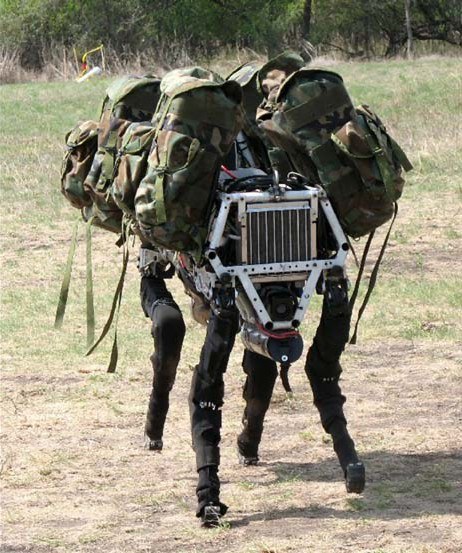
BigDog, photographed for DARPA's own 2007 strategic plan document — the same dynamic-balance problem every legged robot, quadruped or humanoid, still has to solve.
Photo: DARPA, public domain02The actuator problem
BigDog solved balance with brute hydraulic force. A separate lab took a different route to a harder version of the same problem: how do you build a leg that can sense and control the force at its foot directly, without a heavy gearbox or an expensive torque sensor getting in the way? MIT's Biomimetics Lab, led by Sangbae Kim, answered with what its own papers call "proprioceptive actuation" — custom electric motors with a low gear ratio, back-drivable enough that the motor's own current reveals the force at the joint. The approach let MIT's Cheetah 2 run and jump untethered outdoors in September 2014, Cheetah 3 blind-climb stairs and rubble in 2018, and the scaled-down Mini Cheetah become, in March 2019, the first four-legged robot on record to land a backflip.
That actuator design didn't stay four-legged for long. In 2021, MIT unveiled its own humanoid, and its own paper on the robot states plainly that the humanoid's arm and leg actuators are "based on the design of the actuators originally developed for the MIT Mini Cheetah," modified for higher torque — one of the cleanest, single-institution, paper-documented cases anywhere in robotics of an actuator engineered for a quadruped being carried over, largely intact, to power a biped. It's the same category of hardware covered in more depth in our explainer on humanoid actuators, which walks through how this actuator class differs from the older, torque-sensor-heavy designs it replaced.
MIT's official 2019 video of the Mini Cheetah's backflip — the first four-legged robot known to have landed one. Its actuators were later scaled up and reused, largely unchanged in design, for MIT's own humanoid.
03The simulation problem
Solving balance and building the right actuator still leaves a third problem: writing the control software. For decades that meant engineers hand-tuning control equations for each new robot and each new terrain. That started to change with ANYmal, a quadruped built by ETH Zurich spin-off ANYbotics. In a 2019 Science Robotics paper, ETH's Robotic Systems Lab trained a neural-network control policy almost entirely in simulation — the key trick being an "actuator network," a learned model of ANYmal's real, imperfect motors inserted into the simulator to close the gap between simulated and real-world physics — then deployed it directly onto the physical robot, where it out-ran and out-recovered every hand-tuned controller that came before it.
The same lab's 2021 follow-up, "Learning to Walk in Minutes," pushed the idea further: by simulating thousands of ANYmal copies in parallel on a single GPU rather than one robot at a time on a CPU, they cut training time on flat ground from days to under four minutes, and open-sourced the training code as legged_gym. Two of that paper's authors, Nikita Rudin and David Hoeller, then co-authored NVIDIA's Isaac Gym — a general-purpose version of the same massively-parallel GPU simulation trick, released the same year and demonstrated, again, first on ANYmal.
Isaac Gym's successor, Isaac Lab, now trains quadrupeds and humanoids side by side in the same framework, using the same reinforcement-learning libraries, and NVIDIA names Boston Dynamics, Fourier, 1X, and other humanoid makers among the companies using it. The clearest single proof this pipeline crossed over from four legs to two, though, is Unitree's own: its public repository for training its H1 and G1 humanoids to walk credits legged_gym as "the foundation for training and running codes" — the same tool ETH built for a quadruped, reused, acknowledged in writing, for a biped. Our explainer on Sim2Real covers how this simulate-first, deploy-later approach differs from the classical control it replaced.
04Unitree's path
Unitree spent seven years as a robot-dog company before it built a single humanoid. The Laikago launched in 2017 at roughly $20,000–30,000; each generation after it — AlienGo (2019), A1 (2020, under $10,000), Go1 (2021, from $2,700), Go2 (2023, from $1,600) — cut the price further while adding capability, a decline of roughly 94–96% over six years, according to the industry-research newsletter SemiAnalysis. That cost-down manufacturing base — in-house motors, gearboxes, and control electronics built to hit a consumer price point — is what the company and outside analysts alike credit for Unitree's ability to build the H1, its first humanoid, with a reported team of three engineers in about six months in 2023.
Founder Wang Xingxing hasn't framed it as literal component reuse so much as accumulated capability: asked about the strength of Unitree's hardware, he told Geekpark it came mainly from "over a decade of accumulated cognition and experience across both hardware and software." Geekpark's own reporting is more direct about the mechanism, describing the H1 as resting on "years of accumulated quadruped robot-dog technology," on the premise that the underlying engineering of bipedal and quadrupedal robots overlaps. Business outlet 36Kr reports a similar throughline on the manufacturing side: Unitree makes more than 95% of its components in-house, which it says cut its per-unit cost roughly in half between 2022 and early 2025 — the same vertical-integration strategy, applied to a new body plan.
Unitree quadruped price decline
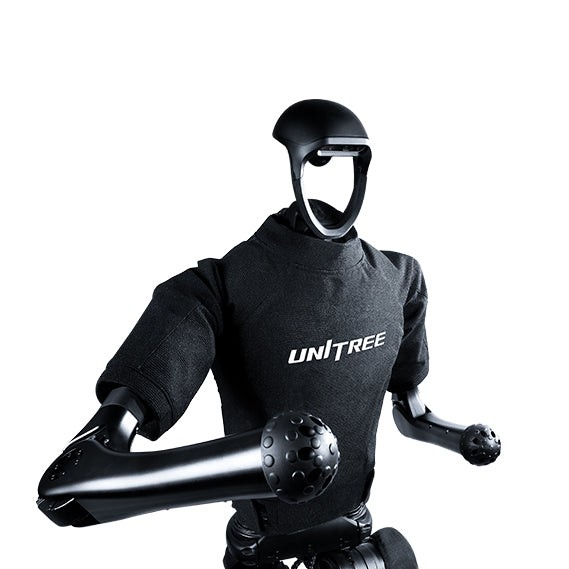
Unitree's H1 — reportedly built by a team of three engineers in about six months, a pace the company and outside analysts alike attribute to years of prior quadruped hardware and manufacturing work, not a from-scratch humanoid program.
Photo: Unitree Robotics, official product photo05Boston Dynamics' path
Atlas and Spot are Boston Dynamics' two most famous robots, and for most of their history they looked like separate projects: Atlas, a hydraulic humanoid built from 2013 for the DARPA Robotics Challenge (created in response to the Fukushima disaster, to test robots that could operate in environments too dangerous for people); Spot, an electric quadruped unveiled in 2016, leased to select early-access customers from around mid-2019, and — starting in June 2020 — Boston Dynamics' first robot sold directly to the public, at $74,500. But the company has been explicit that they share more than a logo. "Atlas's controller is a model-predictive controller (MPC)," Boston Dynamics wrote in a 2023 blog post, describing a control approach — predicting how the robot's dynamics will evolve and continuously re-solving for the best next move — that traces directly back to the same control lineage used on Spot; a 2024 follow-up post describes extending that framework to account for "the momentum of every link in the robot" during manipulation tasks.
The clearest link came with hardware, not just software. In April 2024, Boston Dynamics retired the hydraulic Atlas entirely and unveiled an all-electric successor — swapping in the same electric-actuation approach Spot had already proven viable at commercial scale for nearly four years. The company's own retrospective on the transition put it plainly: "Our journey with Atlas mirrors our journey with the Spot robot... from prototypes to pilots to scaled deployments."
Spot vs. Atlas, side by side
Electric, commercial
Boston Dynamics' first robot sold directly to the public — $74,500 at launch, electric actuation throughout.
Hydraulic research robot → electric humanoid
Started hydraulic, built for the DARPA Robotics Challenge; retired that platform in 2024 for an all-electric redesign the company says retraces Spot's own path to market.
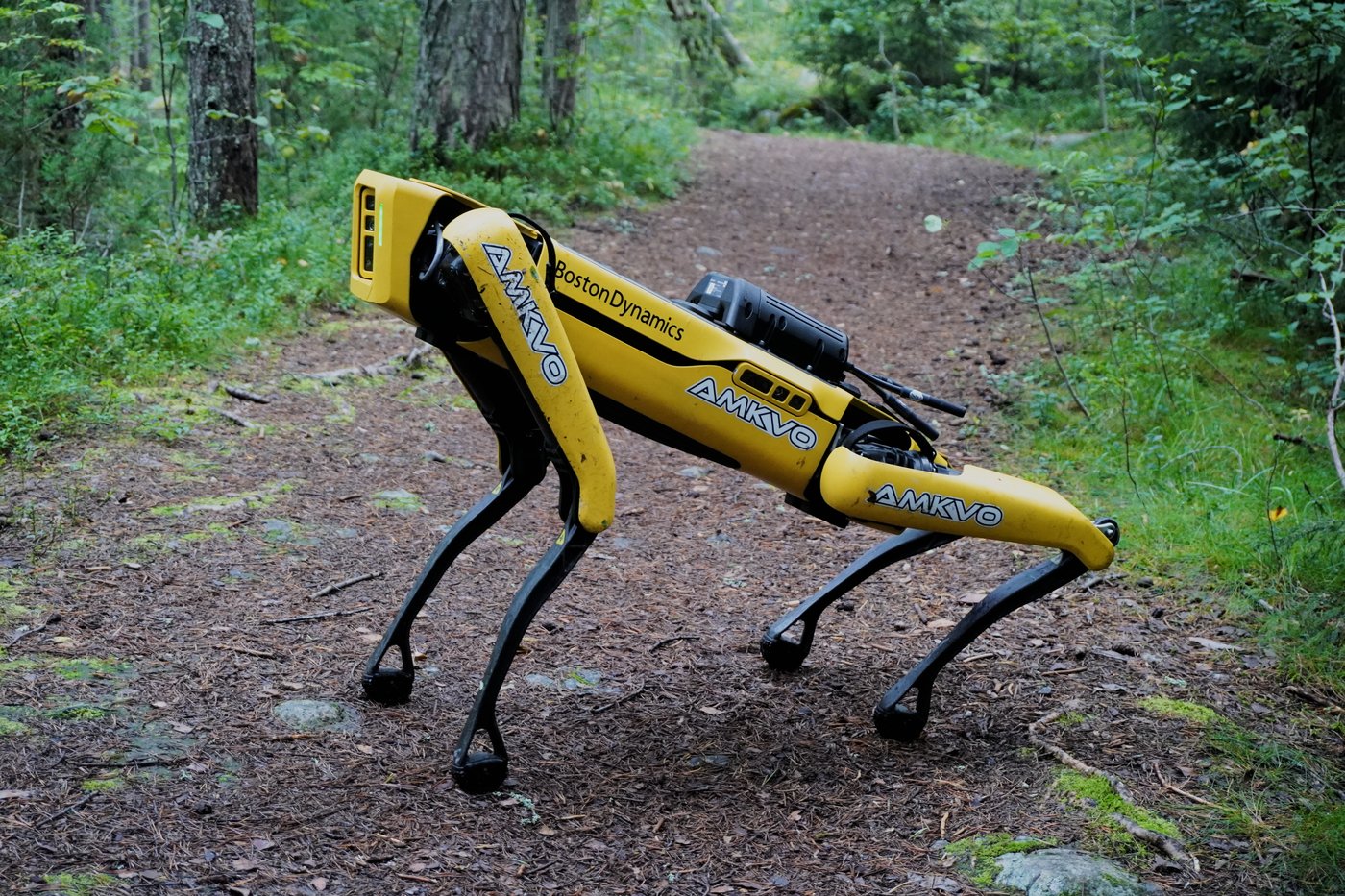
Spot on a forest trail — the electric-actuation, commercially sold quadruped that Boston Dynamics later said its all-electric Atlas humanoid "mirrors" in its own path to market.
Photo: Jonte, CC BY-SA 4.0, via Wikimedia CommonsBoston Dynamics' official 2024 reveal of the all-electric Atlas — the same electric-actuation approach the company had already proven commercially on Spot since 2020.
06Three threads converge
Pull back, and what looks like one humanoid story is really three separate engineering problems — actuators, control software, and simulation — each solved first on a four-legged robot, years before any of them were needed on a two-legged one. MIT solved the actuator problem on the Cheetah line, then reused the design almost unchanged for its own humanoid. Boston Dynamics and ETH Zurich's academic lineage solved the control-software problem on BigDog and ANYmal, and Boston Dynamics has said its humanoid's commercialization path retraces the one it walked with Spot. NVIDIA and ETH solved the simulation problem on ANYmal, and Unitree's own humanoid training code says, in writing, that it's built on that same quadruped-era tooling.
Actuators
- 2017US
MIT's proprioceptive actuator paper (Cheetah)
- 2019US
Mini Cheetah lands the first quadruped backflip
- 2021US
MIT's own humanoid reuses the Mini Cheetah's actuator design
Control systems
- 2005US
BigDog demonstrates dynamic balance on rough terrain
- 2013US
Atlas built for the DARPA Robotics Challenge
- 2023US
Boston Dynamics confirms Atlas runs the same MPC lineage as Spot
Simulation & RL
- 2019CH
ANYmal's sim-to-real RL paper (Science Robotics)
- 2021US/CH
NVIDIA's Isaac Gym, co-authored by ANYmal's own RL team
- 2024CN
Unitree's H1/G1 RL training credits ETH's quadruped tooling
Humanoid robots inherit all three threads — actuators, control, and simulation — from a decade of quadruped research
07The case against the throughline
That throughline is real, but it isn't the whole story, and several credible researchers argue it isn't even the main one. Bob McGrew, OpenAI's former chief research officer, put the counter-argument bluntly: "Manipulation is the hard problem we need to solve to make humanoid robots useful, not locomotion." Reporting in Quanta Magazine backs that framing with specifics from researchers with no stake in the quadruped narrative — MIT's Pulkit Agrawal argues force control in manipulation, not walking, is where robots still fall short of "mastering physics"; former Boston Dynamics researcher Scott Kuindersma says force-aware control, not position control, is "absolutely required" for a useful humanoid; and Google DeepMind's Carolina Parada points out that humans feel resistance when opening a bottle in a way no current humanoid hand does. None of that is a locomotion problem, and none of it was solved by any quadruped described above.
It's also worth being precise about what quadrupeds actually originated versus what they refined. Bipedal balance control has its own, older, largely separate lineage — Honda's ASIMO program ran from 1986 to a public unveiling in 2000, using hand-tuned zero-moment-point control worked out well before BigDog existed, a history our history of the robot industry covers in full. What quadruped research specifically supplied to later humanoids wasn't the basic idea of a walking legged robot — Honda, Waseda, and others got there independently — but a specific, verifiable toolkit: actuator designs, reinforcement-learning training pipelines, and a cost-down manufacturing base, each demonstrably reused rather than reinvented.
And some of the field's most senior voices doubt the current humanoid wave holds up at all. Roboticist Rodney Brooks, co-founder of iRobot and a former MIT robotics lab director, has called much of the industry's demo footage "humanoid theater" and dismissed the strategy of teaching robots dexterity from videos of humans as "pure fantasy thinking," arguing that today's investment funds "expensive training experiments that will never scale" — and predicting that whatever robots succeed commercially in 15 years may not look much like a person at all.
08Where this goes next
None of this settles whether legged locomotion was the bottleneck humanoid robots needed solved, or a convenient toolkit that happened to be lying around when investors decided humanoids were the next AI platform. What's verifiable is narrower and more useful: specific actuators, specific control frameworks, and specific simulation pipelines were built and proven on four-legged robots first, then carried — sometimes by the same engineers, sometimes just the same open-source code — onto two-legged ones. Whether that borrowed toolkit turns out to have been necessary, or merely available, is a question the next few years of humanoid deployments, not more demo videos, will have to answer.
09Timeline at a glance
| Year | Region | Event |
|---|---|---|
| 2002–2005 | US | Boston Dynamics develops and publicly demonstrates BigDog (DARPA-funded) |
| 2005–2009 | US | DARPA's "Learning Locomotion" program distributes LittleDog quadrupeds to six university teams |
| 2013 | US | Atlas humanoid unveiled for the DARPA Robotics Challenge, post-Fukushima |
| 2014 | US | MIT Cheetah 2 runs and jumps untethered outdoors |
| 2016 | US | Boston Dynamics unveils Spot |
| 2017 | CN | Unitree launches the Laikago, its first quadruped |
| 2018 | US | MIT Cheetah 3 blind-climbs stairs and rubble |
| Jan 2019 | CH | Hwangbo et al. publish ANYmal's sim-to-real RL paper in Science Robotics |
| Mar 2019 | US | Mini Cheetah becomes the first four-legged robot on record to backflip |
| 2020 | CN | Unitree launches the A1 quadruped, under $10,000 |
| Jun 2020 | US | Spot becomes Boston Dynamics' first robot sold directly to the public ($74,500) |
| 2021 | US | MIT unveils its own humanoid, reusing the Mini Cheetah's actuator design |
| 2021 | CH | ETH's "Learning to Walk in Minutes" trains ANYmal via massively parallel sim, open-sourced as legged_gym |
| 2021 | US | NVIDIA releases Isaac Gym, co-authored by two of the legged_gym researchers |
| 2021 | CN | Unitree launches the Go1 quadruped, from $2,700 |
| 2023 | CN | Unitree launches the H1, its first humanoid, reportedly built by 3 engineers in ~6 months |
| 2023 | CN | Unitree launches the Go2 quadruped, from $1,600 |
| Aug 2023 | US | Boston Dynamics blog confirms Atlas runs the same MPC control lineage as Spot |
| Apr 2024 | US | Boston Dynamics retires hydraulic Atlas, unveils an all-electric successor |
| May 2024 | CN | Unitree unveils the G1 humanoid at $16,000 |
| 2024 | Global | NVIDIA's Isaac Lab begins training Unitree, Boston Dynamics, Fourier, and other humanoids alongside quadrupeds in one framework |
10FAQ
Do humanoid robots literally reuse parts from quadruped robots?
Not usually identical parts, but often the same design lineage and, in some cases, the same manufacturing base. MIT's own humanoid explicitly reused its Mini Cheetah actuator design, scaled up for higher torque, and Unitree's humanoid actuators descend from the same in-house motor program that built its quadrupeds — though the H1/G1's higher-torque units aren't the identical components used in the Go-series.
Is Boston Dynamics' Atlas built on Spot's technology?
They share a control paradigm — model-predictive control — that Boston Dynamics has described using nearly identical language for both robots, and the company has explicitly compared Atlas's commercialization "journey" to Spot's. But Atlas and Spot are separate hardware platforms with separate actuator histories (hydraulic-to-electric for Atlas, electric from the start for Spot); Atlas didn't inherit Spot's specific components.
Did Unitree's H1 really take only 3 people and 6 months to build?
That's the figure reported by Chinese trade press (Geekpark, 36Kr) and echoed by outside analysts such as SemiAnalysis, attributed by both Unitree and outside observers to years of prior quadruped hardware and manufacturing work rather than a from-scratch humanoid program. It describes the initial H1 prototype team, not Unitree's full humanoid headcount today.
Is it fair to say quadruped robots caused the humanoid boom?
"Caused" is too strong. Researchers including MIT's Pulkit Agrawal, former Boston Dynamics researcher Scott Kuindersma, and Google DeepMind's Carolina Parada argue manipulation and force control, not legged locomotion, remain the real unsolved bottleneck for useful humanoids. What quadruped research demonstrably supplied is narrower but verifiable: specific actuators, control frameworks, and RL training pipelines that a decade of humanoid programs have documented reusing — whether or not it was the single decisive factor in the boom.
Didn't bipedal/humanoid research exist before quadruped robots got good?
Yes. Honda's ASIMO program ran from 1986 to a 2000 public unveiling (and the robot itself until 2018), well before Boston Dynamics' BigDog or the RL-based quadruped work of the 2010s. Bipedal balance control has its own, older, largely independent research lineage; what quadrupeds specifically contributed to later humanoids was actuator design, RL-based control, and manufacturing scale — not the foundational idea of a walking two-legged robot itself.
11Sources
01. The balance problem
02. The actuator problem
03. The simulation problem
04. Unitree's path
05. Boston Dynamics' path
07. The case against the throughline
Related articles
History
All History articles →History
- ›The History of the Robot Industry
- ›From Robot Dogs to Humanoids(this article)