Company & Robot DB
Unitree's Humanoid Robots: H1, G1, H2, and R1
01Four robots, one strategy
Unitree entered the humanoid category in August 2023 with the H1, six months after starting the project — late compared to Boston Dynamics' decades of bipedal research, but fast for a from-scratch commercial product. Rather than iterating one flagship model the way Tesla has with Optimus, Unitree has since split its humanoid line by purpose: the H1 as a research- and capability-focused flagship, the G1 as a mass-market platform priced to undercut everyone else, the H2 as a more human-proportioned model built for expressive, entertainment-oriented motion, and the R1 as a stripped-down, sub-$6,000 developer platform.
The throughline across all four is the same one that built Unitree's quadruped business: design and manufacture the actuators, motors, and reducers in-house rather than buying them from third-party suppliers, and let that vertical integration set the price rather than the other way around. Analysts have repeatedly pointed to this as the mechanism letting Unitree price humanoids 5–10x below Western rivals, not any single software or AI breakthrough.
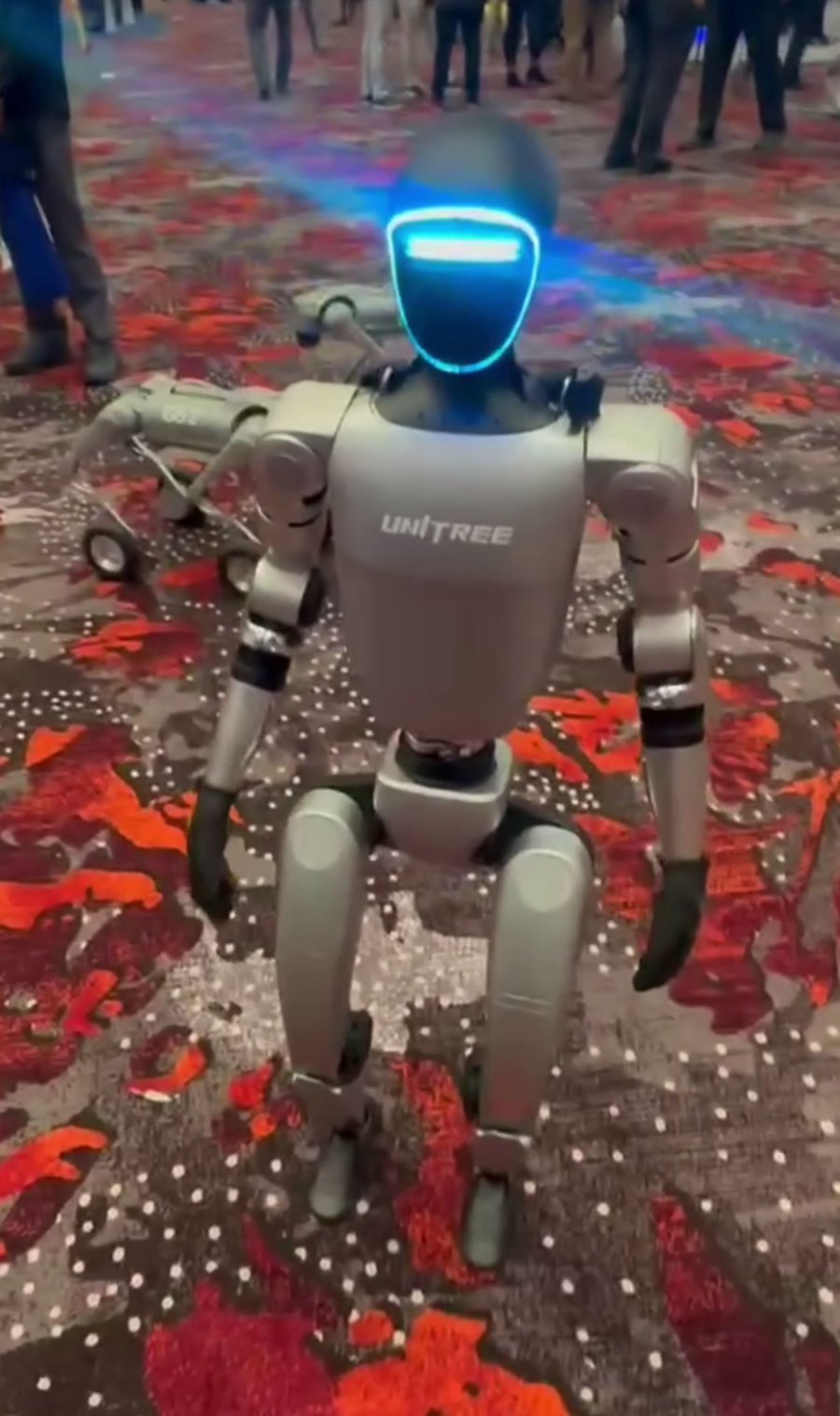
Unitree's G1 — the roughly $16,000 humanoid that Morgan Stanley analysts have called "likely the most used humanoid robot globally," simply on the strength of its price.
Photo: Sayanesy, CC0, via Wikimedia CommonsUnitree's official reveal video for the H1 (August 2023) — "the preview of alf-a-year achievement," as the video's own on-screen text puts it, referring to the roughly six months since Unitree began the humanoid project.
02Development timeline (2023–2026)
Each new model has arrived roughly every six to twelve months, with pricing dropping (R1) or specialization narrowing (H2) rather than every generation simply replacing the last — Unitree still sells all four models today, aimed at different buyers.
| Year | Event |
|---|---|
| 2023-02 | Unitree begins its humanoid project |
| 2023-08 | H1 unveiled — Unitree's first humanoid |
| 2024-03 | H1 sets a certified 3.3 m/s Guinness World Record; lands a hydraulics-free backflip |
| 2024-05 | G1 unveiled at ICRA 2024 for $16,000 |
| 2024-08 | G1 mass production begins |
| 2025-01 | 16 H1 units perform at the CCTV Spring Festival Gala |
| 2025-05 | Four teleoperated G1 units compete in a humanoid kickboxing exhibition |
| 2025-07 | R1 launched at $5,900 |
| 2025-10 | H2 unveiled, built for expressive/entertainment-oriented motion |
| 2026-01 | Unitree discloses 5,500+ humanoid units shipped in 2025 |
| 2026-06 | Nvidia announces a GR00T reference platform built on the H2/G1 |
03The lineup, side by side
The clearest way to read Unitree's humanoid strategy is by price and purpose rather than by generation number: each model targets a different budget and use case, and all four remain on sale simultaneously.
H1 / G1 / H2 / R1 compared
H1 — the flagship
1.8m, 47kg, ~$90,000. Unitree's speed- and capability-focused flagship — the Guinness-record holder and first hydraulics-free backflip.
SourceUnitree official
G1 — the volume seller
1.3m class, ~35kg, $16,000 base (up to ~$40,000 EDU). The model behind Unitree's claimed 2025 shipment volume.
H2 — built to perform
1.8m, 70kg, ~$29,900 domestic base. More human-proportioned, aimed at expressive motion for entertainment and service roles.
SourceTechNode, Oct 2025
R1 — the developer platform
Under 4ft, 25kg, $5,900. Aimed at individual developers and early-stage research teams, not casual consumers.
SourceBloomberg, Jul 2025
Unitree's official reveal video for the H2, titled "Destiny Awakening" — the model built for more human-proportioned, expressive motion rather than raw speed or capability records.
Unitree's official reveal video for the R1 — the sub-$6,000 developer platform, shown here performing a handstand.
04What's technically distinctive
Unitree's own M107 electric joint motors — delivering 360 N·m of peak torque without any hydraulics — are the common hardware thread across H1, G1, and H2, the same integrated driver-motor-reducer-encoder design the company uses in its quadrupeds. Unitree sells some of these actuators as standalone components through its own shop, aimed at competitions, DIY builds, and academic labs — a deliberate ecosystem play rather than a closed-hardware approach.
Software is similarly open rather than proprietary: H1, G1, and H2 all support ROS2, MuJoCo, and Isaac Lab out of the box, and Unitree has released its own open-source vision-language-action model, UnifoLM-VLA-0, built on the open Qwen2.5-VL-7B backbone. In June 2026, Nvidia CEO Jensen Huang announced a formal partnership building an Isaac GR00T humanoid reference platform on Unitree's H2 (extended to the more widely used G1), with Stanford, ETH Zurich, UC San Diego, and the Allen Institute for AI among the confirmed adopters — a research-ecosystem endorsement no Chinese humanoid maker had previously secured at this scale.
The underlying hardware problem — packing precise, high-torque actuators into human-scale limbs — is covered in more depth, across the whole industry rather than one company, in our explainer on humanoid actuators, tactile sensors, and dexterous hands.
G1 spec sheet (Unitree's own published figures)
05Records, demos, and the autonomy question
In March 2024, an H1 set a Guinness World Record for the fastest bipedal humanoid robot at 3.3 m/s — a certified, independently verified figure. Unitree later circulated video of an H1 reaching roughly 10 m/s on a track, calling it a new record, but the coverage itself notes the company flagged a possible measurement error; treat the certified 3.3 m/s figure as the reliable one. The same month, an H1 became the first hydraulics-free humanoid to land a standing backflip, trained via reinforcement learning in simulation and transferred to the real robot — Unitree has not published an independent, third-party audit distinguishing which parts of that demo ran autonomously versus with operator assistance, the same caveat that has dogged Tesla's Optimus demos.
The G1 has since performed its own share of viral motions, including what Unitree calls the world's first side-flip by a humanoid robot. At China's 2025 CCTV Spring Festival Gala, 16 H1 units performed a choreographed handkerchief dance alongside human dancers after roughly three months of training — an impressive feat of motion control, but a scripted stage performance, not a demonstration of open-ended autonomy. A May 2025 "world's first humanoid kickboxing" event used four human-piloted G1 units, with Unitree confirming the robots were remotely operated by named human controllers rather than fighting on their own — an important distinction the marketing footage alone doesn't make obvious.
Unitree's official "World's First Side-Flipping Humanoid Robot" video — the G1 performing a motion Unitree presents as a reinforcement-learning-trained capability rather than a one-off stunt, in the same vein as the H1 backflip discussed below.
Unitree's official highlight reel from the May 2025 "world's first humanoid kickboxing" event — four G1 units, each remotely operated by a named human controller rather than fighting autonomously.
06Sales and the disputed ranking
Unitree disclosed in January 2026 — for the first time ever, by its own account — that it shipped more than 5,500 humanoid units in 2025 across the H1/G1/H2/R1 lineup, with total production exceeding 6,500 units. Whether that actually makes Unitree the world's top-selling humanoid maker by units is genuinely disputed between industry research firms, not a settled fact — see our full company history for the competing estimates and why they disagree. The company's own IPO prospectus, filed two months later, gives a slightly different full-year 2025 figure — 5,215 units — a gap of a few hundred units the company hasn't explained, plausibly a difference between physical delivery and formal revenue recognition. Whichever figure is used, the growth curve is the real story: just 5 units in 2023 (the H1's launch year), 410 in 2024 at an average price of about ¥260,700 (~$36,000), then thousands more in 2025 at a lower average price of about ¥166,400 (~$24,540) as the cheaper G1 and R1 took a growing share of the mix.
Humanoid units shipped, by year (IPO prospectus figures)
eeo.com.cn / InfoQ, citing Unitree's STAR Market IPO prospectus, Mar 2026
07Pricing against Western rivals
No Western humanoid maker has matched Unitree's price floor. Tesla has stated a $20,000–$30,000 target for a future Optimus, not yet achieved in volume. Figure AI's unreleased Figure 03 is informally estimated around $20,000 for an eventual consumer version, with enterprise deployments believed to run $70,000–$150,000 per unit — Figure has not published an official price. Agility Robotics sells its Digit for roughly $250,000 outright, or leases it at about $30/hour under a robots-as-a-service model. Against all three, Unitree's R1 ($5,900), G1 ($16,000 base), H2 (~$29,900 domestic base), and even the flagship H1 (~$90,000) undercut every published or estimated figure.
Unitree's own IPO prospectus names Tesla specifically as its most serious competitive threat, citing Tesla's manufacturing scale, supply chain, and AI resources, and noting that Tesla had begun small-batch trial production of Optimus Gen 3. Wang Xingxing has been more measured about the technology itself than about price, telling an August 2025 industry conference that "the basic hardware is sufficient, it's not good enough" and that current AI models remain "not good enough, and not unified enough" — a rare admission from a company otherwise built around aggressive claims.
08FAQ
What's the difference between Unitree's H1, G1, H2, and R1?
H1 is the capability-focused flagship (fastest, first backflip); G1 is the ~$16,000 mass-market model behind most of Unitree's shipment volume; H2 is a more human-proportioned model built for expressive, entertainment-style motion; and R1 is a stripped-down, $5,900 developer platform. All four remain on sale.
Are Unitree's humanoid demos (backflips, dancing, kickboxing) autonomous?
It varies, and Unitree hasn't published an independent audit for most of them. The H1's backflip is an RL-trained motion policy, but Unitree hasn't detailed how much of the published clip ran without operator assistance. The Spring Festival Gala dance was a scripted, choreographed stage performance. The kickboxing bouts were explicitly confirmed as teleoperated by human controllers, not autonomous combat.
How does Unitree's humanoid pricing compare to Tesla, Figure, and Agility?
Unitree undercuts all of them. Tesla targets $20,000–$30,000 for a future Optimus (not yet in volume production); Figure's unreleased Figure 03 is estimated around $20,000 for consumers or $70,000–$150,000+ for enterprise; Agility's Digit costs roughly $250,000 outright. Unitree's R1 ($5,900), G1 ($16,000), and H2 (~$29,900) all sit at or below Tesla's stated future target, while even the flagship H1 (~$90,000) undercuts Digit and enterprise Figure pricing.
Is Unitree really the world's top humanoid seller?
It's disputed between research firms, not a confirmed fact. Unitree shipped over 5,500 humanoid units in 2025 by its own account (disclosed January 2026) — a large, verifiable number — but whether that makes it #1 globally depends on which industry report you read. See our history of Unitree for the competing estimates.
09Sources
04. What's technically distinctive
05. Records, demos, and the autonomy question
06. Sales and the disputed ranking
07. Pricing against Western rivals
Related articles
Articles
- ›The History of Unitree Robotics
- ›Wang Xingxing: The Engineer Behind Unitree
- ›Unitree's Quadruped Robots: From Laikago to the B2
- ›Humanoid Robot Actuators & Hands
- ›The Physical AI Landscape 2026: A Market Map by Element Technology
- ›From Robot Dogs to Humanoids
- ›Humanoid Robots: Size and Disputed Shipments
Company Deep Dives
Unitree
- ›The History of Unitree Robotics
- ›Wang Xingxing: The Engineer Behind Unitree
- ›Unitree's Humanoid Robots: H1, G1, H2, and R1(this article)
- ›Unitree's Quadruped Robots: From Laikago to the B2
Figure AI
1X Technologies
Physical Intelligence
Skild AI
NVIDIA
- ›NVIDIA Isaac GR00T, Explained: What NVIDIA Actually Sells in Robotics
- ›NVIDIA DRIVE, Explained: The Automotive Platform Behind Mercedes-Benz, Uber, and a Dozen Other Automakers
- ›NVIDIA Jetson: The Decade-Old Hardware Lineage Behind Physical AI
- ›NVIDIA: A History of the GPU
- ›NVIDIA CUDA, Explained: The Software Behind NVIDIA's AI Moat
- ›Jensen Huang: From a Denny's Dishwasher to NVIDIA's CEO