Company & Robot DB
The History of Anduril Industries
01Founding
Anduril's founding story starts two and a half years before the company existed. In 2014, Palmer Luckey — fresh off selling his VR startup Oculus to Facebook — met Trae Stephens at a Founders Fund retreat; Stephens, six months into a Founders Fund role, had been tasked with finding "the next Palantir or SpaceX" in defense technology. Luckey's own departure from Facebook, in March 2017, is a story with its own controversy, covered in full in our profile of Palmer Luckey — but the short version is that he'd spent roughly six months out of public view after a 2016 political-donation controversy before his exit was announced.
One week after leaving Facebook, Luckey and Stephens held a recruitment lunch at Luckey's home. Among the attendees was Brian Schimpf, then Palantir's director of engineering, who joined as a co-founder and became CEO — a title Luckey has never held. Anduril Industries was incorporated on April 20, 2017, by five co-founders: Luckey, Stephens (now Executive Chairman), Schimpf (CEO), Matt Grimm (COO), and Joe Chen, an early Oculus hardware lead. The name comes from Aragorn's sword in The Lord of the Rings — Quenya for "Flame of the West."
The founding thesis was to build a venture-backed defense company that could iterate faster and cheaper than legacy primes like Lockheed Martin and RTX, financed by private capital rather than cost-plus government contracts from day one. The first product was the Sentry Tower — a solar-powered, AI-linked surveillance tower — first demonstrated to the Department of Homeland Security in September 2017. In an early pilot, Anduril has said the system led to 55 apprehensions in 12 operational days at one Texas site and 10 interceptions in a San Diego pilot; formal CBP deployment began in early 2018 with four towers, and by 2024–2025 Anduril towers covered roughly 600 miles — about 30% — of the US-Mexico border.
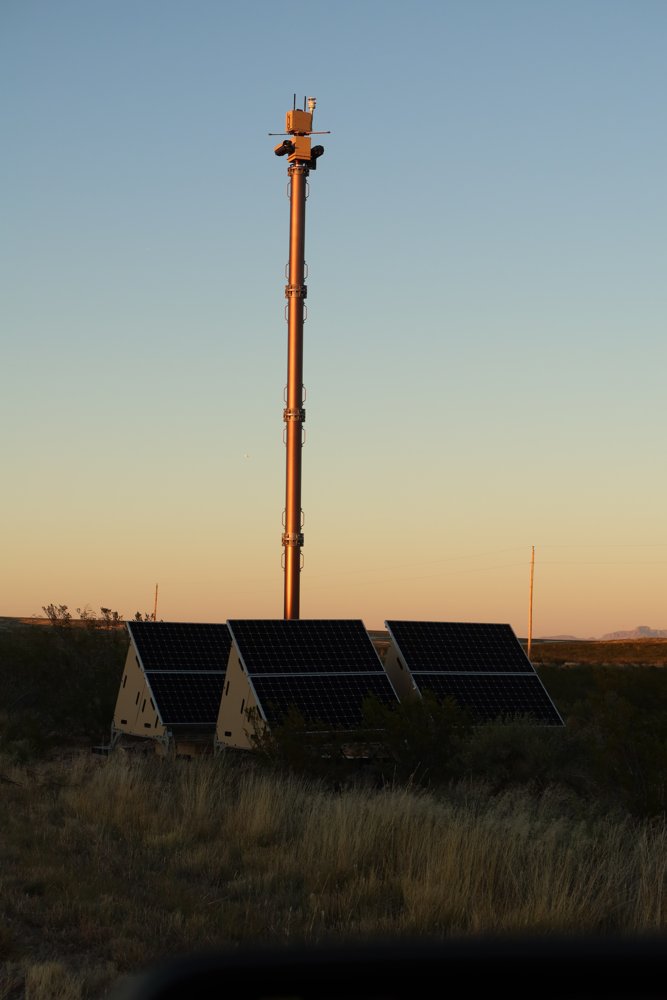
A solar-powered Sentry Tower on the US-Mexico border — Anduril's first product, and still the visible backbone of its border-surveillance business.
Photo: Jasonateff, CC BY 3.0, via Wikimedia Commons- 2017
Founded, Sentry Tower
Border-surveillance towers for CBP
- 2019-2020
Ghost & Anvil
Autonomous aircraft, counter-drone
- 2023-2024
Roadrunner, Barracuda, Fury
Interceptors and an autonomous jet
- 2025
EagleEye, Ghost Shark, Copperhead
AR headset, undersea vehicles
- 2026
$20B Army deal, Arsenal-1 production
Enterprise contract, Ohio factory live
02Funding
Anduril's funding accelerated steadily rather than in one dramatic jump. A 2017 seed round of $17.6 million valued the young company at roughly $88 million; by a September 2019 Series B ($120 million), Anduril had crossed the $1 billion mark. A June 2021 Series D ($450 million) brought the valuation to $4.6 billion, followed by a December 2022 Series E ($1.48 billion) at $8.48 billion.
The pace then sharply accelerated: an August 2024 Series F raised $1.5 billion at a $14 billion valuation, a June 2025 round raised $2.5 billion at $30.5 billion — Founders Fund's single largest check ever written, at $1 billion — and a Series H announced May 13, 2026 raised a further $5 billion at a $61 billion valuation, roughly doubling the company's value in well under a year. (Some March 2026 reporting described an approximately $4 billion round targeting a $60 billion valuation; this appears to be earlier-stage coverage of the same raise that closed as the May 2026 Series H, though Anduril's own announcements should be checked directly if the distinction matters for a given purpose.) Cumulative funding is reported as roughly $11.4 billion by Crunchbase and $11.9 billion by PitchBook — aggregators differ on how they treat non-equity capital, so treat either figure as an estimate rather than a precise total.
Valuation by funding round
Crunchbase / TechCrunch / company announcements, compiled through May 2026
Funding rounds
Seed
$17.6M led by Founders Fund, valuing the young company at roughly $88M.
Series B
$120M, crossing a $1B valuation for the first time — unicorn status two years after founding.
Series D
$450M led by Elad Gil, more than doubling the prior valuation to $4.6B.
Series E
$1.48B led by Valor Equity Partners, nearly doubling the valuation to $8.48B.
Series F
$1.5B co-led by Founders Fund and Sands Capital, at a $14B valuation.
SourceTechCrunch, Aug 2024
Series H
$5B led by Thrive Capital and Andreessen Horowitz, at a $61B valuation — roughly doubling in under a year.
03From border towers to an autonomy stack
Every Anduril hardware product runs on Lattice, the company's AI sensor-fusion and command-and-control software — the actual product, Anduril argues, with hardware built to give it something to control. Beyond the Sentry Towers, the portfolio expanded quickly: Ghost, an autonomous rotary-wing aircraft (unveiled 2020, with the Ghost-X variant evaluated by the US Army in 2024); Anvil, a counter-drone interceptor announced in 2019 and delivered to US and UK militaries the same year; and the Altius family of loitering munitions, part of US military assistance sent to Ukraine from 2023.
Anduril's most distinctive later products pair autonomy with strike capability. Roadrunner and Roadrunner-M, revealed December 2023, are twin-turbojet VTOL interceptors reusable if a target is never engaged — Luckey has cited a per-unit cost in the "low hundreds of thousands" of dollars. The Barracuda family of air-breathing autonomous cruise missiles, unveiled in September 2024, led to a May 2026 framework agreement to supply the US Army a minimum of 3,000 Surface-Launched Barracuda-500M munitions starting in 2027. Menace (mobile electronic warfare and command systems) and Pulsar (AI-driven counter-drone jamming, with a lighter Pulsar-L variant revealed in 2025) round out the ground- and air-focused portfolio.
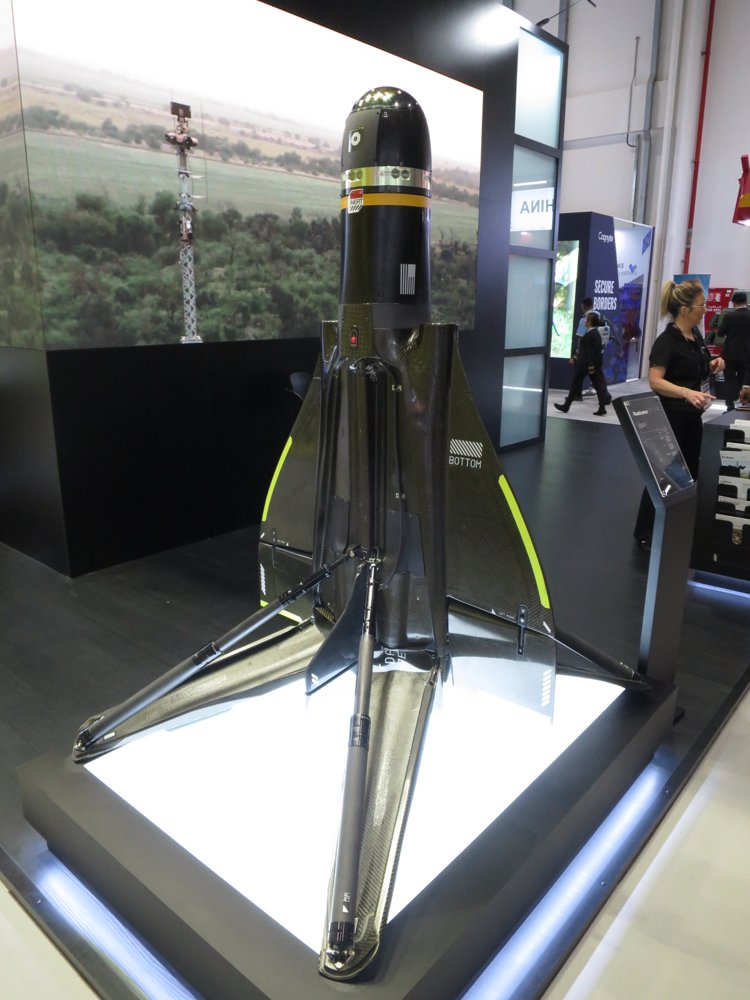
Roadrunner, the twin-turbojet VTOL interceptor Anduril revealed in December 2023 — reusable if a target is never engaged, and priced, Luckey has said, in the "low hundreds of thousands" of dollars per unit.
Photo: Mztourist, CC BY 4.0, via Wikimedia CommonsAnduril's official reveal video for Roadrunner and Roadrunner-M (December 2023) — the interceptor family discussed in section 03 below.
04The product lineup
Anduril's highest-profile recent program is Fury (YFQ-44A), its entrant in the US Air Force's Collaborative Combat Aircraft program — a semi-autonomous fighter jet built from Anduril's September 2023 acquisition of Blue Force Technologies, taken from a clean-sheet design to first flight in 556 days, flying for the first time on October 31, 2025, competing against General Atomics' YFQ-42A.
Underwater, Anduril's Dive-LD autonomous underwater vehicle (from its 2022 acquisition of Dive Technologies) can carry and deploy the Copperhead family of autonomous underwater munitions, unveiled in April 2025. Separately, Anduril's Ghost Shark extra-large autonomous underwater vehicle — co-developed with Australia's Department of Defence since a 2022 contract — moved to a production contract worth roughly A$1.7 billion (about US$1.1 billion) in September 2025. In February 2025, Microsoft transferred its roughly $22 billion, decade-long IVAS augmented-reality headset contract with the US Army to Anduril, which unveiled its own successor system, EagleEye, at the AUSA conference in October 2025 — priced, per reporting, at under half the old IVAS unit cost.
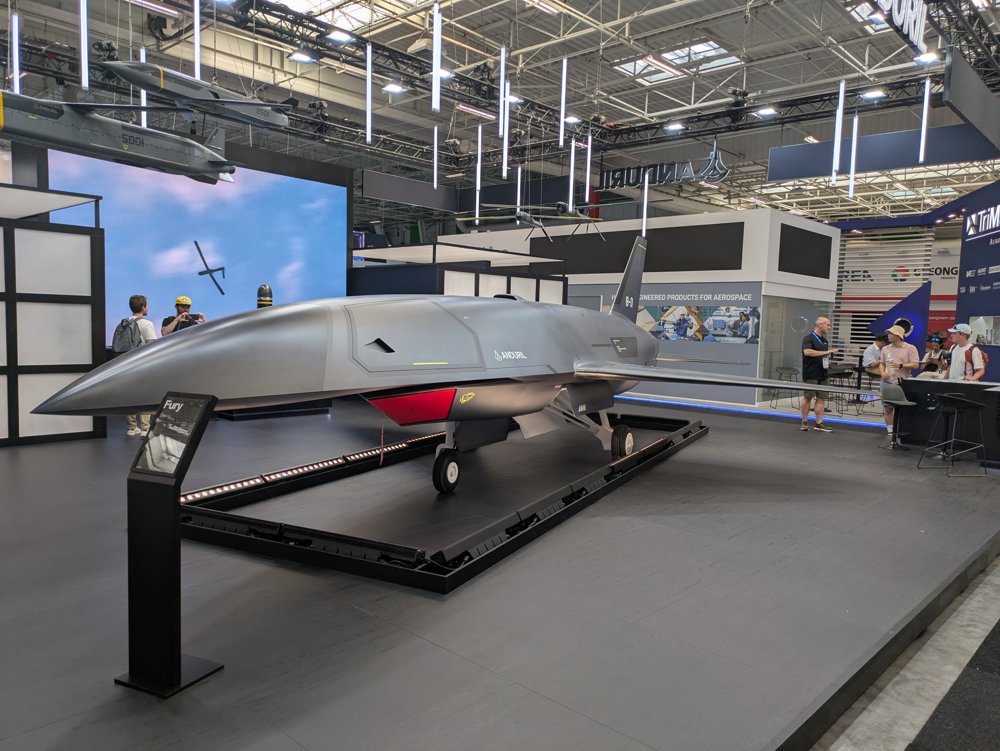
Fury (YFQ-44A), Anduril's entry in the US Air Force's Collaborative Combat Aircraft program — built from a clean sheet to first flight in 556 days after Anduril's 2023 acquisition of Blue Force Technologies.
Photo: Artvill, CC BY 4.0, via Wikimedia CommonsAnduril's official EagleEye reveal video — the AR/mixed-reality headset that succeeded Microsoft's IVAS program, discussed in section 04 below.
05Contracts and customers
Anduril's largest deal to date is a 10-year, up to $20 billion enterprise framework with the US Army, announced March 14, 2026, consolidating more than 120 previously separate procurement actions into pre-negotiated pricing for Anduril's hardware and software. Other confirmed government business includes a roughly $99.7 million Space Force contract (2024) for space-surveillance mesh networking, later expanded to a $200 million ceiling; a $642 million US Marine Corps counter-drone deal (March 2025); and a State Department-approved roughly $1.98 billion counter-drone sale to Kuwait.
Internationally, Anduril's Ghost Shark partnership with Australia is its most mature relationship outside the US, tied into AUKUS Pillar 2 cooperation. Ukraine has received Altius-family drones as part of US military assistance since 2023, though Ukraine's SBU later scaled back Altius use, citing vulnerability to Russian electronic warfare. In July 2024, China sanctioned Anduril at the corporate level over its role in an $11.1 billion US arms package to Taiwan that included Anduril systems; in December 2025, China separately sanctioned Palmer Luckey personally alongside other US defense executives, barring him from Chinese business dealings.
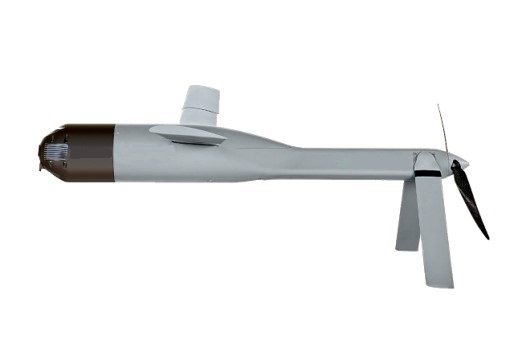
The Altius 600 — the loitering-munition family Ukraine received via US military assistance from 2023, and which Ukraine's SBU later scaled back using over vulnerability to Russian jamming.
Photo: Redstone Arsenal, public domain, via Wikimedia Commons06Scaling the business
To manufacture at the volume its contracts require, Anduril announced Arsenal-1 in 2024 — a roughly $1 billion, 5-million-square-foot hyperscale manufacturing facility in Pickaway County, Ohio, projected to employ over 4,000 people by 2035 and described by Ohio officials as the largest job-creation project in the state's history. Production of Fury began at the facility in March 2026, three to four months ahead of schedule.
Anduril's headcount and revenue have scaled alongside its funding: from roughly 90 employees in mid-2019 to about 400 by early 2021 and more than 7,600 by April 2026. Annual revenue is reported to have grown from about $236 million (2022) to $420 million (2023), roughly $1 billion (2024), and $2.2 billion (2025) — a figure CEO Brian Schimpf disclosed directly alongside the Series H announcement. Luckey has said Anduril will eventually go public, telling CNBC in June 2025 there "isn't really a path" to winning trillion-dollar-scale defense contracts as a private company, though as of this writing no IPO filing has been made.
Scale, by the numbers
| Year | Event |
|---|---|
| 2017-04 | Anduril Industries incorporated by five co-founders |
| 2017-09 | Sentry Tower first demonstrated to DHS |
| 2019-09 | Series B closes; Anduril passes a $1B valuation |
| 2023-09 | Acquires Blue Force Technologies (Fury jet program) |
| 2023-12 | Roadrunner and Roadrunner-M unveiled |
| 2024-08 | Series F closes at a $14B valuation; Arsenal-1 announced |
| 2025-02 | Takes over Microsoft's IVAS Army headset contract |
| 2025-10 | Fury (YFQ-44A) makes first flight; EagleEye unveiled |
| 2026-03 | US Army enterprise framework announced, up to $20B |
| 2026-05 | Series H closes at a $61B valuation |
07The autonomous-weapons debate
Anduril's core products sit at the center of an active ethical and policy debate over autonomous weapons. The company markets its strike systems as human-supervised, with an authorization step before any system engages a target; critics, including the long-running "Stop Killer Robots" campaign, argue the industry-wide trajectory toward greater autonomy erodes meaningful human control — language echoed in UN statements calling fully autonomous lethal weapons "politically unacceptable and morally repugnant." Anduril has also drawn scrutiny for quietly picking up Pentagon computer-vision work related to Project Maven around 2018–2019, after Google withdrew from the same program following internal employee protests.
Anduril's hardware hasn't been immune to failure in the field. In November 2025, two Altius drones crashed during US Air Force testing at Eglin Air Force Base — one falling roughly 8,000 feet — which a company spokesperson described as isolated incidents from hundreds of tests; separately, Ghost drones have reportedly struggled against Russian jamming in Ukraine, contributing to the SBU's decision to scale back Altius use there. Advocacy groups including the ACLU have separately criticized Anduril's border Sentry Towers for pushing migrants toward more dangerous crossing routes, though — unlike Google's Project Maven episode — no organized employee walkout at Anduril has been publicly reported.
- Nov 2025 — two Altius drones crashed during US Air Force testing at Eglin AFB; Anduril called them isolated incidents from hundreds of tests.
- Ukraine's SBU scaled back use of Altius drones, citing vulnerability to Russian electronic-warfare jamming.
- The ACLU and other advocacy groups have criticized Anduril's border Sentry Towers for pushing migrants toward more dangerous crossing routes.
08FAQ
Who founded Anduril, and when?
Palmer Luckey, Trae Stephens, Brian Schimpf, Matt Grimm, and Joe Chen founded Anduril Industries on April 20, 2017, one week after Luckey's departure from Facebook. Brian Schimpf is CEO — Luckey has never held that title, and is credited simply as Founder.
How much has Anduril raised, and what is it worth?
Anduril's cumulative funding is reported as roughly $11.4-11.9B depending on the aggregator, reaching a $61 billion valuation in its May 2026 Series H ($5B), up from an $88 million valuation at its 2017 seed round.
What does Anduril actually make?
Anduril builds defense hardware — border-surveillance towers, counter-drone interceptors (Anvil, Roadrunner), autonomous cruise missiles (Barracuda), an autonomous fighter jet (Fury), undersea vehicles (Dive-LD, Copperhead, Ghost Shark), and an AR headset (EagleEye) — all run on its Lattice AI command-and-control software, which the company considers its core product.
Is Anduril's technology fully autonomous — does a human stay in control?
Anduril markets its strike-capable systems as human-supervised, with an authorization step required before a system engages a target. Critics, including the "Stop Killer Robots" campaign, argue the broader industry trend toward greater autonomy erodes meaningful human control over time — a debate that applies to the sector generally, not a claim that any specific Anduril system currently fires without authorization.
09Sources
01. Founding
02. Funding
03. From border towers to an autonomy stack
04. The product lineup
05. Contracts and customers
06. Scaling the business
07. The autonomous-weapons debate
Related articles
Anduril company profilePalmer Luckey — from Oculus to AndurilWhere Anduril fits on the physical AI landscape mapCompany Deep Dives
Unitree
Figure AI
1X Technologies
Physical Intelligence
Skild AI
Anduril
- ›The History of Anduril Industries(this article)
- ›Palmer Luckey: From Oculus to Anduril
NVIDIA
- ›NVIDIA Isaac GR00T, Explained: What NVIDIA Actually Sells in Robotics
- ›NVIDIA DRIVE, Explained: The Automotive Platform Behind Mercedes-Benz, Uber, and a Dozen Other Automakers
- ›NVIDIA Jetson: The Decade-Old Hardware Lineage Behind Physical AI
- ›NVIDIA: A History of the GPU
- ›NVIDIA CUDA, Explained: The Software Behind NVIDIA's AI Moat
- ›Jensen Huang: From a Denny's Dishwasher to NVIDIA's CEO