Company & Robot DB
NVIDIA Isaac GR00T, Explained: What NVIDIA Actually Sells in Robotics
Key Takeaways
- Isaac GR00T is NVIDIA's foundation model for humanoid robots — software, not a physical product, meant to give robots general-purpose perception and motor skills.
- NVIDIA doesn't build humanoid robots itself; it sells the model, simulator, and chip layers other companies build robots on top of.
- Robotics still doesn't get its own disclosed revenue line — it's a long-run platform bet layered on top of NVIDIA's much larger data-center AI business.
01What Isaac GR00T is
Isaac GR00T is NVIDIA's foundation model for humanoid robots — a piece of software, not a physical product, meant to give a robot general-purpose perception, reasoning, and motor skills instead of hand-coded behavior for each task. NVIDIA first previewed the effort as "Project GR00T" at GTC in March 2024, then unveiled Isaac GR00T N1 a year later at GTC San Jose in March 2025, describing it in its own words as "the world's first open, fully customizable foundation model for generalized humanoid reasoning and skills."
The model uses a dual-system architecture: a fast, reflexive "System 1" that handles moment-to-moment motor control, paired with a slower, deliberate "System 2" vision-language model that plans and reasons about the task at hand — trained on a mix of egocentric human video, real robot trajectories, and synthetic data generated in simulation. CEO Jensen Huang framed the launch in sweeping terms: "The age of generalist robotics is here." NVIDIA's broader pitch to industrial customers, repeated across 2025 and 2026 announcements, goes further still: "every industrial company will become a robotics company."
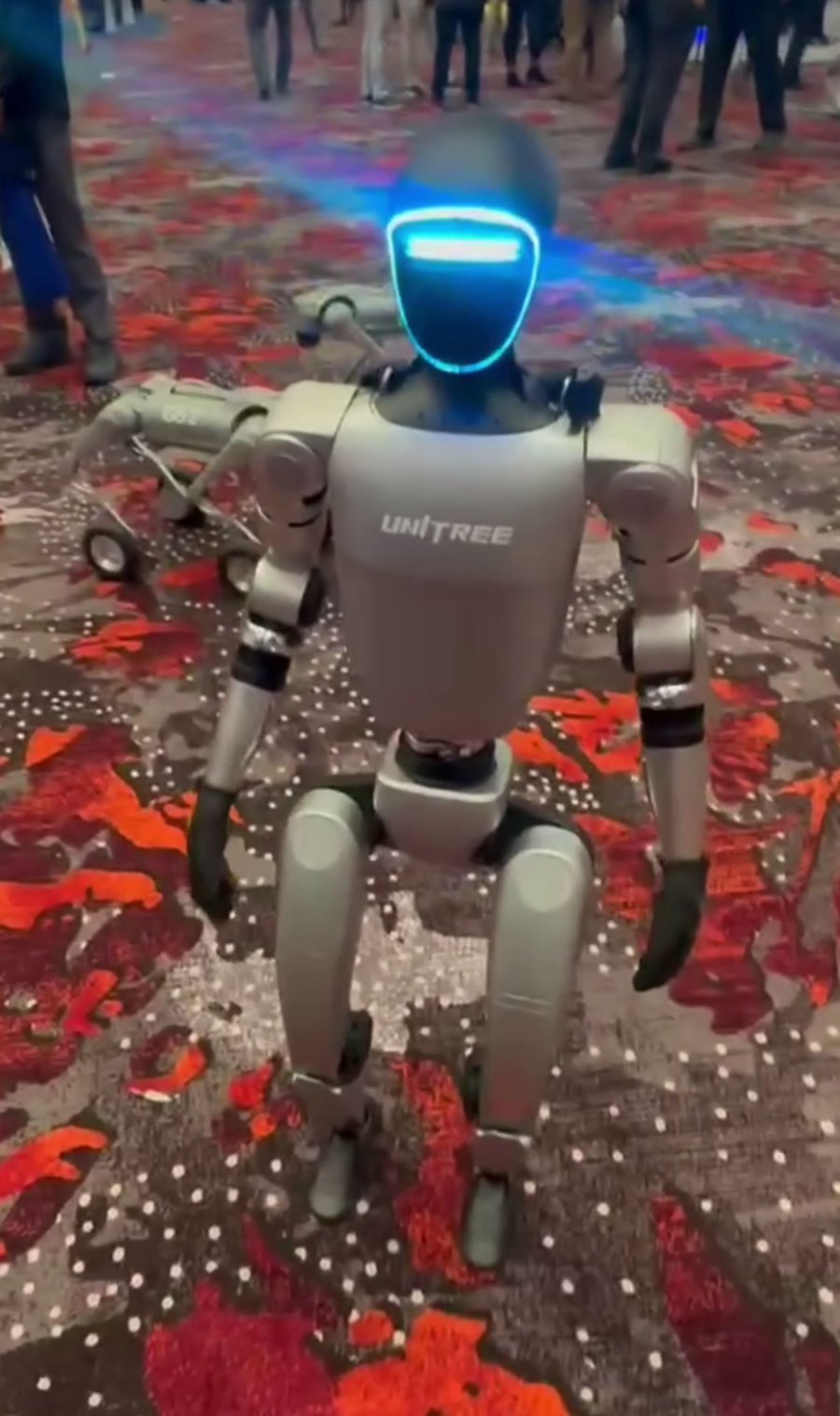
The kind of hardware Isaac GR00T is built to run on. Unitree's G1, pictured here, is the chassis NVIDIA later chose for its own reference platform — covered in the ecosystem section below.
Photo: Sayanesy, CC0, via Wikimedia CommonsGR00T's dual-system architecture
Fast, reflexive
Handles moment-to-moment motor control — the low-level reflexes that keep a grip steady or a step balanced, running many times a second.
Slow, deliberate
A vision-language model that looks at the scene, plans, and reasons about the task at hand, then hands the resulting plan down to System 1 to carry out.
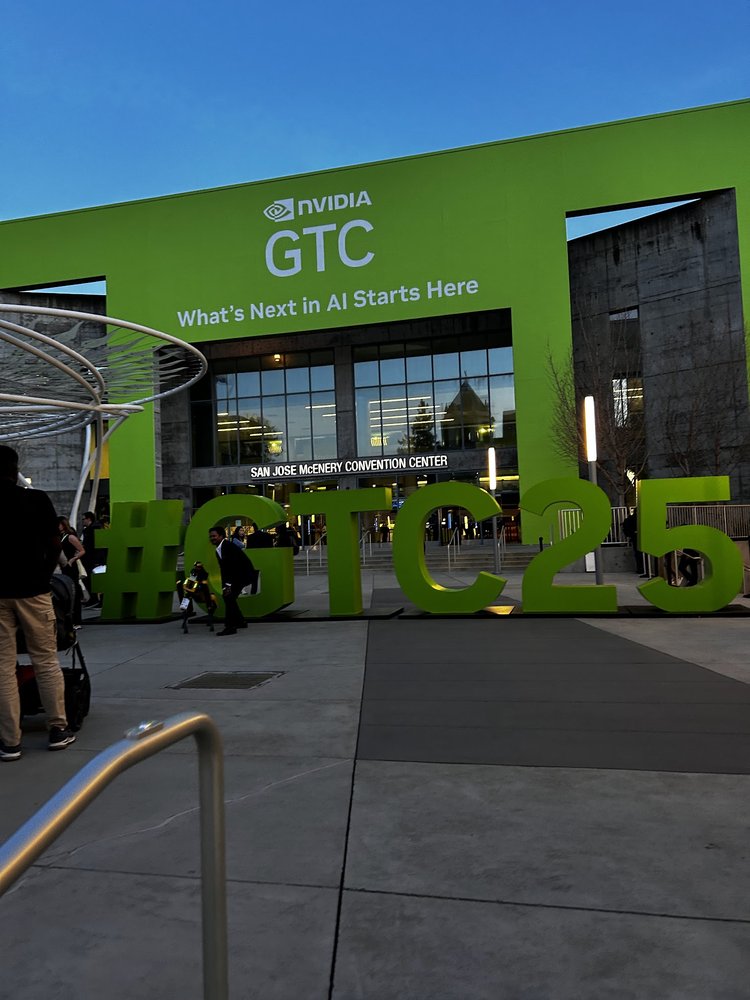
GTC San Jose, March 2025 — the conference where NVIDIA unveiled Isaac GR00T N1, the model at the center of this article.
Photo: Jack145945, CC BY-SA 4.0, via Wikimedia Commons02Development timeline (2024–2026)
GR00T's public history is a series of GTC-keynote announcements, each expanding either the model's capability or the compute it runs on, moving roughly twice a year since the March 2025 unveiling.
| Year | Event |
|---|---|
| 2024-03 | "Project GR00T" and an Isaac robotics platform update first previewed at GTC |
| 2025-03 | Isaac GR00T N1 unveiled at GTC San Jose, described by NVIDIA as the first open humanoid foundation model |
| 2025-06 | GR00T-Dreams (synthetic-trajectory generation via Cosmos world models) unveiled at Computex |
| 2025-08 | Jetson AGX Thor reaches general availability; NVIDIA cites "2 million developers" on its robotics stack |
| 2026-03 | Broad ecosystem release names dozens of industrial and robotics partners at once |
| 2026-06 | GTC Taipei: NVIDIA and Unitree unveil the Isaac GR00T Reference Humanoid Robot |
| 2026-07 | NVIDIA and Hugging Face integrate GR00T 1.7 and Isaac Teleop into LeRobot; NVIDIA cites "3 million" developers |
NVIDIA's own explainer for Isaac GR00T N1 (March 2025) — the dual-system architecture and the training data described in the section below.
03The full stack
What NVIDIA actually sells is less a single product than a pipeline. Isaac Sim provides the physics simulation; Cosmos and Cosmos Transfer generate and photorealistically augment synthetic training video from that simulation; GR00T-Dreams, unveiled at Computex 2025, uses the same Cosmos world models to turn a single image and a language instruction into a synthetic robot-motion "dream" — NVIDIA says this cut the time to generate GR00T N1.5's training data to roughly 36 hours versus about three months of manual collection, though that specific figure is NVIDIA's own claim and hasn't been independently audited. Isaac Lab handles the reinforcement- and imitation-learning training itself; Isaac Teleop, which reached general availability at GTC 2026, lets developers capture real demonstrations in both simulation and the real world through one unified tool. GR00T is the foundation model that sits on top of all of it; Jetson AGX Thor is what a finished robot actually runs the model on.
GR00T's version cadence
GR00T N1
The original release: dual-system (fast action / slow reasoning) architecture trained on human video, robot trajectories, and synthetic data.
N1.5 / N1.6
Updated vision-language backbone for better grounding and instruction-following (N1.5); architecture and data improvements aimed at bimanual and locomotion-plus-manipulation tasks (N1.6).
SourceNVIDIA Research
N1.7
VLM backbone moved to a newer model pretrained on 20,854 hours of egocentric video; integrated into Hugging Face's LeRobot alongside Isaac Teleop the same July.
SourceNVIDIA Blog, Jul 2026
Related reading
Robot Foundation Models: Market Size, Players, and the Funding Boom
Where GR00T fits among the other foundation-model players racing for the same bet.
Related reading
AI Compute & Chips for Robots: Market Size and Players
How big the robot-compute-chip market actually is, and who's trying to challenge Jetson's lead.
04Ecosystem: who's actually building on it
Loose ties vs. confirmed ones
NVIDIA doesn't build humanoid robots itself — its business model is to sell the layers other companies build robots on top of, and a March 2026 press release naming dozens of partners at once is the clearest single snapshot of how that plays out in practice. A few of those relationships are concrete and independently verifiable, shown below. Others are looser: NVIDIA's own release groups eight humanoid makers (Agility Robotics, Boston Dynamics, Figure, 1X, AGIBOT, Hexagon Robotics, NEURA Robotics, and Humanoid) together as "building humanoids using Cosmos, Isaac Sim, Isaac Lab, and GR00T N models," without per-company specifics — language worth reading as directional rather than a confirmed deployment list for each name on it.
The Unitree reference platform
The most concrete recent example is the reference platform NVIDIA built with Unitree, unveiled at GTC Taipei in June 2026: a humanoid combining Unitree's "H2 Plus" chassis (roughly 1.8m, 31 degrees of freedom) with tactile five-finger hands from Singapore's Sharpa and a Jetson AGX Thor "brain" running the full Isaac software stack, for 75 degrees of freedom in total. NVIDIA named Ai2, ETH Zurich, Stanford, and UC San Diego as research-institution users. Coverage of the announcement noted NVIDIA choosing a Chinese robot maker for this specific reference design — though NVIDIA has said it is pursuing similar reference platforms with US and European humanoid makers too, so this isn't an exclusive arrangement.
Related reading
Unitree's Humanoid Robots: H1, G1, H2, and R1
Unitree's own product lineup, sold independently of this NVIDIA reference platform.
NVIDIA's full GTC Taipei 2026 keynote replay (June 2026) — includes the Isaac GR00T Reference Humanoid Robot built with Unitree, covered in the ecosystem section below.
Concrete, independently verifiable partnerships
- ABB, FANUC, Yaskawa, and KUKA — use Omniverse and Isaac Sim for virtual commissioning and digital-twin production-line validation
- Johnson & Johnson MedTech — uses Isaac Sim and Cosmos for its Monarch surgical platform
Hugging Face and LeRobot
In July 2026, NVIDIA and Hugging Face expanded their partnership, integrating GR00T 1.7 and Isaac Teleop into the open-source LeRobot library and describing GR00T 1.7 as "the first open and commercially viable robot foundation model." The two companies claimed their combined ecosystems now connect NVIDIA's self-reported 3 million robotics developers with Hugging Face's 16 million AI builders — the kind of scale claim that's genuinely hard to verify from outside NVIDIA. See the linked article below for how that developer-count claim has moved over time.
Related reading
The History of LeRobot
Hugging Face's open-source robotics stack, and how it plugs into NVIDIA's own tools.
05Scale next to the core business
Whatever the developer-adoption numbers mean, robotics doesn't even get its own disclosed revenue figure. NVIDIA's earnings commentary groups Automotive and Robotics under one heading, but the only dollar figure it discloses there is Automotive revenue: $2.3 billion for full fiscal year 2026, against $215.9 billion in total company revenue and $193.7 billion from Data Center alone — that $2.3 billion is an automotive number, not a robotics one (see the DRIVE article linked below for that business in detail). Robotics revenue on its own isn't broken out at all — automotive alone already comes to only about 1% of NVIDIA's business, next to Data Center's roughly 90%, so whatever robotics contributes specifically is smaller still. Starting with its Q1 FY2027 results, NVIDIA stopped reporting Automotive as a standalone line altogether, folding it — and robotics — into a broader "Edge Computing" category alongside PCs and game consoles, itself a sign of how small both lines remain relative to the rest of the company.
None of that means the bet is unserious — NVIDIA's market capitalization sat around $5.1 trillion as of mid-July 2026, the world's largest, built almost entirely on the data-center AI business the chart below tracks. Robotics is a long-run platform play layered on top of that, not something NVIDIA needs to work today.
Related reading
NVIDIA DRIVE
NVIDIA's automotive compute platform — the other physical-AI bet built on the same chip lineage.
06Challenges ahead
GR00T's code is released under an Apache 2.0 license, but the pretrained model weights on Hugging Face carry NVIDIA's own "Open Model License" — a standard type of license for pretrained weights that adds usage-policy terms for downstream commercial deployments, the same general pattern many other model providers use.
The competition is real, and not obviously behind. Google DeepMind's Gemini Robotics reportedly adapts to new tasks from 50–100 demonstrations using a single large model rather than GR00T's two-system split, though as of mid-2026 it remains limited to "selected trusted testers" rather than a public release — meaning it's arguably less open than GR00T even as it competes on capability. Physical Intelligence's π0 is a third approach again, and notably Physical Intelligence is simultaneously an NVIDIA compute customer (a named Jetson Thor evaluator) and a foundation-model competitor to GR00T — the industry's biggest names aren't cleanly sorted into "NVIDIA's ecosystem" versus "NVIDIA's rivals."
07FAQ
Does NVIDIA make its own humanoid robot?
No. NVIDIA sells the foundation model (Isaac GR00T), the simulation and synthetic-data tools (Isaac Sim, Cosmos), and the onboard compute chip (Jetson AGX Thor) that other companies' robots run on. Its closest thing to an actual robot is a reference design built with Unitree's hardware and Sharpa's hands, unveiled in June 2026 for research use, not a product NVIDIA sells directly to consumers.
Is Isaac GR00T actually open-source?
Partially — the code itself is Apache 2.0, but the pretrained weights carry NVIDIA's own "Open Model License" with added commercial-use conditions, a real gap from unrestricted open source. See the "Challenges ahead" section above for what that's caused in practice.
How big a business is robotics for NVIDIA today?
Very small, and not even separately disclosed — robotics is folded into a combined "Automotive and Robotics" line whose only disclosed figure, Automotive revenue, was already just about 1% of NVIDIA's total revenue in fiscal year 2026. See the "How small this actually is" section above for the full breakdown.
How does GR00T compare to Google DeepMind's Gemini Robotics or Physical Intelligence's π0?
All three are robot foundation models pursuing the same general goal through different architectures — GR00T's fast/slow dual-system split, Gemini Robotics' single large reasoning model, and π0's diffusion-based action generation. As of mid-2026, GR00T's weights are publicly downloadable while Gemini Robotics remains limited to selected testers, though independent, apples-to-apples benchmarks comparing all three on real-world tasks are not available.
08Sources
01. What Isaac GR00T is
03. The full stack
04. Ecosystem: who's actually building on it
05. Scale next to the core business
Related articles
Articles
Company & Market Data
Company Deep Dives
Unitree
Figure AI
1X Technologies
Physical Intelligence
Skild AI
NVIDIA
- ›NVIDIA Isaac GR00T, Explained: What NVIDIA Actually Sells in Robotics(this article)
- ›NVIDIA DRIVE, Explained: The Automotive Platform Behind Mercedes-Benz, Uber, and a Dozen Other Automakers
- ›NVIDIA Jetson: The Decade-Old Hardware Lineage Behind Physical AI
- ›NVIDIA: A History of the GPU
- ›NVIDIA CUDA, Explained: The Software Behind NVIDIA's AI Moat
- ›Jensen Huang: From a Denny's Dishwasher to NVIDIA's CEO