Company & Robot DB
The History of Unitree Robotics
01A student's robot dog becomes a company
Unitree's story starts with founder Wang Xingxing (王兴兴), born in 1990 in Ningbo, Zhejiang. As a freshman at Zhejiang Sci-Tech University in 2009, he built his first bipedal robot, and during a master's degree in mechanical engineering at Shanghai University he designed a low-cost quadruped he called "XDog," self-funded with roughly 20,000 yuan and built around inexpensive outer-rotor brushless motors rather than the costly custom actuators used by research labs like Boston Dynamics. XDog became enough of an online sensation that it attracted buyer and investor interest before Wang had a company to sell through.
After finishing his degree, Wang briefly joined drone maker DJI in 2016 but resigned after about two months to found his own company with backing from an angel investor. Unitree Technology Co., Ltd. was registered in a 50-square-meter office in Hangzhou's Binjiang District on August 26, 2016. The company's first commercial product, the Laikago quadruped — named after Laika, the Soviet space dog — was announced roughly a year later, in October 2017, priced at around $20,000–$30,000, a fraction of what research-grade quadrupeds cost at the time. Wang told IEEE Spectrum he expected further refinement and higher volume to bring the price down over time, a strategy that has defined nearly every Unitree product since.
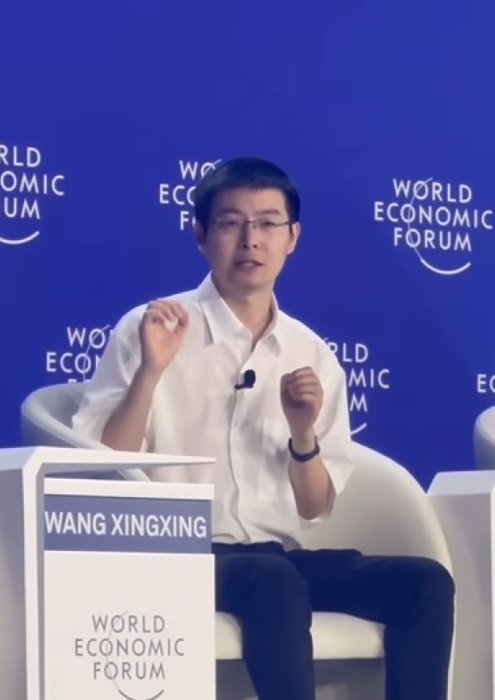
Unitree founder Wang Xingxing at the World Economic Forum's Annual Meeting of the New Champions in Tianjin — the event, nicknamed "Summer Davos," where he later announced Unitree's Series C round in June 2025.
Photo: China News Service, CC BY 3.0, via Wikimedia Commons- 2013–16
Student project
"XDog" built at Shanghai University
- 2016–17
Founding & first product
Unitree founded, Laikago launched
- 2019–2024
Quadruped scale-up
AlienGo → A1 → Go1 → Go2 → B2
- 2023–2025
Humanoid pivot
H1, G1, H2, R1 launched
- 2026
Shanghai IPO
STAR Market listing approved
02Funding: from angel round to unicorn
Unitree's early funding followed a slow, staged path typical of Chinese hardware startups rather than the front-loaded mega-rounds common in Silicon Valley humanoid startups. An angel investor put in 2 million yuan for a 20% stake around the 2016 founding, followed by a second angel round from Bianliang Capital in 2018. Sequoia China then led a December 2019 round — commonly reported in English-language press as "Series A," though Chinese financial media more precisely label it "Pre-A" — investing 15 million yuan at a 150 million yuan valuation, followed by smaller Pre-A+ and Series A rounds through 2020–2021 backed by Xiangfeng Capital, Chuxin Capital, and Shunwei Capital.
Funding accelerated once Unitree's humanoid line began shipping, and later rounds are precise enough — thanks to disclosures in Unitree's own IPO prospectus — to chart directly rather than rely on press-release ranges. What's publicly branded a Series B, led by Matrix Partners China and Dunhong Capital with industrial-technology group Hexagon AB participating, actually closed across three tranches between January and August 2022 totaling roughly 219.5 million yuan (about $31 million). A further 600.3 million yuan (about $85 million) closed in February 2024 — contemporary press described this round as "nearly 1 billion yuan," a figure the later prospectus doesn't support — followed by another 284.7 million yuan (about $40 million) in September 2024. Unitree closed its final pre-IPO round, commonly called Series C, in June 2025 — announced at the World Economic Forum's Tianjin "Summer Davos" meeting — raising 694.5 million yuan (about $98 million) from investors including China Mobile's fund, Tencent, Alibaba, Ant Group, Geely Capital, and ByteDance-linked Jinqiu Capital, at a post-money valuation of roughly 12.7 billion yuan (commonly reported as about $1.7 billion).
Funding rounds by amount raised (IPO prospectus figures)
InfoQ, citing Unitree's STAR Market IPO prospectus, Mar 2026
Funding rounds
Series A ("Pre-A" in Chinese press)
Sequoia China leads with 15 million yuan (~$2.1M) at a 150 million yuan valuation — a modest start compared to Western humanoid startups' early rounds.
Series B (3 tranches)
219.5 million yuan (~$31M) across three closings between January and August, led by Matrix Partners China and Dunhong Capital, with Hexagon AB participating.
Series B2
~600 million yuan (~$85M) in February, followed by a further ~285 million yuan (~$40M) in September — smaller than the "nearly 1 billion yuan" contemporary press reported.
Series C
694.5 million yuan (~$98M) from China Mobile's fund, Tencent, Alibaba, Ant Group, Geely Capital, and ByteDance-linked Jinqiu Capital, at a post-money valuation of ~12.7 billion yuan (~$1.7B) — unicorn status.
03From robot dogs to humanoids
For its first seven years, Unitree was a quadruped company: Laikago (2017) was followed by AlienGo (2019), A1 (2020), Go1 (2021), and Go2 (2023), each generation dropping the entry price further while adding capability. Unitree only entered the humanoid category in 2023, with the H1, and pushed the same low-cost playbook onto a bipedal robot the following year with the $16,000 G1 — a fraction of what Western humanoid programs charge. The quadruped and humanoid lines are covered in full in our deep dive into Unitree's humanoid robots and our deep dive into its quadrupeds.
| Year | Event |
|---|---|
| 2016-08 | Unitree registered in Hangzhou's Binjiang District |
| 2017-10 | First product, the Laikago quadruped, announced at ~$20,000–$30,000 |
| 2019-12 | Sequoia China leads a 15M-yuan Series A |
| 2022-04 | Series B closes, led by Matrix Partners China |
| 2023-08 | H1, Unitree's first humanoid, unveiled |
| 2024-02 | Series B2 closes at nearly 1B yuan |
| 2024-05 | G1 humanoid unveiled at $16,000 |
| 2025-01 | 16 Unitree H1 units perform at the CCTV Spring Festival Gala |
| 2025-06 | Series C closes at ~$1.7B valuation, unicorn status reached |
| 2026-03 | Unitree files for a Shanghai STAR Market IPO |
| 2026-07 | CSRC approves the IPO at an implied ~$6 billion valuation |
04Revenue and profitability
Unitree's revenue was still modest as recently as 2023 — about 159 million yuan (roughly $23.5 million), with humanoids (the H1 had just launched that August) contributing under 2% of sales. Revenue then roughly doubled in 2024 to about 392 million yuan, before jumping to about 1.7 billion yuan (roughly $250 million) in 2025, a year in which humanoid robots overtook quadrupeds to become the company's largest single revenue line for the first time, at just over half of main-business revenue.
Gross margin improved alongside that growth, from about 44% in 2023 to about 60% in 2025, and Unitree's 2025 adjusted net profit (excluding non-recurring items) came to roughly 591 million yuan (about $90 million) — though the company's IPO prospectus doesn't specify a single year as its first profitable one, and an early investor has said Unitree has actually been profitable every year since 2020. Growth has not been perfectly linear: Unitree's own disclosure ahead of its listing-committee hearing showed first-quarter 2026 revenue up 68% year-on-year, but adjusted net profit down roughly 52% over the same quarter a year earlier — a reminder that a single strong annual figure doesn't rule out a genuinely uneven quarter-to-quarter path.
Revenue by year
05From factory floor to prime-time TV
2025 was the year Unitree's robots left the trade-show floor for mainstream Chinese culture. On Lunar New Year's Eve, China Media Group's Spring Festival Gala — one of the most-watched broadcasts in the world — featured 16 Unitree H1 units, dressed in floral Yangge-dance vests and marketed for the segment under the nickname "Fuxi," spinning red handkerchiefs in sync with human dancers in a segment directed by filmmaker Zhang Yimou.
A few months later, Hangzhou hosted what state broadcaster CCTV/CMG billed as the world's first humanoid kickboxing event, in which four human-piloted Unitree G1 units fought scored bouts (the robots were teleoperated by named human controllers, not fighting autonomously). Days after that, Beijing held what was billed as the world's first humanoid half-marathon — though Unitree itself didn't field an official team, saying the company had been too busy preparing the kickboxing event; a Unitree G1 that did appear belonged to a third-party customer team running its own control software, and did not finish competitively. A second running of the Beijing race in April 2026 saw a Unitree H1 clock a qualifying pace that would have beaten the human 1,500-meter world record over a short, irregular course — a marketing extrapolation rather than a regulated result — before falling shortly after crossing the finish line in the actual race, which a rival's robot won outright.
CGTN's broadcast footage of "Yang Bot," the 2025 CCTV Spring Festival Gala segment directed by Zhang Yimou — 16 Unitree H1 units performing the Yangko folk dance and spinning handkerchiefs alongside human dancers.
06IPO: the road to Shanghai's STAR Market
Unitree filed for an IPO on Shanghai's STAR Market (科创板) on March 20, 2026, seeking to raise 4.2 billion yuan (reported as roughly $610–619 million depending on the exchange rate used) at an implied valuation of about 42 billion yuan — commonly converted to roughly $6 billion, well below the $7 billion figure some press had floated as a target back in September 2025. The listing moved unusually fast by Chinese IPO standards: the Shanghai Stock Exchange's listing committee approved the application on June 1, 2026, just 73 days after acceptance, and China's securities regulator (the CSRC) issued final registration approval on July 3, 2026, with the registration formally taking effect on July 6. No trading date has been set as of this writing.
How Unitree's valuation moved in a year
The Robot Report, Jun 2025 / Caixin Global, Jul 2026
07Scale and the disputed top-seller claim
Unitree's Hangzhou factory spans roughly 50,000 square meters, and the company's IPO prospectus lays out a five-year target of 190,000 robots a year — split roughly 75,000 humanoids and 115,000 quadrupeds — a scale-up from a company that listed 480 employees, 175 of them in R&D, in its March 2026 filing.
Whether Unitree is actually the world's top-selling humanoid maker by units is genuinely contested, not just a marketing line to take at face value. Unitree itself only disclosed 2025 figures for the first time in a January 2026 clarification blog post — more than 5,500 humanoid units shipped, and more than 6,500 produced — after what it described as inaccurate numbers circulating online; the post explicitly says Unitree "has never previously disclosed any sales data of 2025 externally." One industry report (from CCID Media) puts Unitree at roughly 32% of a 17,000-unit global 2025 market, ranking it first; another (reportedly from Omdia) estimates a smaller roughly 13,000-unit global market with Unitree at a similar 32% share but in second place behind a different maker — the two named research organizations don't agree on which company actually shipped the most humanoids in 2025. What's less disputed is that Unitree, alongside fellow Chinese maker AgiBot, dominates recent volume: TrendForce's April 2026 outlook has the two companies together accounting for close to 80% of all humanoid shipments as China's output surges through 2026.
Company scale (IPO prospectus, Mar 2026)
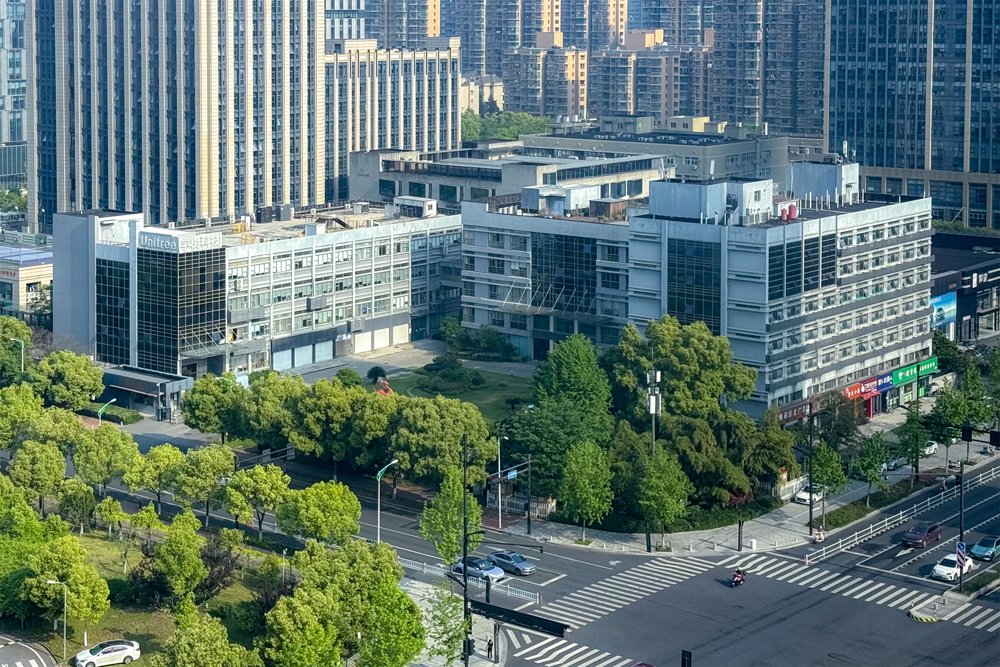
Unitree's headquarters in Hangzhou's Binjiang District — the same district where the company was registered in a 50-square-meter office in 2016.
Photo: Windmemories, CC BY-SA 4.0, via Wikimedia Commons08Military use and security concerns
Unitree's low price has repeatedly put its robots in places the company says it never intended. In August 2022, Russian state media showed a robot dog visually matching Unitree's Go1 — rebranded by a Russian firm as the "M-81" — fitted with an anti-tank rocket launcher at a Moscow defense expo. Unitree co-founder Chen Li told the South China Morning Post at the time that "all the company's products are for civilians" and that Unitree "does not support any military-related applications," while acknowledging the company couldn't fully track resale of its robots through third parties. Ukraine's military has since separately used modified Unitree robot dogs, purchased through a UK-based supplier, for scouting.
- May 2025 — all 24 members of the US House Select Committee on the Chinese Communist Party asked regulators to consider adding Unitree to the Commerce Department's Entity List, the Pentagon's Section 1260H list, and the FCC's Covered List.
- June 2026 — the US Department of Defense added Unitree (as "Hangzhou Yushu Technology") to its Section 1260H list of Chinese military companies, citing an assessed link to China's state-asset regulator and its "military-civil fusion" defense-industrial base — a designation that bars the Pentagon from directly buying from listed firms, but is not an export ban.
- 2025 — independent security researchers disclosed a pre-installed backdoor (CVE-2025-2894) on Go1 units and a separate, unpatched Bluetooth vulnerability affecting Go2, B2, G1, and H1 that could let one compromised robot spread the exploit to others on the same network.
Unitree's position throughout has been that it sells civilian hardware and doesn't control what buyers or resellers do with it afterward — a defense that grows harder to sustain the more its robots turn up, unmodified logos and all, in state military demonstrations and defense-committee letters rather than just viral stunt videos.
09FAQ
Who founded Unitree, and when?
Wang Xingxing founded Unitree on August 26, 2016, in Hangzhou, after self-funding a low-cost quadruped robot ("XDog") as a mechanical engineering master's student at Shanghai University and briefly working at DJI.
Is Unitree actually the world's top-selling humanoid maker?
It's disputed. Unitree disclosed shipping over 5,500 humanoid units in 2025 for the first time in January 2026. One industry report ranks it first globally at roughly 32% share of a 17,000-unit market; another puts the global market at roughly 13,000 units with Unitree in second place at a similar share. Both figures agree Unitree is a major player, not that it's definitively first.
How much has Unitree raised, and what is it worth?
Unitree raised roughly $252 million through its June 2025 Series C, which valued it at about $1.7 billion. Its July 2026 Shanghai STAR Market IPO approval implies a valuation of roughly $6 billion, targeting a raise of about $610–619 million.
Have Unitree's robots really been used by militaries?
Yes, in ways Unitree says it never intended. Russian state media showed a Go1-based robot armed with a rocket launcher in 2022, and Ukraine's military has used modified Unitree units for scouting. In 2025–2026, this scrutiny escalated: a US House committee asked regulators to consider export restrictions, and the Pentagon added Unitree to its list of Chinese military-linked companies in June 2026 — a designation that restricts direct US government purchases rather than banning exports outright.
10Sources
01. A student's robot dog becomes a company
04. Revenue and profitability
05. From factory floor to prime-time TV
06. IPO: the road to Shanghai's STAR Market
07. Scale and the disputed top-seller claim
08. Military use and security concerns
Related articles
Company Deep Dives
Unitree
- ›The History of Unitree Robotics(this article)
- ›Wang Xingxing: The Engineer Behind Unitree
- ›Unitree's Humanoid Robots: H1, G1, H2, and R1
- ›Unitree's Quadruped Robots: From Laikago to the B2
Figure AI
1X Technologies
Physical Intelligence
Skild AI
NVIDIA
- ›NVIDIA Isaac GR00T, Explained: What NVIDIA Actually Sells in Robotics
- ›NVIDIA DRIVE, Explained: The Automotive Platform Behind Mercedes-Benz, Uber, and a Dozen Other Automakers
- ›NVIDIA Jetson: The Decade-Old Hardware Lineage Behind Physical AI
- ›NVIDIA: A History of the GPU
- ›NVIDIA CUDA, Explained: The Software Behind NVIDIA's AI Moat
- ›Jensen Huang: From a Denny's Dishwasher to NVIDIA's CEO