Company & Robot DB
NVIDIA: A History of the GPU
Key Takeaways
- NVIDIA's first chip failed and nearly sank the company before RIVA 128 (1997) turned it into a graphics-card maker.
- A decade-long, initially unprofitable bet on CUDA (2006) became the software moat behind today's AI dominance.
- Two crypto-mining boom-bust cycles preceded the current, much larger AI-datacenter demand cycle that pushed NVIDIA's market cap past $5 trillion.
01A failed first chip (1993–1997)
The NV1: a bet on the wrong graphics approach
NVIDIA was incorporated on April 5, 1993 by Jensen Huang, Chris Malachowsky, and Curtis Priem — the founding meeting, by the company's own telling, happened at a Denny's in San Jose. The company's first product, the NV1 (1995), bet on a graphics approach called quadratic surface rendering rather than the triangle-based rendering the rest of the industry was converging on around Microsoft's DirectX standard. That bet failed commercially, and NVIDIA came close to running out of money.
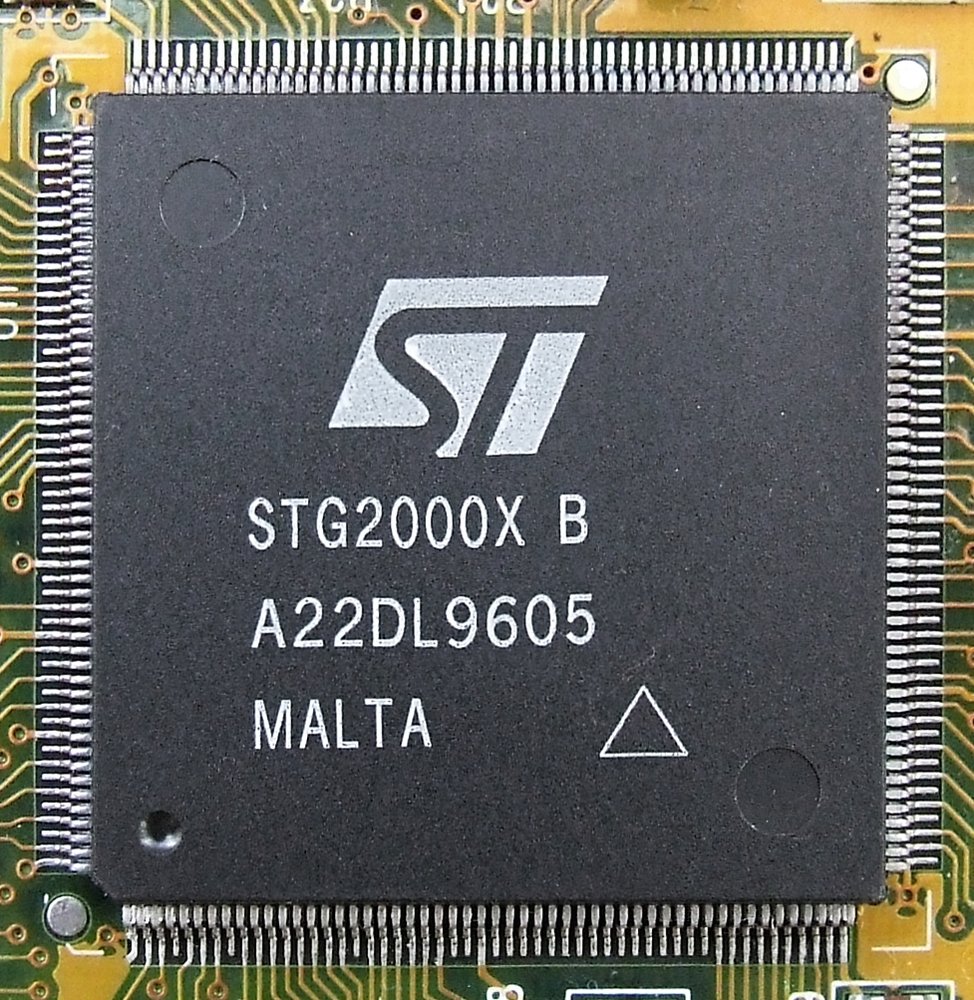
NVIDIA's first chip, the NV1 (1995) — a commercial failure that bet on a graphics approach (quadratic surfaces) the industry didn't standardize on. NVIDIA's turnaround came two years later with RIVA 128.
Photo: Trio3D, CC BY-SA 3.0, via Wikimedia CommonsRIVA 128: the save
The turnaround came with RIVA 128 in 1997: a conventional, triangle-based 3D chip that sold over a million units in its first four months. It didn't just save the company — it set the pattern NVIDIA has repeated since.
02GeForce and the invention of the GPU
GeForce 256 and the IPO
NVIDIA went public on NASDAQ on January 22, 1999, at $12 a share. The same year, it launched GeForce 256 and marketed it as the world's first "GPU" — graphics processing unit — a term NVIDIA coined for the launch rather than one that already existed in the industry. The technical claim behind the label was that GeForce 256 moved transform-and-lighting calculations, previously handled by the CPU, onto the graphics card itself.
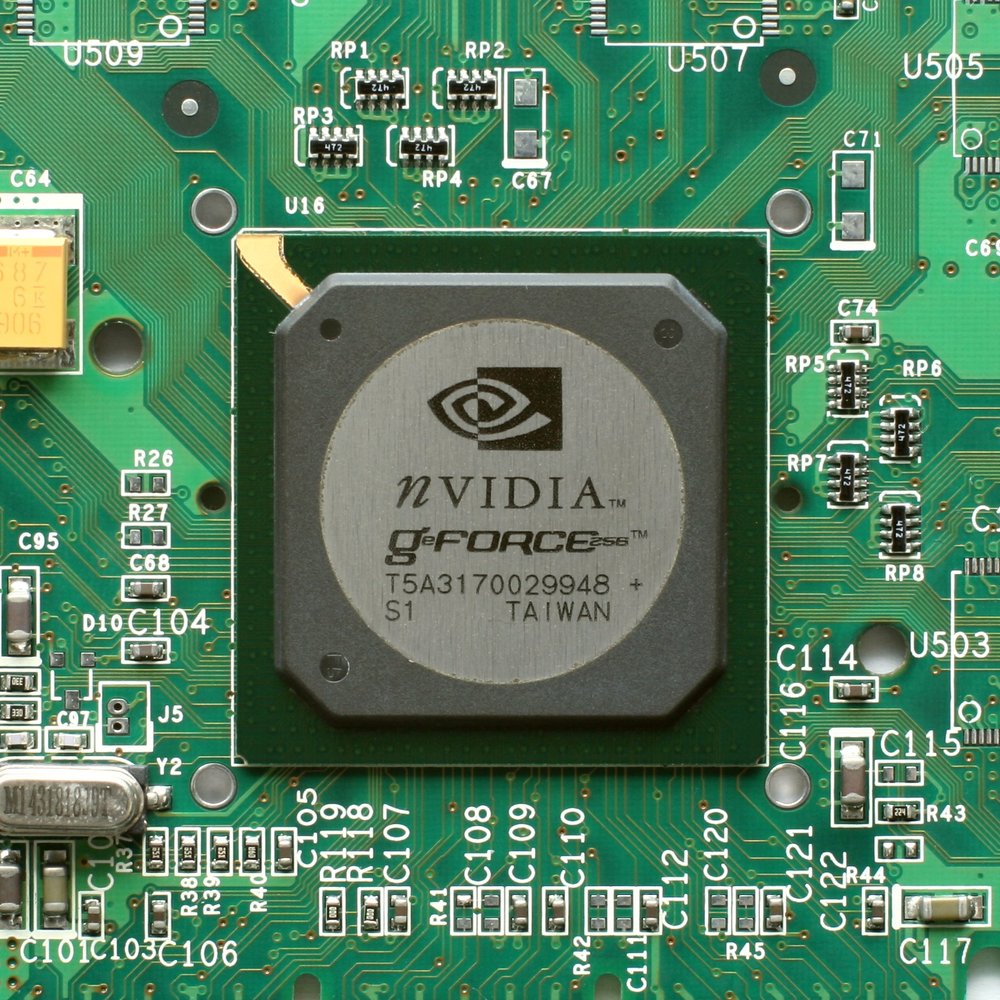
GeForce 256 (1999) — the card NVIDIA marketed as the world's first "GPU," a term the company coined for this launch. It shipped the same month NVIDIA went public on NASDAQ.
Photo: Konstantin Lanzet, CC BY-SA 3.0, via Wikimedia CommonsWas NVIDIA really first?
Whether GeForce 256 was truly the first chip to do this is disputed by hardware historians — competitors had shipped chips with overlapping capabilities — but the marketing claim stuck, "GPU" became the industry-standard term for the category, and NVIDIA has owned the label ever since.
03A decade-long investment in CUDA
CUDA launches, alongside Tesla
In November 2006, NVIDIA launched CUDA, a programming platform that let developers write general-purpose code that ran directly on GPU hardware, instead of disguising non-graphics computation as graphics operations through OpenGL — the awkward workaround researchers had relied on before. CUDA shipped alongside NVIDIA's Tesla GPU architecture, which introduced a unified shader model letting every core on the chip run general computation rather than being split into fixed graphics-only and shading-only units.
NVIDIA's own retrospective on CUDA's first 20 years (April 2026) — the platform discussed in the section below, credited with turning GPUs into general-purpose computers.
AlexNet: the moment that convinced the field
For years afterward, CUDA looked like a side investment in a gaming company's balance sheet — a research and scientific-computing tool with no obvious mass market. That changed in 2012, when Alex Krizhevsky and Ilya Sutskever, working with Geoffrey Hinton, trained a deep convolutional neural network called AlexNet on two NVIDIA GTX 580 gaming GPUs and won the ImageNet competition by a wide margin. AlexNet is now widely credited as the moment that convinced the machine-learning field that GPUs, not CPUs, were the right hardware for deep learning at scale — and NVIDIA had already spent six years building the software layer that made it possible.
The CUDA moat
That six-year head start compounded into something more durable than a single generation's performance lead: a software moat. Every framework, library, and research codebase written against CUDA between 2006 and 2012 made switching away from NVIDIA hardware more expensive rather than less, and that dynamic has only deepened since — CUDA is now widely cited as the single biggest reason AMD and other chipmakers, despite building competitive raw silicon, have struggled to take meaningful AI-training market share away from NVIDIA.
Related reading
NVIDIA CUDA
How that six-year software head start became the moat rivals still can't cross.
04The AI supercycle (2017–2026)
| Year | Event |
|---|---|
| 1993-04 | NVIDIA incorporated by Jensen Huang, Chris Malachowsky, and Curtis Priem |
| 1995 | NV1, NVIDIA's first chip, fails commercially on an unadopted graphics approach |
| 1997 | RIVA 128 ships, selling over 1 million units in four months and saving the company |
| 1999-01 | NVIDIA goes public on NASDAQ at $12/share |
| 1999 | GeForce 256 launches, marketed as the world's first "GPU" — a term NVIDIA coined |
| 2006-11 | CUDA launches alongside the Tesla GPU architecture, opening GPUs to general-purpose code |
| 2012 | AlexNet, trained on two NVIDIA GTX 580 GPUs, wins ImageNet and reshapes machine learning |
| 2017 | Volta architecture introduces Tensor Cores, silicon built specifically for deep learning |
| 2022-03 | Hopper architecture and the H100 chip unveiled at GTC |
| 2022-11 | ChatGPT's release triggers an industry-wide scramble for NVIDIA AI GPUs |
| 2023-06 | NVIDIA's market capitalization crosses $1 trillion for the first time |
| 2025-10 | NVIDIA becomes the first company to close above a $5 trillion market cap |
| 2026-05 | NVIDIA's market cap reaches a record $5.5 trillion |
Tensor Cores: purpose-built silicon
NVIDIA's 2017 Volta architecture introduced Tensor Cores, silicon purpose-built to accelerate the matrix-multiplication math at the core of deep learning, rather than repurposed graphics hardware. Every architecture since — Ampere, Hopper, Blackwell — has extended that same bet.
H100 and the ChatGPT demand shock
Hopper and its flagship H100 chip, unveiled at NVIDIA's GTC keynote in March 2022, is the clearest inflection point. NVIDIA pitched the H100 as up to 9x faster than its predecessor for AI training, built around a dedicated "Transformer Engine" for large language models. Eight months later, OpenAI released ChatGPT, and every major technology company scrambled to train and run competing models — nearly all of them on NVIDIA's A100 and H100 chips, since no comparable software ecosystem to CUDA existed for a competing chipmaker's hardware. That demand surge is the direct cause of the market-capitalization growth described below.
NVIDIA's official GTC 2022 Spring keynote (March 2022) — the event where Jensen Huang unveiled the Hopper architecture and the H100, months before ChatGPT's release created the demand surge described below.
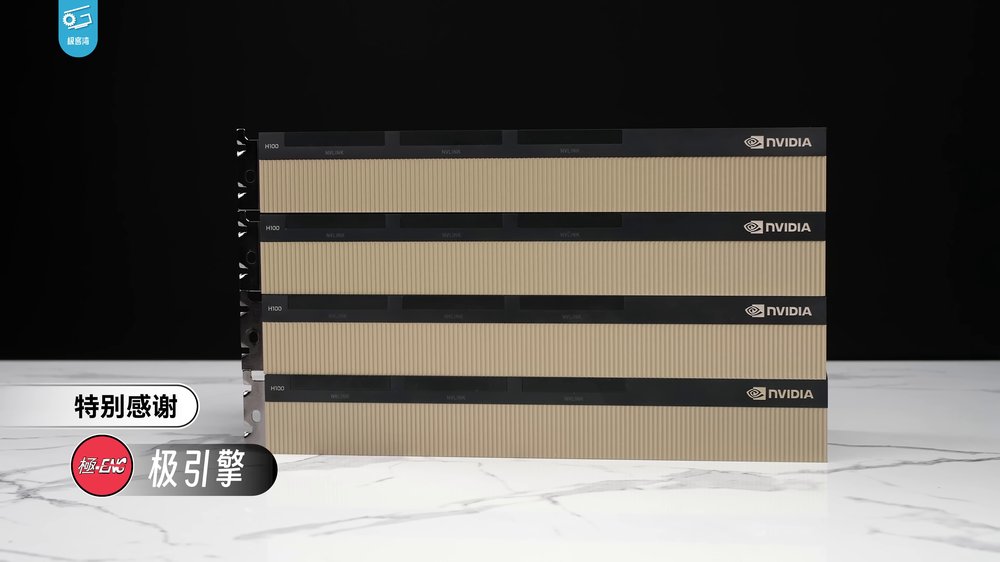
The H100 (2022) — the Hopper-architecture chip NVIDIA unveiled months before ChatGPT's release, and the GPU every major AI lab scrambled to buy once it did.
Photo: Geekerwan, CC BY 3.0, via Wikimedia CommonsRelated reading
NVIDIA Isaac GR00T
NVIDIA's humanoid-robot foundation model, and the Jetson Thor chip it runs on.
05Boom and bust, twice: the crypto-mining cycles (2016–2022)
First boom: prices climb, disclosure lags
Long before AI created sustained demand for NVIDIA's chips, cryptocurrency mining created two sharp, temporary ones — and both left a lasting mark on how NVIDIA talks about demand today. NVIDIA's market capitalization sat around $14 billion in 2016. By 2018, as Ethereum and other GPU-mineable cryptocurrencies boomed, it had climbed to a reported $175 billion, and NVIDIA posted fiscal-2018 revenue of a then-record $9.71 billion, up 41% year-on-year — growth NVIDIA's own results commentary attributed broadly to gaming, data-center, and other markets, without singling out mining's specific contribution.
The SEC settlement
That omission became a legal problem. In May 2022, the SEC charged NVIDIA with inadequate disclosures, finding that across consecutive quarters of fiscal 2018 the company failed to tell investors that cryptomining demand was a significant element of its gaming-GPU revenue growth — obscuring how much of that growth might not repeat once mining demand faded. NVIDIA settled, agreeing to a cease-and-desist order and a $5.5 million penalty, without admitting or denying the SEC's findings. The fade came fast: NVIDIA's fiscal-2019 third-quarter results, reported in November 2018, disappointed investors on weak crypto-related demand, the stock fell roughly 31% over the year, and Bitcoin's own market capitalization dropped below $100 billion that same month — down sharply from a reported peak of roughly $300 billion in January 2018.
Second boom and the Lite Hash Rate fix
A second, larger mining boom followed in 2021, again centered on Ethereum, helping push NVIDIA's fiscal-2022 revenue to $26.9 billion (up 61%) and its market capitalization briefly above a reported $800 billion. This time NVIDIA tried to head off a repeat of 2018's gamer backlash and shortage complaints directly: the RTX 3060, launched in February 2021, shipped with a "Lite Hash Rate" (LHR) limiter NVIDIA said used a tamper-proof handshake between driver, silicon, and firmware to cut Ethereum-mining performance roughly in half. It didn't hold — within about two weeks, a leaked NVIDIA development driver removed the limiter entirely, and over the following year miners progressively clawed back more of the blocked performance through further leaked and modified drivers, even as NVIDIA extended LHR to most of the RTX 30-series lineup.
The Merge ends Ethereum GPU mining overnight
The second boom ended not because of a crash but because of a protocol change: Ethereum's September 2022 transition to proof-of-stake ("the Merge") eliminated GPU mining for the network overnight, taking the dominant source of GPU-mining demand with it. NVIDIA removed LHR entirely the following month, October 2022 — by then a moot restriction on a demand source that had already disappeared. Both cycles follow the same shape: a mining-driven demand spike NVIDIA didn't create and couldn't fully control, followed by a crash NVIDIA didn't cause either.
06Becoming the world's most valuable company
Crossing $1 trillion, then $5 trillion
NVIDIA crossed a $1 trillion market capitalization for the first time in June 2023 — seven months after ChatGPT's release. It kept climbing from there: roughly $4 trillion by July 2025, the first $5 trillion close in October 2025, and a $5.5 trillion record in May 2026, the highest market capitalization any publicly traded company has reached. As of mid-2026 it remains the world's most valuable company, having tripled in value in about a year — faster than Apple or Microsoft, the only other US companies to have crossed $3 trillion.
Market cap and the events behind it (2016–2026)
What the stock splits mean
NVIDIA has split its stock six times since 2000 (most recently a 10-for-1 split in June 2024), meaning one share bought at the 1999 IPO would, share-count alone, have become 480 shares by mid-2026 — a mechanical effect of splits, not a return figure.
NVIDIA on the market
07Challenges ahead
Boom-bust cycles before, and how this one's different
NVIDIA's demand has been through sharp boom-bust cycles before, driven by causes that had nothing to do with its own product roadmap — most notably the two crypto-mining cycles detailed above, each followed by an oversupply glut once mining economics turned or a network changed its underlying algorithm. The current AI-datacenter demand cycle is larger.
Competitors and the TSMC dependency
Competition and dependency risk are real even at NVIDIA's current scale. AMD and a growing list of hyperscalers are building their own custom AI silicon, shown below, trying to erode NVIDIA's position at the high end — though none has replicated CUDA's software ecosystem depth. NVIDIA's entire chip output, meanwhile, depends on a single external manufacturer, TSMC — a concentration risk shared industry-wide but still a genuine single point of failure. NVIDIA's automotive-chip export exposure to China and its data-center-chip export restrictions are covered in more detail in the DRIVE article on this site.
Who's trying to erode NVIDIA's high end
- AMD — competing data-center GPUs (Instinct MI300/MI350 series), still without a CUDA-comparable software ecosystem
- Google — custom TPU (Tensor Processing Unit) silicon, used internally and offered through Google Cloud
- Amazon — custom Trainium chips, offered through AWS as a lower-cost alternative to NVIDIA GPUs
Related reading
NVIDIA DRIVE
NVIDIA's automotive compute platform — real revenue, but still small relative to its own guidance.
08FAQ
Did NVIDIA invent the GPU?
NVIDIA coined the term "GPU" to market its 1999 GeForce 256, claiming it as the first chip to move transform-and-lighting calculations from the CPU onto the graphics card. Hardware historians dispute whether it was truly first to do this — competitors had shipped chips with overlapping capabilities — but the marketing term "GPU" stuck as the industry-standard name for the category, and NVIDIA has been closely associated with it ever since.
Why did CUDA matter so much?
Before CUDA (2006), using a GPU for anything other than graphics meant disguising the computation as a graphics operation through OpenGL — a cumbersome workaround. CUDA let developers write general-purpose code that ran directly on GPU hardware. For years it looked like a niche research tool, until 2012's AlexNet showed GPUs were the right hardware for deep learning at scale, and the software ecosystem NVIDIA had already built around CUDA gave it a multi-year head start over any competitor.
Has NVIDIA's demand always grown this fast?
No — NVIDIA has been through sharp boom-bust demand cycles before, twice driven by cryptocurrency mining (2017–18 and 2021) rather than its own product roadmap, each followed by an oversupply glut once mining economics shifted. The current AI-datacenter boom is larger.
Did NVIDIA get in trouble over crypto mining?
Yes. In May 2022, the SEC charged NVIDIA with inadequate disclosures for failing to tell investors, across consecutive quarters of fiscal 2018, that cryptomining demand was a significant driver of its gaming-GPU revenue growth. NVIDIA settled — a $5.5 million penalty and a cease-and-desist order — without admitting or denying the findings.
09Sources
05. Boom and bust, twice: the crypto-mining cycles (2016–2022)
06. Becoming the world's most valuable company
Related articles
Articles
Company & Market Data
Company Deep Dives
Unitree
Figure AI
1X Technologies
Physical Intelligence
Skild AI
NVIDIA
- ›NVIDIA Isaac GR00T, Explained: What NVIDIA Actually Sells in Robotics
- ›NVIDIA DRIVE, Explained: The Automotive Platform Behind Mercedes-Benz, Uber, and a Dozen Other Automakers
- ›NVIDIA Jetson: The Decade-Old Hardware Lineage Behind Physical AI
- ›NVIDIA: A History of the GPU(this article)
- ›NVIDIA CUDA, Explained: The Software Behind NVIDIA's AI Moat
- ›Jensen Huang: From a Denny's Dishwasher to NVIDIA's CEO