Company & Robot DB
Travis Kalanick: From Uber to Atoms
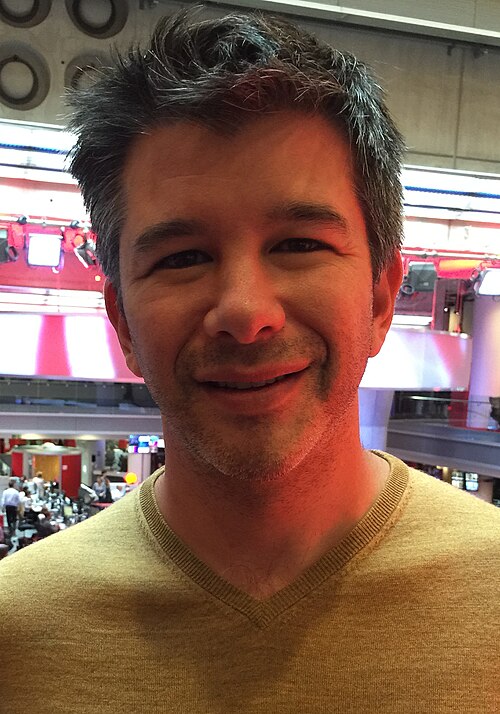
Travis Kalanick at BBC Broadcasting House in London, October 2014 — three years before the investor letter that ended his time as Uber's CEO.
Photo: cellanr, CC BY-SA 2.0, via Wikimedia CommonsKalanick's first long-form public appearance after eight years, on a16z's official channel (2026) — the source for several of his quotes below.
01Early life
| Year | Event |
|---|---|
| 1976-08 | Born in Los Angeles; grows up in Northridge |
| ~1990s | Sells Cutco knives door-to-door as a teenager |
| 1994 | At 18, starts SAT-prep company New Way Academy |
| 1998 | Drops out of UCLA to join Scour |
| 2000 | MPAA/RIAA/NMPA sue Scour over 1.8 million files; Chapter 11 follows in September |
| 2001 | Founds Red Swoosh with Michael Todd |
| 2007 | Akamai acquires Red Swoosh for $18.7M; Kalanick nets ~$2M after taxes |
| 2009 | Co-founds UberCab with Garrett Camp |
| 2010-10 | SFMTA cease-and-desist over the name; UberCab becomes Uber |
| 2011-02 | Benchmark invests $11M for ~20% at a $50M valuation |
| 2013-12 | Uber in 65 cities; Google Ventures invests $250M at a $3.5B valuation |
| 2016 | Saudi Arabia's PIF invests $3.5B in Uber |
| 2017-02 | Harassment allegations go public; dashcam video of Kalanick arguing with a driver |
| 2017-05 | Boating accident kills his mother and seriously injures his father |
| 2017-06-13 | Announces an indefinite leave of absence from Uber |
| 2017-06-20 | Resigns as CEO after five investors demand it in the "Moving Uber Forward" letter |
| 2018-01 | SoftBank-led share purchase values Uber at $48B, giving him liquidity |
| 2018-03 | His 10100 fund takes control of City Storage Systems for $150M; he becomes CEO |
| 2019-12 | Leaves Uber's board after selling more than $2.5B of stock (~90% of his holding) |
| 2026-03 | City Storage Systems renamed Atoms; Pronto acquisition announced |
| 2026-07 | Atoms raises $1.7B led by a16z, with Uber participating |
Northridge, and a competitive household
Travis Cordell Kalanick was born in Los Angeles on August 6, 1976, and grew up in Northridge, in the San Fernando Valley. His mother, Bonnie, worked in retail advertising for the Los Angeles Daily News; his father, Donald, was a civil engineer for the city of Los Angeles. Accounts of his school years consistently describe the same trait — a competitiveness that showed up in everything from grades to arguments — and he graduated from Granada Hills Charter High School before enrolling at UCLA to study computer engineering and business economics.
The engineering-plus-economics combination shows up in what he built next. Almost every company since sits at that seam: a technical system whose difficulty is as much the unit economics around it as the code. Uber was a dispatch problem and a pricing problem at once. CloudKitchens is a real-estate problem wearing a software interface. Atoms, by his own description, is an attempt to treat manufacturing, property and transport as one programmable machine.
Selling knives, then selling test prep
His first businesses started while he was still a teenager. He sold Cutco knives door-to-door — the classic American commission-only sales apprenticeship — and at 18 he started a test-preparation company called New Way Academy, teaching SAT preparation. Neither is a technology story: his formative business experience was carrying a quota, not shipping software.
In 1998 he dropped out of UCLA, along with Michael Todd and Vince Busam, to join Scour, the multimedia search engine and peer-to-peer file-sharing service founded by Dan Rodrigues. He was 22.
Before Uber, in four numbers
02Scour and Red Swoosh
Scour, and the 2000 lawsuit
Scour Exchange let people search for and share media files, which in 2000 put it directly in front of the entertainment industry's lawyers. The Motion Picture Association of America and the Recording Industry Association of America sued in federal court in Manhattan on July 24, 2000, alleging Scour had made 1.8 million infringing files available and demanding $150,000 for each work infringed; the National Music Publishers Association joined the action. The contemporaneous report carries no total, and the $250 billion figure repeated ever since comes from later compiled accounts rather than from multiplying those two numbers — statutory damages are counted per work, not per file. In September 2000 Scour filed for Chapter 11 bankruptcy protection.
The six years of Red Swoosh
In 2001 Kalanick started Red Swoosh with Michael Todd, building peer-to-peer content delivery for the same media companies that had just sued him; he has described it as his "revenge business". It was a grinding six years. He took no salary for long stretches, and in September 2001 the company used roughly $110,000 of its payroll tax withholdings to keep operating; later accounts differ on who made that call, and Kalanick and co-founder Michael Todd have given conflicting versions of it. Akamai Technologies acquired Red Swoosh in April 2007 for an aggregate purchase price of $18.7 million, per Akamai's own filings; Kalanick's own take, after taxes, was around $2 million.
Both companies put him in front of regulators, incumbents and their lawyers before he had a product at scale. Scour was also, in product terms, an early version of what streaming later became; it ran out of money before that market arrived.
Kalanick telling the Scour and Red Swoosh years himself, at FailCon in San Francisco in November 2011: the lawsuits, the co-founder's departure, the trouble with the IRS and the sale to Akamai. This is his side of those events; as noted above, later accounts differ on parts of them.
03Uber
Founding, 2009
In 2009 Kalanick co-founded UberCab with Garrett Camp. Ryan Graves was the CEO at launch and held the job for about ten months before Kalanick took over. In October 2010 the San Francisco Municipal Transportation Agency served the company with a cease-and-desist order over the "cab" in its name; the company dropped it and became Uber.
The funding, and the operating style
The funding history compressed fast. In February 2011 Benchmark's Bill Gurley invested $11 million for roughly 20% of the company at a $50 million valuation. By December 2013 Uber operated in 65 cities, and Google Ventures put in $250 million at a $3.5 billion valuation. In 2016 Saudi Arabia's Public Investment Fund invested $3.5 billion — the same sovereign fund that would later back CloudKitchens.
Kalanick's operating style during those years is inseparable from both the growth and what followed. Uber's expansion playbook — enter first, argue with regulators afterwards, compete on subsidy — worked commercially and generated a running series of conflicts, and the internal culture that produced it eventually became the company's central problem.
Three funding moments that set Uber's trajectory
Founding, and a name change
Co-founded with Garrett Camp as UberCab, with Ryan Graves as launch CEO. A 2010 cease-and-desist from San Francisco's transit agency over the word "cab" produced the name Uber.
Benchmark's $11M
Bill Gurley invested $11 million for roughly 20% at a $50 million valuation — the same firm that would lead the investor group demanding his resignation six years later.
Google Ventures' $250M
A $250 million investment at a $3.5 billion valuation, with Uber then operating in 65 cities — the point at which the company stopped being a city-by-city experiment.
04The 2017 exit
What surfaced in February 2017
The pressure became public in February 2017. A former engineer's account of harassment and HR failures at the company, published on her personal blog, was followed within weeks by a Bloomberg-published dashcam video of Kalanick arguing with an Uber driver over fares — he apologized to employees by email — and by reporting that he had known about harassment allegations without acting. In the same period he asked his newly hired SVP of Engineering, Amit Singhal, to resign after Singhal failed to disclose that he had left Google following a harassment claim.
The resignation, and the fight after it
Then it turned personal. At the end of May 2017, Kalanick's parents were in a boating accident that seriously injured his father and killed his mother. On June 11 the final report of the independent investigation into harassment at Uber was presented to the company's leadership; on June 13 Kalanick announced an indefinite leave of absence; on June 20, after five major investors including Benchmark delivered a letter titled "Moving Uber Forward" demanding he step aside, he resigned as CEO.
He kept his board seat, and the fight continued: Benchmark sued him in August 2017 for fraud and breach of fiduciary duty, a case that moved to arbitration. In January 2018 a SoftBank-led share purchase valued Uber at $48 billion and gave him liquidity. On December 24, 2019 he announced he would leave the board effective December 31, having sold more than $2.5 billion of Uber stock — about 90% of his holding — in the preceding weeks.
Key events before and after the resignation
- Feb 2017 — A former engineer publishes a detailed account of harassment and HR failures at Uber on her personal blog; reporting follows that Kalanick knew of allegations without acting, and Bloomberg publishes dashcam video of him arguing with a driver.
- May 2017 — His parents are in a boating accident; his mother dies and his father is seriously injured.
- Jun 11, 2017 — The final report of the independent investigation into harassment at Uber is presented to the company's leadership.
- Jun 13, 2017 — Kalanick announces an indefinite leave of absence.
- Jun 20, 2017 — Five major investors including Benchmark deliver a letter titled "Moving Uber Forward" demanding he step aside; he resigns as CEO the same day, keeping his board seat.
- Dec 2019 — He leaves Uber's board effective December 31, after selling more than $2.5 billion of stock, about 90% of his holding.
I love Uber more than anything in the world and at this difficult moment in my personal life I have accepted the investors request to step aside so that Uber can go back to building rather than be distracted with another fight.
05The eight years after Uber
In March 2018, nine months after resigning, Kalanick announced that his new fund, 10100, was taking a controlling stake in City Storage Systems for $150 million and that he would run it as CEO. The money came from the Uber shares he had just sold into SoftBank's purchase, and the business was unglamorous by design: buy distressed buildings, convert them into delivery-only kitchens, rent them to restaurant operators.
CloudKitchens raised heavily — a reported $400 million from Saudi Arabia's PIF in 2019, $850 million in 2021 at a reported $15 billion valuation with Microsoft investing — and then hit the same wall as the rest of the ghost-kitchen category when the delivery boom cooled, with layoffs, site closures and tenant churn reported from 2023 onward. Through all of it Kalanick said almost nothing publicly, which is itself unusual for a founder of his profile, and which he now describes as intentional.
Related reading
Atoms: Inside Travis Kalanick's Industrial Robotics Company
The company side of this story — the six operating businesses, the funding history and the specialized-robots-over-humanoids argument.
06Atoms
The company called Atoms
On March 13, 2026, City Storage Systems was renamed Atoms, and the eight years were re-presented as one project: an industrial robotics group organized into Atoms Food, Atoms Mining and Atoms Transport, with CloudKitchens as the food business and the newly acquired Pronto — Anthony Levandowski's mine-and-quarry autonomy company — as the technology base for mining. In July 2026 Atoms raised $1.7 billion led by a16z, with Ben Horowitz joining the board and Uber participating at a reported $100 million. In August, Gautam Gupta, Uber's finance chief until shortly after Kalanick's own departure, joined as CFO.
Levandowski's return, and Kalanick's own framing
The Pronto acquisition puts Levandowski back into a Kalanick company. He led Uber's self-driving unit until his firing in May 2017, was indicted on 33 federal counts of trade-secret theft in 2019, pleaded guilty to one count and was sentenced in August 2020 to 18 months in prison plus a $95,000 fine and $756,499.22 in restitution, and was pardoned in January 2021. What Atoms bought is that mining technology, and both facts belong in any account of Atoms Mining.
Kalanick's own framing rejects the comeback narrative. "When I told my friends, family and colleagues about my plans for what was next, they were really excited I was 'coming back,'" he wrote in his essay published by a16z. "The thing is, I never left."
When I told my friends, family and colleagues about my plans for what was next, they were really excited I was 'coming back.' The thing is, I never left.
07Open questions
What Kalanick is proposing this time is testable. Atoms Food has customers, buildings and a software layer; Atoms Mining has a technology and a pitch — about 20% more gold per year — that, by his own account, mine operators answer with "prove it"; Atoms Transport has not been announced. The $1.7 billion is real; the valuation behind it was not disclosed.
The governance record is the other open item, and it is not resolved by a new company. The specific failures that ended his Uber tenure were about how the company handled harassment complaints and internal conduct, and Atoms has not been through a public test of that kind. Reporting since the launch has been thin on the inside of the company — a launch-party piece noted that neither Kalanick nor an Atoms representative responded to requests for comment. Both belong in the same paragraph: an operating record with customers and revenue, and an institutional record that has not been tested at this company.
08Sources
02. Scour and Red Swoosh
04. The 2017 exit
05. The eight years after Uber
Related articles
Company Deep Dives
Unitree
Figure AI
1X Technologies
Physical Intelligence
Skild AI
NVIDIA
- ›NVIDIA Isaac GR00T, Explained: What NVIDIA Actually Sells in Robotics
- ›NVIDIA DRIVE, Explained: The Automotive Platform Behind Mercedes-Benz, Uber, and a Dozen Other Automakers
- ›NVIDIA Jetson: The Decade-Old Hardware Lineage Behind Physical AI
- ›NVIDIA: A History of the GPU
- ›NVIDIA CUDA, Explained: The Software Behind NVIDIA's AI Moat
- ›Jensen Huang: From a Denny's Dishwasher to NVIDIA's CEO
AgileX Robotics
Atoms
- ›Atoms: Inside Travis Kalanick's Industrial Robotics Company
- ›Travis Kalanick: From Uber to Atoms(this article)