Company & Robot DB
Wang Xingxing: The Engineer Behind Unitree
01Early life
Wang Xingxing was born in 1990 in Yuyao, a county-level city administered by Ningbo, Zhejiang province. By his own and his teachers' accounts, he was an unusually quiet child — one profile describes him as "almost completely silent with classmates," and a middle-school English teacher reportedly told his mother the boy was "a bit slow." English, in particular, was a weak subject throughout his schooling, in contrast to strong marks in math, physics, and chemistry.
What set him apart early was a compulsion to build things: a wind-powered miniature car in elementary school, an attempted miniature turbine engine in middle school, and — around 2006, in high school — a working rechargeable battery he built after self-studying the chemistry. He enrolled at Zhejiang Sci-Tech University in 2009 to study mechatronics, and that winter break, using his own pocket money, bought a roughly 30-yuan Arduino board and a dozen small servos to build a 14-degree-of-freedom bipedal robot for about 200 yuan total — cut, drafted, and polished entirely by hand.
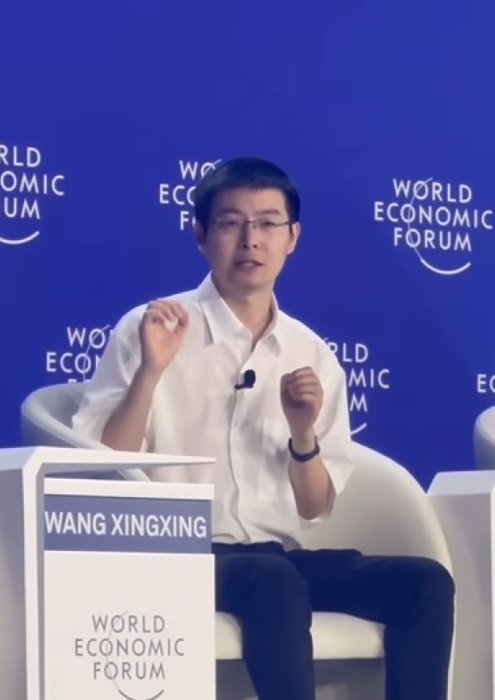
Wang Xingxing at the World Economic Forum's Annual Meeting of the New Champions in Tianjin, June 2025 — one of the highest-profile public appearances by a man Chinese tech press consistently describes as low-profile and reluctant to court the spotlight.
Photo: China News Service, CC BY 3.0, via Wikimedia Commons02XDog and two months at DJI
Wang's master's research at Shanghai University (2013–2016) is where the company's origin story actually starts. His advisor, legged-robot specialist Jia Wenchuan, recruited him as the only master's student that year admitted from outside Shanghai University's own undergraduate program — citing, in Jia's own words, Wang's "geek spirit" despite unremarkable entrance scores. Working from a research grant exploring brain-computer-interface control of quadruped locomotion, Wang spent roughly three years developing XDog, a low-cost quadruped built around inexpensive outer-rotor brushless motors rather than the costly custom actuators used by labs like Boston Dynamics. A lab roommate recalled he was consistently "first to arrive, last to leave," and he delayed his own graduation in 2015 because the project wasn't finished. XDog won second prize (and a ¥80,000 cash award — his "first pot of gold," as one profile put it) at Shanghai's "Star Creator" innovation competition in August 2015, then went viral after he posted test footage online, drawing coverage from IEEE Spectrum and attracting buyer and investor interest before he had a company to sell through.
After graduating in mid-2016, Wang joined drone maker DJI — and resigned roughly two months later, while still in his probationary period, to found his own company on the strength of that investor interest. Unitree Technology Co., Ltd. was registered in Hangzhou's Binjiang District on August 26, 2016, backed by 2 million yuan in angel funding for a 20% stake. Unitree's subsequent corporate history — its product lines, funding rounds, and 2026 IPO — is covered in full in our full history of Unitree.
| Year | Event |
|---|---|
| 1990 | Born in Yuyao, Ningbo, Zhejiang province |
| 2009 | Enrolls at Zhejiang Sci-Tech University; builds a ~200-yuan bipedal robot as a freshman |
| 2013 | Begins a master's degree at Shanghai University under Jia Wenchuan; starts developing XDog |
| 2015-08 | XDog wins second prize at Shanghai's "Star Creator" innovation competition |
| 2016-05 | Joins drone maker DJI after graduating |
| 2016-08 | Resigns from DJI after ~2 months; founds Unitree in Hangzhou on Aug 26 |
| 2025-02 | Sits in the front row of Xi Jinping's private-enterprise symposium in Beijing |
| 2025-04 | Receives China's Youth May Fourth Medal |
| 2025-08 | Keynotes the World Robot Conference in Beijing |
| 2026-06 | New Fortune 500 list values his stake at ~¥12.61 billion (~$1.75B) |
| 2026-07 | Unitree's IPO approval implies his 23.82% direct stake is worth over ¥14 billion (~$1.95B) |
03How he works
Wang's public statements return repeatedly to two themes: obsessive attention to hardware detail, and cost as a design constraint rather than an afterthought. "You have to push every detail to its absolute extreme — even a single screw or a single wire matters tremendously," he said at an industry forum in December 2024, the same appearance where he described "cost" as "the KPI for everything we do; the core of it is making money." That framing extends to a specific long-run target: he has said the cost of a humanoid robot should eventually be no higher than that of ten air conditioners.
He's also been explicit about rejecting the price-war dynamics that have shaped parts of China's EV and solar industries. "When everyone is selling robots at a loss, that will wreck this industry," he said in a February 2026 interview, adding: "I advocate rational restraint. Don't engage in malicious, ineffective competition... our biggest competitor has always been ourselves." Colleagues and early investors describe him as reserved, plain-dressing, and personally involved in day-to-day R&D and hiring rather than delegating outward-facing duties — a 36Kr profile called him someone who "refuses to be over-hyped," avoiding the spotlight even as Unitree's own profile grew.
04From the lab to the front row
Wang's highest-profile public moment came on February 17, 2025, when he sat in the front row of a private-enterprise symposium in Beijing chaired by Xi Jinping, alongside Huawei's Ren Zhengfei, Alibaba's Jack Ma, Tencent's Pony Ma, BYD's Wang Chuanfu, and Xiaomi's Lei Jun — one of only six entrepreneurs asked to speak, and reportedly the youngest person in the room. He appeared again that June at the World Economic Forum's "Summer Davos" meeting in Tianjin, and in August 2025 delivered a keynote at the World Robot Conference in Beijing, where he offered a blunt assessment of the industry's actual maturity: "the basic hardware is sufficient, it's not good enough," and current AI models remain "not good enough, and not unified enough" — comparing embodied AI's present stage to the 1–3 years before ChatGPT's breakthrough.
Even Elon Musk has weighed in publicly: in December 2025, after Unitree G1 robots performed as backup dancers at a pop concert in Chengdu, Musk called the routine "impressive" on X. Wang's own reply was characteristically modest: "the public's affection for Unitree robots has exceeded my own expectations."
05Recognition, without elected office
Wang has collected a wide range of institutional recognition without holding elected political office. He received China's Youth May Fourth Medal — one of the country's top honors for outstanding young people — in April 2025, was named to TIME's TIME100 AI list the same year, and placed near the top of Fortune China's 2025 "40 Under 40" business-elites ranking. He also holds several advisory and standards roles: a seat on Hong Kong's Chief Executive's Advisory Team for the 2025–2027 term, vice-director of a Ministry of Industry and Information Technology standardization committee for humanoid robots and embodied intelligence (alongside AgiBot's Peng Zhihui), and the first rotating chairmanship of a Hangzhou embodied-intelligence industry alliance.
- No National People's Congress (NPC) delegate seat or Chinese People's Political Consultative Conference (CPPCC) membership is documented for Wang as of mid-2026 — his influence runs through advisory and standards bodies, not elected office.
- China Youth May Fourth Medal (April 2025) and the preceding Zhejiang provincial version (March 2025) — national and provincial honors for outstanding young people.
- TIME100 AI (2025) and Fortune China's "40 Under 40" business-elites list (2023 and 2025).
06What Unitree's rise means for his wealth
Wang's personal wealth has climbed in step with Unitree's valuation, though every figure below is a snapshot tied to a specific date rather than a stable number — treat the trajectory, not any single figure, as the reliable takeaway. He debuted on the New Fortune 500 Wealth Creation List in June 2025 at 6.69 billion yuan (about $920 million); by the same list's June 2026 edition, his holdings were valued at 12.61 billion yuan (about $1.75 billion). Hurun Report's Global Rich List, with a wealth snapshot dated January 15, 2026, described him only as a "future billionaire" — not yet counted among its confirmed billionaires at that point.
Unitree's IPO prospectus discloses Wang's actual ownership structure: he holds 23.82% of the company directly, plus a further 10.94% through an employee-stock-ownership vehicle he controls, for 34.76% total economic interest — while a differentiated voting arrangement gives him roughly 68.78% of voting rights, making him Unitree's controlling shareholder. Chinese financial press calculated that his direct 23.82% stake alone would be worth more than 14 billion yuan (about $1.95 billion) once the STAR Market listing prices, based on the IPO's implied valuation.
Wang's wealth, by snapshot date
07On the future
Wang has been candid about why the humanoid-robot investment boom happened when it did, crediting Tesla rather than any technical breakthrough of his own industry: "the reason is actually simple — Tesla started building humanoid robots," he said in a February 2025 interview, arguing that Musk's prior credibility in cars and rockets gave the category legitimacy that let governments and capital move in without waiting for results. On timelines, he's offered a specific, widely circulated estimate: current robot technology sits at roughly the capability level of a 10-year-old child, and closing that gap to adult-level competence will take "three to five years if fast, definitely not more than ten if slow."
On open-sourcing his own core technology, he's been more guarded than his public reputation for openness might suggest: "whatever we ourselves develop will definitely not be open-sourced," he said, while separately noting Unitree does release some reinforcement-learning algorithms to help grow the wider industry — "there are many open-source options, but open source alone is completely insufficient; you have to outperform others across every dimension to succeed."
08FAQ
Who is Wang Xingxing?
Wang Xingxing (born 1990, Yuyao, Zhejiang) is the founder and controlling shareholder of Unitree Robotics. He built a low-cost quadruped robot, XDog, as a master's student at Shanghai University, briefly worked at drone maker DJI, then founded Unitree in Hangzhou in August 2016.
Is Wang Xingxing a billionaire?
As of a January 2026 snapshot, Hurun Report described him only as a "future billionaire," not yet a confirmed one. But by later 2026 estimates tied to Unitree's IPO approval, his direct 23.82% ownership stake alone was calculated to be worth over 14 billion yuan (about $1.95 billion) — past the billionaire threshold. Every figure is a snapshot tied to a specific date, not a stable number.
What is Wang Xingxing's engineering philosophy?
Obsessive attention to hardware detail combined with cost discipline as a core design constraint, not an afterthought — he's described cost as "the KPI for everything we do" and said a humanoid robot's eventual cost should be no higher than ten air conditioners. He's also explicitly rejected price-war competition, saying Unitree's real competitor "has always been ourselves."
Does Wang Xingxing hold any political office in China?
No elected office — no National People's Congress delegate seat or CPPCC membership is documented for him. His influence instead runs through advisory and standards bodies: a seat on Hong Kong's Chief Executive's Advisory Team, vice-director of a national humanoid-robot standardization committee, and a front-row appearance at Xi Jinping's 2025 private-enterprise symposium.
09Sources
01. Early life
02. XDog and two months at DJI
03. How he works
04. From the lab to the front row
05. Recognition, without elected office
06. What Unitree's rise means for his wealth
07. On the future
Related articles
Company Deep Dives
Unitree
- ›The History of Unitree Robotics
- ›Wang Xingxing: The Engineer Behind Unitree(this article)
- ›Unitree's Humanoid Robots: H1, G1, H2, and R1
- ›Unitree's Quadruped Robots: From Laikago to the B2
Figure AI
1X Technologies
Physical Intelligence
Skild AI
NVIDIA
- ›NVIDIA Isaac GR00T, Explained: What NVIDIA Actually Sells in Robotics
- ›NVIDIA DRIVE, Explained: The Automotive Platform Behind Mercedes-Benz, Uber, and a Dozen Other Automakers
- ›NVIDIA Jetson: The Decade-Old Hardware Lineage Behind Physical AI
- ›NVIDIA: A History of the GPU
- ›NVIDIA CUDA, Explained: The Software Behind NVIDIA's AI Moat
- ›Jensen Huang: From a Denny's Dishwasher to NVIDIA's CEO