Company & Robot DB
NVIDIA DRIVE, Explained: The Automotive Platform Behind Mercedes-Benz, Uber, and a Dozen Other Automakers
Key Takeaways
- NVIDIA doesn't build cars — automakers like Mercedes-Benz, Uber, BYD, and Toyota build on NVIDIA's DRIVE chips, software, and safety framework.
- Eleven years and several chip generations after the original DRIVE PX, the business is real but still small next to NVIDIA's data-center revenue.
- NVIDIA's own revenue guidance for DRIVE has repeatedly missed its targets.
01What DRIVE is
The DRIVE stack
DRIVE is NVIDIA's automotive compute and software platform: a stack spanning the DRIVE Thor system-on-chip, the automotive-certified DriveOS operating system, and DRIVE Hyperion, a reference sensor-and-compute architecture that Tier-1 suppliers and automakers build production vehicles around rather than designing their own from scratch.
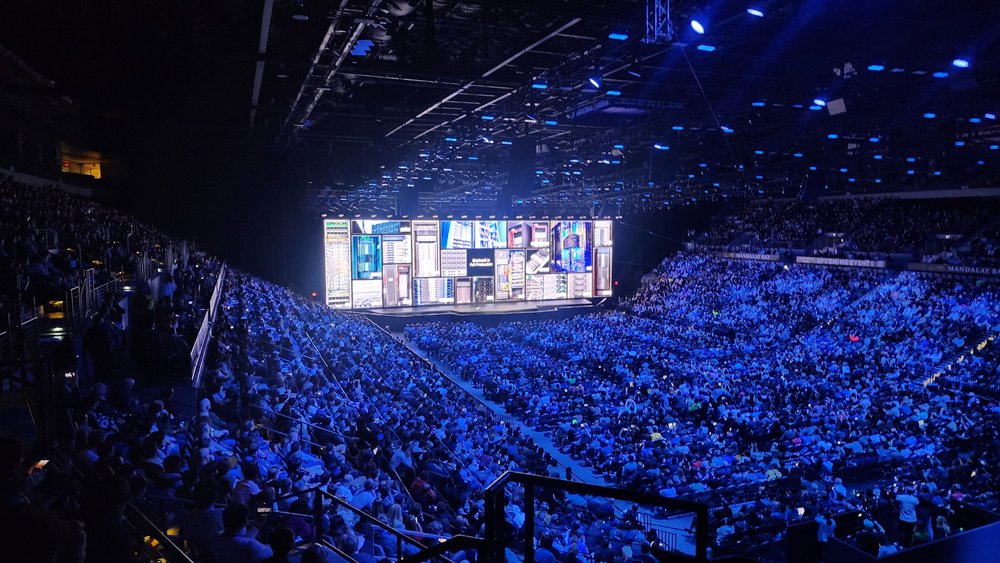
Jensen Huang delivering NVIDIA's CES 2025 keynote (January 2025) — the same annual event where NVIDIA has announced most of the DRIVE partnerships and safety systems discussed below, including CES 2026's Alpamayo reasoning models and expanded DRIVE Hyperion ecosystem.
Photo: Joseph Zadeh, CC BY-SA 4.0, via Wikimedia CommonsFrom DRIVE PX to DRIVE Thor
NVIDIA first entered the space with DRIVE PX in January 2015 — two Tegra X1 chips supporting up to 12 cameras — and has iterated through DRIVE PX 2, Xavier, Orin, and a cancelled chip called Atlan on the way to today's Blackwell-based DRIVE Thor, announced in March 2024.
DRIVE Thor, in numbers
DRIVE Thor vs. Jetson AGX Thor
The current DRIVE Thor SoC and Jetson AGX Thor are built on the same underlying Blackwell architecture.
Related reading
NVIDIA's Bet on Physical AI: Isaac GR00T and Jetson Thor
The humanoid-robot side of NVIDIA's physical-AI bet, built on the same Blackwell-based chip lineage.
02The technical approach
Three computers, one pipeline
NVIDIA frames its AV development pipeline as "three computers," shown below. At CES 2026, NVIDIA introduced Alpamayo and AlpaSim as the current generation of that pipeline, with the Mercedes-Benz CLA named as the first production car to ship the full Alpamayo-based stack.
NVIDIA's "three computers"
NVIDIA's own "On the Road With DRIVE AV" (March 2026) — Jensen Huang and NVIDIA's VP of Automotive riding through San Francisco while demoing the DRIVE AV software stack discussed below.
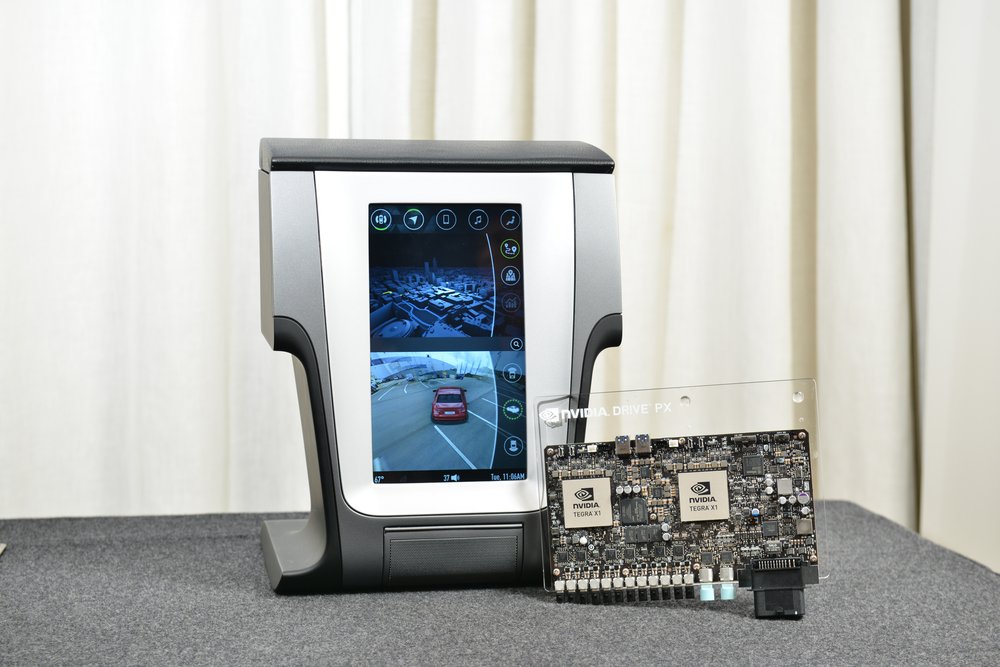
The original DRIVE PX, shown at Computex Taipei in June 2015 — two Tegra X1 chips supporting up to 12 cameras. Eleven years and several chip generations later, DRIVE's current hardware (DRIVE Thor) is discussed below.
Photo: NVIDIA Taiwan, CC BY 2.0, via Wikimedia CommonsHalos: the safety framework wrapping it all
Wrapping around all of it is Halos, NVIDIA's safety framework, launched at GTC in March 2025 and unifying hardware, software, and validation tooling from cloud to car. Its production automotive layer, Halos OS, arrived at GTC 2026 as a three-tier architecture built on ASIL-D-certified DriveOS, adding safety middleware and an NCAP five-star active-safety application stack. Separately, DriveOS 6.0 itself earned ISO 26262 ASIL-D functional-safety certification and ISO 21434 cybersecurity process certification from TÜV SÜD and TÜV Rheinland in January 2025 — NVIDIA says the first such comprehensive third-party assessment spanning chip, OS, and software together, though that certification covered the then-current Orin silicon rather than Thor.
03Who's actually building on it
Full stack + robotaxi: Mercedes-Benz, Uber, Aurora
DRIVE partnerships split into roughly three tiers. At the deepest, full-stack-plus-robotaxi tier: Mercedes-Benz's L4-ready S-Class, unveiled for a robotaxi service launching with Uber in January 2026, runs the complete DRIVE Hyperion architecture and DRIVE AV L4 software with Halos safety layered in; Uber itself partnered with NVIDIA in October 2025 to build what the companies called the world's largest planned Level 4 robotaxi network, targeting roughly 100,000 vehicles and dozens of cities by 2028, alongside Lucid and Nuro; and Aurora, together with Continental, is using DRIVE Thor for driverless freight trucks Continental plans to mass-manufacture starting 2027.
Level-4-targeted hardware: BYD, Geely, and the rest
A second, Level-4-targeted tier — BYD, Geely, Isuzu, and Nissan — was announced together in March 2026 as building next-generation AV programs on production-ready DRIVE Hyperion hardware, joining GM, Toyota, and Hyundai/Kia, who had signed on earlier for a mix of Level 2+ driver assistance and, in Hyundai's case via its Motional joint venture, Level 4 robotaxi development.
Chip supply only: Xiaomi
A third, narrower tier uses NVIDIA mainly as a chip supplier rather than a full-stack partner: Xiaomi's SU7 and YU7 run DRIVE Orin and DRIVE Thor silicon under Xiaomi's own in-house "Pilot Pro" software, a Level 2 driver-assistance product rather than NVIDIA's own DRIVE AV stack.
Partner tiers, by depth of integration
Mercedes-Benz, Uber, Lucid, Nuro, Aurora
Full DRIVE Hyperion hardware + DRIVE AV L4 software + Halos safety, aimed at driverless robotaxi or freight service.
BYD, Geely, Isuzu, Nissan, GM, Toyota, Hyundai/Kia
Production-ready DRIVE Hyperion hardware for next-generation AV programs, mostly still short of a public robotaxi launch.
Xiaomi
DRIVE Orin/Thor silicon under the automaker's own in-house software (Xiaomi's "Pilot Pro"), a Level 2 product, not NVIDIA's DRIVE AV software stack.
04The revenue gap
Guidance vs. actual
NVIDIA's own past guidance for this business has not matched what it actually delivered. In February 2024, CFO Colette Kress told investors NVIDIA expected its Automotive vertical to reach roughly $5 billion in revenue for fiscal year 2026. The actual result, reported a year later: $2.3 billion — under half the guided figure, even as the number grew 39% year-on-year. Trade press covering the March 2026 earnings call summarized the situation bluntly: automotive remains roughly 1% of NVIDIA's total revenue, next to Data Center's roughly 90%, and Jensen Huang has said publicly that he isn't concerned about the gap given how large he expects the business to eventually become.
NVIDIA's own guidance vs. what it actually reported
Yahoo Finance, Feb 2024 (guidance) / NVIDIA Newsroom, Feb 2026 (FY2026 results)
A moving target: no more standalone Automotive segment
Starting with its Q1 FY2027 results in May 2026, NVIDIA stopped breaking out Automotive as its own reporting segment altogether, folding it into a broader "Edge Computing" category alongside PCs and robotics — meaning there's no longer a clean, single figure to track this business against going forward, and no updated automotive-specific revenue guidance has been given under the new structure as of this writing.
NVIDIA's CES 2026 keynote livestream (January 2026) — includes the Alpamayo reasoning models and the DRIVE Hyperion ecosystem expansion covered in the sections below.
05Where DRIVE fits in the business
China and export controls
NVIDIA's automotive silicon has also mostly avoided the export-control fight that has repeatedly hit its data-center chips: DRIVE Orin carries an export classification that's freely exportable to China for civilian automotive use, unlike the restricted classifications covering NVIDIA's most advanced data-center GPUs. Trade press has framed automotive as one of NVIDIA's few remaining growth paths into the Chinese market even as its China data-center revenue has been squeezed — though NVIDIA's China automotive-chip market share is itself reportedly under pressure from domestic rival Horizon Robotics, according to trade-press tracking that NVIDIA hasn't confirmed or disputed.
A long-run bet, not an urgent one
As with robotics, none of this small-scale-today framing means NVIDIA is deprioritizing the bet: the company's ~$5.1 trillion market capitalization as of mid-July 2026 is overwhelmingly a data-center story, and automotive is a long-run platform play layered on top rather than something NVIDIA needs to monetize immediately.
06Challenges ahead
No confirmed safety incidents — yet
No independently verified safety incident has been tied specifically to NVIDIA's DRIVE hardware or software as of this writing. Reported AV recalls and investigations in this period — a 2024 Waymo software recall, a Zoox crash investigation in Las Vegas — involve companies that either don't use NVIDIA's onboard compute (Waymo runs in-house/Intel-based hardware) or whose incident reporting doesn't attribute the cause to NVIDIA's stack specifically. That's a fact worth stating plainly rather than a guarantee about the future, given how many vehicles now run DRIVE hardware.
A regulatory patchwork
Regulatory certification remains a genuine patchwork. DriveOS's ASIL-D certification covered Orin-generation silicon, not yet Thor, and NVIDIA has not published a similarly detailed independent safety assessment specific to Thor-based Hyperion deployments as of this writing — worth watching as Hyperion 9's 2026 production ramp proceeds.
Competition from two directions
Competition is intensifying from two directions at once: Qualcomm's Snapdragon Ride and Mobileye's vertically integrated EyeQ-plus-software approach both target the same mid-tier ADAS market NVIDIA competes in outside its flagship Level-4 partnerships, and in China specifically, domestic chipmaker Horizon Robotics has reportedly gained share fast enough that trade press describes the market as a forming NVIDIA/Horizon duopoly rather than NVIDIA's alone.
Where DRIVE faces competition
Qualcomm — Snapdragon Ride
Targets the same mid-tier ADAS market NVIDIA competes in outside its flagship Level-4 partnerships.
Mobileye — EyeQ + software
A vertically integrated EyeQ-chip-plus-software approach aimed at the same mid-tier ADAS market.
Horizon Robotics
Domestic Chinese chipmaker reportedly gaining share fast enough that trade press now describes the market as a forming NVIDIA/Horizon duopoly.
Harder to track from the outside
Finally, the revenue-reporting change itself is worth watching rather than dismissing as a footnote: folding Automotive into a broader Edge Computing category makes it structurally harder for outside observers — investors, journalists, an article like this one — to track whether the DRIVE business is actually closing the gap between NVIDIA's ambitions and its results.
07FAQ
Does NVIDIA build self-driving cars itself?
No. NVIDIA sells the DRIVE Thor chip, DriveOS operating system, and DRIVE Hyperion reference architecture that automakers and Tier-1 suppliers build production vehicles on. Automakers and partners like Uber and Aurora run the actual vehicles and services.
How is DRIVE Thor different from Jetson AGX Thor?
They're built on the same underlying Blackwell chip architecture, but differ in packaging, qualification, and software: DRIVE Thor runs the automotive-certified DriveOS and meets automotive functional-safety standards (ASIL-D), while Jetson AGX Thor targets general robotics developers without that automotive certification.
How big is NVIDIA's automotive business, really?
Small relative to NVIDIA's overall size, and behind NVIDIA's own past guidance: fiscal-year 2026 Automotive revenue was $2.3 billion against roughly $5 billion NVIDIA had guided in early 2024, and about 1% of NVIDIA's $215.9 billion in total revenue. Starting the following quarter, NVIDIA stopped reporting Automotive as a standalone segment.
Has an NVIDIA DRIVE-based vehicle been involved in a confirmed safety incident?
No independently verified incident has been publicly attributed specifically to NVIDIA's DRIVE hardware or software as of this writing. Reported AV recalls/investigations in this period involve companies (Waymo, Zoox) whose onboard compute isn't NVIDIA-based or whose incident reporting doesn't name NVIDIA's stack as the cause.
08Sources
01. What DRIVE is
02. The technical approach
03. Who's actually building on it
04. The revenue gap
05. Where DRIVE fits in the business
Related articles
Company & Market Data
Company Deep Dives
Unitree
Figure AI
1X Technologies
Physical Intelligence
Skild AI
NVIDIA
- ›NVIDIA Isaac GR00T, Explained: What NVIDIA Actually Sells in Robotics
- ›NVIDIA DRIVE, Explained: The Automotive Platform Behind Mercedes-Benz, Uber, and a Dozen Other Automakers(this article)
- ›NVIDIA Jetson: The Decade-Old Hardware Lineage Behind Physical AI
- ›NVIDIA: A History of the GPU
- ›NVIDIA CUDA, Explained: The Software Behind NVIDIA's AI Moat
- ›Jensen Huang: From a Denny's Dishwasher to NVIDIA's CEO