Company & Robot DB
Jensen Huang: From a Denny's Dishwasher to NVIDIA's CEO
Key Takeaways
- NVIDIA nearly failed within its first few years — its first chip, the NV1, flopped, and a rival's (Sega's) contract payment gave the company the runway to build the RIVA 128 chip that saved it.
- Huang bet the company on CUDA for a decade with no clear market before AI training on GPUs proved the bet right in 2012.
- Huang's NVIDIA stake has made him one of the world's richest people.
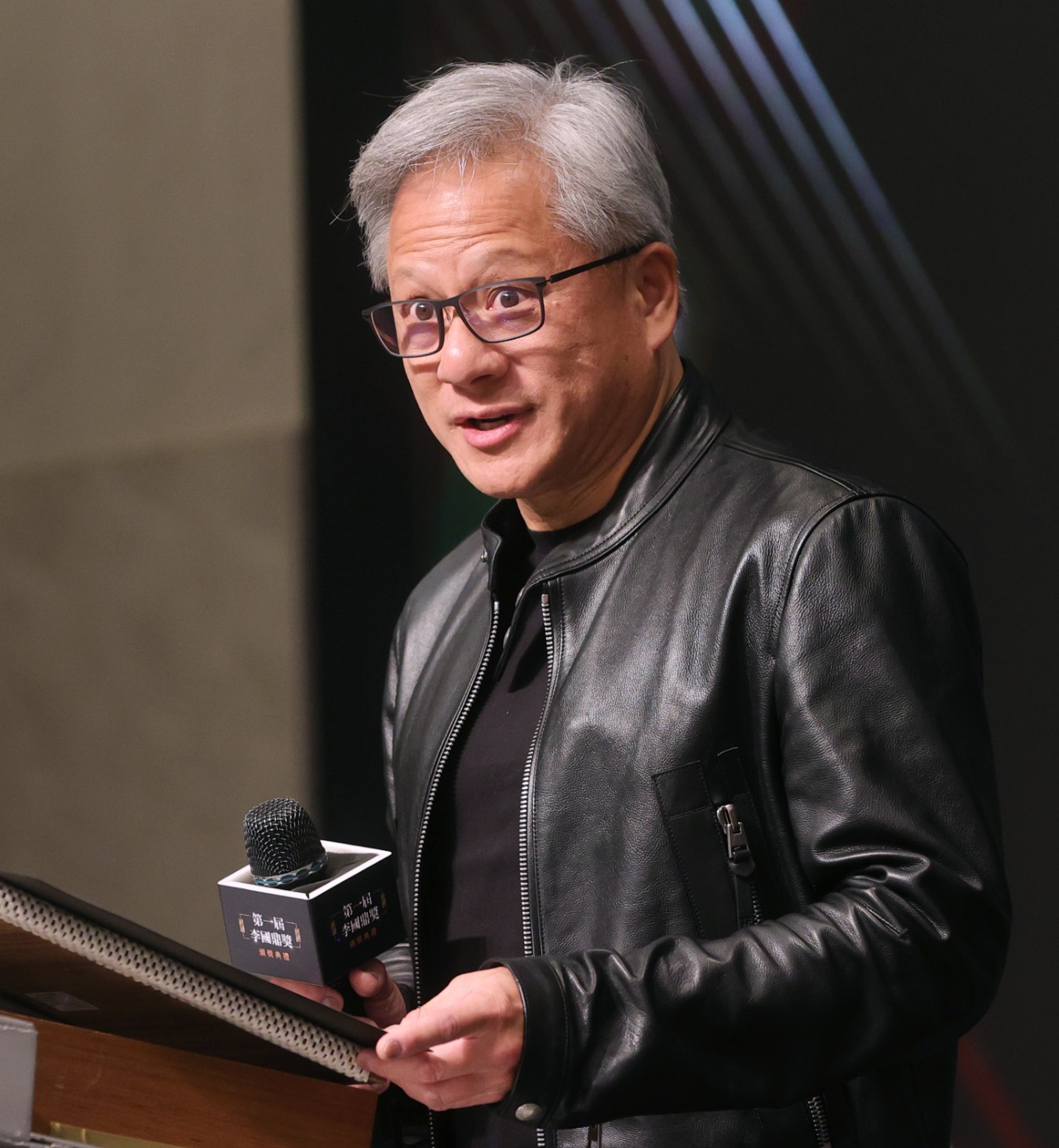
Jensen Huang, NVIDIA's co-founder and CEO since 1993, at Taiwan's inaugural Lee Kuo-ting Award ceremony in November 2023 — the country he was born in, and where his public homecomings later grew into the phenomenon nicknamed "Jensanity."
Photo: Taiwan Presidential Office, CC BY 2.0, via Wikimedia Commons01Early life: from Taiwan to Aloha, Oregon
| Year | Event |
|---|---|
| 1963 | Born in Taiwan |
| 1968 | Family relocates to Bangkok, Thailand, for his father's job |
| 1973 | Sent ahead of family to the US; enrolled at Oneida Baptist Institute, Kentucky, by mistake |
| 1975 | Family reunites in Beaverton, Oregon; transfers to Aloha High School |
| 1978 | Ranked table-tennis junior nationally; works nights at a local Denny's |
| 1984 | Graduates Oregon State University with a BSEE |
| 1992 | Earns a master's from Stanford; NVIDIA's founding meetings begin at a Denny's |
| 1993-04 | Co-founds NVIDIA with Chris Malachowsky and Curtis Priem |
| 1996 | NVIDIA cuts staff roughly in half after the NV1's commercial failure; Sega's final payment keeps it afloat |
| 1997 | RIVA 128 launches and saves the company |
| 2006-11 | NVIDIA unveils CUDA |
| 2012 | AlexNet, trained on NVIDIA GPUs, validates GPUs for deep learning |
| 2019 | Donates $2 million to Oneida Baptist Institute, naming a new building Huang Hall |
| 2025-04 | US requires an export license for NVIDIA's H20 chip, forcing a $4.5B charge; PM Shigeru Ishiba receives Huang in Tokyo |
| 2025-05 | Mobbed by fans and paparazzi at Computex Taipei — the "Jensanity" phenomenon |
| 2025-08 | US resumes granting H20 export licenses to China |
| 2025-10 | NVIDIA becomes the first company to reach a $5 trillion market cap; Financial Times names Huang Person of the Year |
| 2025 | Jointly receives the Queen Elizabeth Prize for Engineering |
| 2026-01 | US eases H200 export rules for China, with a 25% tariff attached |
| 2026-03 | Proxy filing shows 870.6M NVIDIA shares (3.58%) beneficially owned |
| 2026-05 | Returns to Taipei for an employee event; delivers a keynote at the Taipei Music Center on June 1 |
| 2026 | Named 2026 IEEE Medal of Honor recipient |
A boarding-school mix-up in Kentucky
Jensen Huang was born in Taiwan in 1963. When he was about five, his family moved to Thailand for his father's job as a chemical engineer, and he attended an international school in Bangkok. Political unrest in Thailand pushed the family to consider the United States, and in 1973 Huang and an older brother went ahead of the rest of the family to live with an uncle in Tacoma, Washington. He holds dual Taiwanese and American citizenship.
The uncle, believing he was enrolling the boys in a respected preparatory school, instead placed them at Oneida Baptist Institute — a religious reform academy in rural Kentucky, originally founded in the 1890s to stop feuding clans in Clay County from killing each other. Huang was nine. Every student had a daily job; his was cleaning the communal bathrooms. He has said the other kids were tough enough to carry pocket knives, and that fights there "weren't pretty." He found ways to fit in anyway — tutoring an older dorm-mate in math, joining the swim team — and has said, without irony, that he loved his time there: "We worked really hard. We studied really hard."
In 2019, decades later, he donated $2 million toward a new dormitory and classroom building at the school, named Huang Hall.
A nationally ranked ping-pong player who scrubbed floors for travel money
Two years after Kentucky, Huang's parents settled in Beaverton, Oregon, and the brothers transferred to nearby Aloha High School, where Huang skipped two grades and graduated at sixteen.
He also became a serious table-tennis player, training and competing out of Paddle Palace, a Portland club, and scrubbing its floors to help pay his own way to tournaments. In a January 1978 letter to Sports Illustrated, Paddle Palace owner Lou Bochenski called the teenage Huang "perhaps the most promising junior ever to play table tennis" in the Pacific Northwest; at fifteen, Huang finished third in junior doubles at the U.S. Open Table Tennis Championships. He later told the Seattle Post-Intelligencer, "I loved that sport, but I never loved it more than academics."
Aloha, Oregon, and a job at Denny's
From age fifteen until he left for college, Huang worked the graveyard shift at a local Denny's — washing dishes, bussing tables, and eventually waiting on customers — a detail that resurfaced two decades later when he chose a different Denny's as the place to found NVIDIA.
Same job, twenty years apart
02From college to chip design
Huang studied electrical engineering at Oregon State University, graduating in 1984 with the highest honors in his class; it's also where he met his future wife, Lori Mills, in an engineering lab. He later earned a master's degree in electrical engineering from Stanford University in 1992, attending night classes while working full-time.
Recruited out of Oregon State by Texas Instruments, AMD, and LSI Logic, Huang chose AMD first, designing microprocessors. He then moved to LSI Logic, where he worked on graphics-accelerator technology for clients including Sun Microsystems — the job that put him in regular contact with two colleagues, Chris Malachowsky and Curtis Priem, who would become his co-founders. He rose to director of LSI's CoreWare division before leaving to start his own company.
Huang's path to founding NVIDIA
03Founding NVIDIA
A $600 start, and a name that means envy
Huang, Malachowsky, and Priem held their early planning meetings at a Denny's on Berryessa Road in East San Jose in late 1992, before formally incorporating NVIDIA on April 5, 1993. Each founder put in $200 — $600 total — reportedly because their lawyer required at least that much in the company's account to make the incorporation official. The name NVIDIA comes from the Latin invidia, meaning envy: the reaction the three hoped rivals would eventually have.
The name came together from two directions at once. Priem had already been using "NV" as a placeholder label for his chip designs and files, short for "next version." When the trio needed a name for the company itself, their first choice, NVision, turned out to be too close to Envision, an existing toilet-paper brand — so they went looking for other options and landed on invidia. Drop the leading "I" and what's left is "nvidia," which happened to already start with the "NV" they'd been using all along — so the two ideas merged into one name: NVIDIA.
How NVIDIA got its name
Priem's placeholder label for his own chip designs and files — short for "next version."
Dropped — too close to Envision, an existing toilet-paper brand.
Drop the leading "I" from invidia (Latin for envy) — what's left already started with their "NV."
Near-collapse, and a rival's lifeline
NVIDIA's first chip, the NV1, failed commercially. At the time, NVIDIA was also under a separate, staged-payment contract to build the graphics chip for Sega's next console — later released as the Dreamcast. Partway through that project, Huang concluded a chip built around the same quadratic-surface approach as the NV1 wouldn't meet Sega's performance requirements. By his own account, he personally flew to Japan to tell Sega's then-president, Shoichiro Irimajiri, that directly — effectively advising a partner to walk away from a contract NVIDIA was still being paid to fulfill. Sega paid out the final $5 million installment anyway, giving NVIDIA both that funding and roughly six months of runway. How close the company came to failing, and how a rival's payment pulled it back from the brink, is one of the more striking chapters in Huang's early career.
NVIDIA used that funding and time to build RIVA 128, a conventional chip compatible with Microsoft's DirectX standard. It sold over a million units in its first four months in 1997 and saved the company.
Related reading
NVIDIA: A History of the GPU
The NV1's failure and the DirectX-driven pivot to RIVA 128, in full technical detail.
NVIDIA's near-death and turnaround, 1995–1997
Huang has said he's used the phrase "thirty days from going out of business" to describe NVIDIA's mindset for more than three decades — not as an exaggeration, but as the operating assumption that still shapes how he runs the company.
04How Huang runs the company
No fixed org chart, no scheduled one-on-ones
NVIDIA has no traditional layered management structure under Huang: as of late 2024, roughly 55 to 60 executives and senior engineers reported to him directly, an unusually flat arrangement for a company NVIDIA's size. He holds no regularly scheduled one-on-one meetings, preferring to deliver feedback in group settings so every relevant executive hears the same reasoning at the same time. Employees can also email him directly with a short list of their top priorities or problems; he has said he reads roughly a hundred of these a day. Huang has described the underlying idea as making "mission," not any individual manager, "the boss" — reorganizing teams around whatever problem matters most rather than preserving a fixed reporting chain.
Typical company Huang's size
- Feedback filtered through several layers of middle management
- Regularly scheduled one-on-ones with a direct manager
- A handful of direct reports to the CEO
NVIDIA under Huang
- Feedback delivered in group settings, same reasoning for everyone at once
- No regularly scheduled one-on-ones
- 55–60 executives and senior engineers report directly to Huang
A demanding culture, by his own account rooted in his parents
In a May 2026 interview with Taiwan's Central News Agency, Huang connected his demanding management style directly to how he was raised. He has also been openly dismissive of managers who discourage employees from using AI tools at work, calling that kind of restriction "insane."
To a Taiwanese parent, nothing is ever good enough, and you can't go a day without some criticism.
05Betting the company on CUDA
A decade most people call silence
NVIDIA unveiled CUDA in November 2006, a platform that let developers write general-purpose code for NVIDIA's graphics chips instead of graphics-only workloads. The near-term financial case was weak: chip costs rose, and there was no obvious market yet buying GPUs to do anything other than render 3D graphics. Huang has described the launch itself as landing to near silence — nobody in the audience wanted it, asked for it, or understood what it was for. NVIDIA kept investing in CUDA for years anyway, on the belief that giving researchers a general-purpose way to use GPU parallelism would eventually matter, even without a specific market in view.
AlexNet, and the payoff
That bet paid off in 2012, when a University of Toronto team trained a neural network called AlexNet on NVIDIA GPUs and jumped the accuracy of an annual image-recognition benchmark, ImageNet. The result is widely credited with convincing the AI research community that GPUs, and CUDA specifically, were the right tool for training neural networks at scale — NVIDIA's own account of its history marks this as the start of its "AI era."
CUDA developers, self-reported at successive keynotes (2021–2026)
NVIDIA doesn't publish a continuous developer count — these are the figures Huang and NVIDIA have announced at individual events, self-reported and not independently audited.
06Net worth and recognition
Net worth and NVIDIA ownership
Live-tracked estimates of Huang's net worth move daily with NVIDIA's stock price and vary by methodology, but multiple trackers placed him in the $160–200 billion range through the first half of 2026; one ranking put him as the world's eighth-richest person as of late May 2026. According to NVIDIA's own 2026 proxy filing, Huang beneficially owned 870,604,104 shares — about 3.58% of the company — as of March 23, 2026, worth roughly $191 billion at that filing's reference share price. Around 58.7 million of those shares belong to the Jen-Hsun and Lori Huang Foundation rather than to Huang personally.
That wealth is entirely separate from his salary. NVIDIA's 2026 proxy statement lists Huang's base salary as $1.5 million, unchanged from fiscal 2025, with total fiscal-2026 compensation — including bonus and stock awards — of roughly $36.3 million, itself a small fraction of what his existing ownership stake is worth.
Nearly all of Huang's wealth comes from holding NVIDIA stock since 1993, not from what NVIDIA pays him to run it.
Who owns Huang's NVIDIA stake
- Held personally by Huang~811.9M (93%)
- Held by the Jen-Hsun and Lori Huang Foundation~58.7M (7%)
"Jensanity" in Taiwan
Huang's visits to Taiwan, where he was born, have drawn crowds and press coverage more typical of a celebrity than a chip executive — commentary has nicknamed the phenomenon "Jensanity." Ahead of Computex 2025 in Taipei, he was met by paparazzi and a pop-up NVIDIA merchandise store; he returned in May 2026 for an employee event tied to NVIDIA's Taipei headquarters project and delivered a keynote at the Taipei Music Center on June 1, 2026.
Japan has extended a comparable level of access, if not the same street-level fandom: in April 2025, Prime Minister Shigeru Ishiba received Huang for a courtesy call at the Prime Minister's Office in Tokyo.
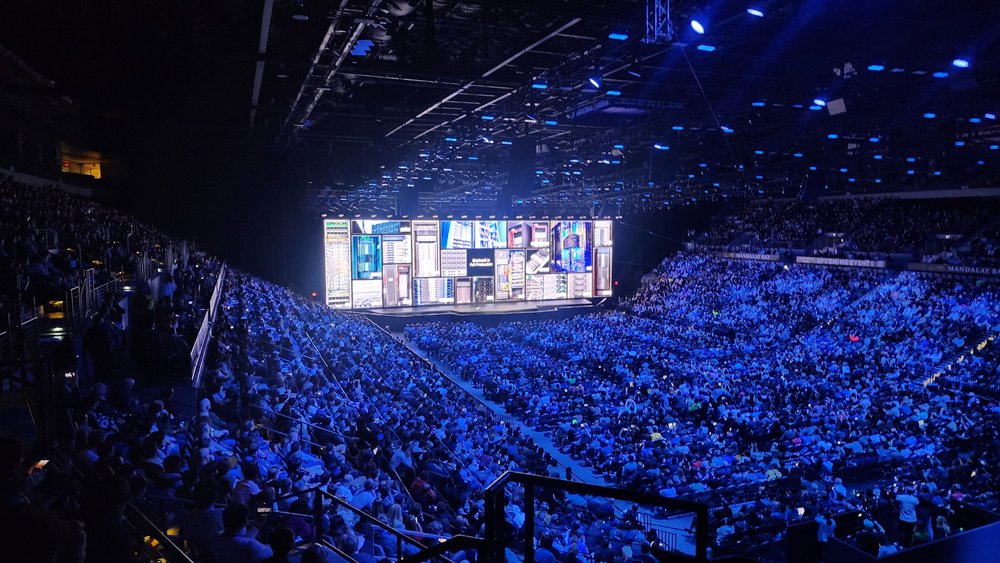
Huang's keynotes, like this one at CES 2025 in Las Vegas, already draw among NVIDIA's biggest public crowds outside Taiwan — where, as described below, the reception escalates into what press coverage has nicknamed "Jensanity."
Photo: Joseph Zadeh, CC BY-SA 4.0, via Wikimedia Commons- Computex 2025, Taipei — met by paparazzi and a pop-up NVIDIA merchandise store
- April 2025, Tokyo — courtesy call with Japanese PM Shigeru Ishiba at the Prime Minister's Office
- May 2026, Taipei — returns for an employee event tied to NVIDIA's new headquarters project
- June 1, 2026, Taipei — keynote at the Taipei Music Center
Awards, 2025–2026
Huang and NVIDIA chief scientist Bill Dally jointly received the Queen Elizabeth Prize for Engineering in 2025. The IEEE named Huang the recipient of its 2026 Medal of Honor, its highest award, carrying a $2 million prize. The Financial Times named Huang individually its Person of the Year for 2025, tied to NVIDIA becoming the first company to reach a $5 trillion market capitalization that October.
- Queen Elizabeth Prize for Engineering, 2025 (shared with NVIDIA chief scientist Bill Dally)
- IEEE Medal of Honor, 2026 (IEEE's highest award, $2 million prize)
- Financial Times Person of the Year, 2025 (individually named)
A separate, often-confused honor — TIME's 2025 Person of the Year — went to a group cover called "The Architects of AI," which included Huang alongside several other executives and researchers, not to Huang individually.
07Export controls and succession
The China export-control rollercoaster
In April 2025, the US government began requiring an export license for NVIDIA's H20 chip — a version of NVIDIA's AI accelerator designed specifically to comply with earlier China export rules — effectively halting sales. NVIDIA recorded a $4.5 billion charge that quarter for unsellable inventory and purchase commitments. Washington reversed course in August 2025 and began granting licenses again, though Chinese authorities discouraged domestic buyers on security grounds; NVIDIA reported only about $60 million in H20 revenue from China that quarter. In January 2026, US regulators eased restrictions further on NVIDIA's newer H200 chip, moving it from a near-blanket denial to case-by-case review with a 25% tariff attached, but as of mid-2026 few, if any, units had actually shipped to Chinese customers — again because of objections from Beijing, not Washington. Huang has pushed back publicly and sometimes sharply on the idea that NVIDIA should simply write off the China market; pressed on the topic during a 2026 podcast appearance, he responded, "you're not talking to someone who woke up a loser."
- Apr 2025 — US requires an export license for H20, halting sales; NVIDIA takes a $4.5B charge
- Aug 2025 — US resumes granting licenses, but China discourages buyers; H20 China revenue only ~$60M that quarter
- Jan 2026 — US eases H200 rules to case-by-case review with a 25% tariff, but few units actually ship — again due to Chinese, not US, objections
No named successor
NVIDIA has not named a designated successor to Huang.
This is a real risk precisely because of how centralized decision-making is under his flat management structure — architectural and strategic judgment that, unlike at more conventionally layered companies, isn't obviously distributed across a bench of deputies. Huang, born in 1963 and now 63, has said publicly that he intends to keep running NVIDIA "until the last day of his life." The closest thing to a deep bench is a small group of long-tenured executives, though none has been publicly floated as a successor:
- Colette Kress — EVP and CFO; NVIDIA's most visible public-facing executive after Huang
- Ajay Puri — EVP, Worldwide Field Operations, at NVIDIA since 2005
- Debora Shoquist — EVP, Operations, leading manufacturing and supply chain
08FAQ
Did Jensen Huang found NVIDIA alone?
No. He co-founded NVIDIA in 1993 with two former LSI Logic colleagues, Chris Malachowsky and Curtis Priem. Huang has been NVIDIA's CEO since its founding, while Malachowsky and Priem stepped back from day-to-day roles years ago.
How did Jensen Huang become one of the world's richest people?
Almost entirely from his ownership stake in NVIDIA, which he has held since co-founding the company in 1993 and hasn't sold down significantly since. NVIDIA's own 2026 proxy filing shows he beneficially owns roughly 3.58% of the company; as NVIDIA's market value climbed toward the trillions, so did the value of that stake, pushing live-tracked net-worth estimates into the $160–200 billion range through the first half of 2026.
Why did NVIDIA almost go out of business in its early years?
NVIDIA's first chip, the NV1 (1995), bet on a graphics approach the rest of the industry didn't adopt, and it failed commercially — NVIDIA cut its staff roughly in half. Huang has said Sega paid out a final $5 million contract installment even after he told Sega's president the chip NVIDIA was building wouldn't work for them, buying NVIDIA enough time to build RIVA 128, the 1997 chip that turned the company around. NVIDIA's full early product history is covered in a separate history article on this site.
Does Jensen Huang have a successor lined up at NVIDIA?
Not publicly. NVIDIA hasn't named a designated successor, and Huang has said he intends to keep running the company indefinitely. The lack of a clear succession plan is a risk, given how centralized NVIDIA's flat management structure is around Huang personally.
09Sources
01. Early life: from Taiwan to Aloha, Oregon
02. From college to chip design
03. Founding NVIDIA
05. Betting the company on CUDA
06. Net worth and recognition
Related articles
Company Deep Dives
Unitree
Figure AI
1X Technologies
Physical Intelligence
Skild AI
NVIDIA
- ›NVIDIA Isaac GR00T, Explained: What NVIDIA Actually Sells in Robotics
- ›NVIDIA DRIVE, Explained: The Automotive Platform Behind Mercedes-Benz, Uber, and a Dozen Other Automakers
- ›NVIDIA Jetson: The Decade-Old Hardware Lineage Behind Physical AI
- ›NVIDIA: A History of the GPU
- ›NVIDIA CUDA, Explained: The Software Behind NVIDIA's AI Moat
- ›Jensen Huang: From a Denny's Dishwasher to NVIDIA's CEO(this article)