Company & Robot DB
NVIDIA Jetson: The Decade-Old Hardware Lineage Behind Physical AI
Key Takeaways
- Jetson has shipped purpose-built edge-AI compute for robots, drones, and cameras since 2014 — six chip generations before "physical AI" became a buzzword.
- Both Isaac GR00T and DRIVE Thor run on hardware this lineage built.
- NVIDIA holds an estimated majority of the edge-AI robotics compute market, though Qualcomm and others are organizing to challenge that lead.
01What Jetson is
Compute that lives inside the machine
Jetson is NVIDIA's family of small, power-efficient computer modules built to run AI models on-device — inside a robot, a drone, a security camera, a piece of factory equipment — rather than in a data center. Where a data-center GPU processes AI workloads for thousands of users at once over a network, a Jetson module runs entirely inside the machine it's embedded in, under a power budget measured in watts rather than kilowatts.
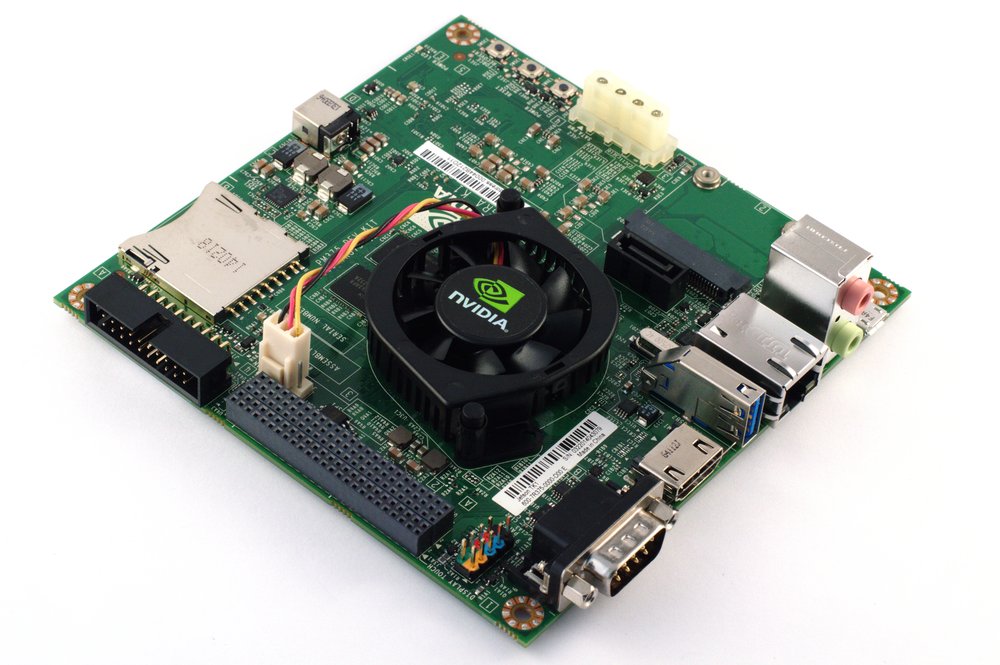
The original Jetson TK1, a PR sample received directly from NVIDIA UK in July 2014 — eleven years and six generations before Jetson AGX Thor.
Photo: Gareth Halfacree, CC BY-SA 2.0, via Wikimedia CommonsThe lineage under GR00T and DRIVE Thor
Jetson is the hardware lineage both Isaac GR00T and DRIVE Thor build on.
02Where Jetson actually shows up
"Robot" and "physical AI" get used loosely in coverage of this space. What's actually shipping today, running on Jetson hardware in commercial volume rather than as a demo, is narrower and in some ways more mundane than humanoids — the clearest examples are in logistics and delivery, where running AI on-device instead of over a network connection has an obvious, easy-to-explain payoff: a delivery robot or drone can't wait on a cellular round-trip to decide whether to brake for a pedestrian.
Named deployments, by category
Serve Robotics
Serve's third-generation delivery robots run on Jetson Orin and are simulated in NVIDIA Isaac Sim before deployment — moving from the prior Xavier generation to Orin gave them roughly 5x more onboard compute. Serve says its robots have completed more than 100,000 autonomous sidewalk deliveries since 2021 at a 99.8% completion rate.
SourceNVIDIA case study
Zipline
Zipline's current delivery drone carries up to eight pounds of cargo for 10 miles at up to 70 mph, using two onboard Jetson Orin NX modules for autonomous navigation and precision landing. The company says it has completed more than 850,000 deliveries across seven countries.
SourceNVIDIA Blog
Elementary Robotics
Elementary Robotics builds Jetson-based machine-vision systems that catch manufacturing defects in real time on production lines, processing high-resolution camera frames on-device to keep up with line speed rather than sending them over a network. Toyota is both a customer and an investor in the company.
SourceNVIDIA Blog
Skydio
Skydio, a member of NVIDIA's Inception startup program, builds autonomous drones for infrastructure inspection, public safety, and defense that fly and avoid obstacles without a human pilot actively steering — the kind of on-device perception-and-navigation workload Jetson is built for.
Jetson also underpins the humanoid and quadruped robots covered elsewhere on this site — Isaac GR00T's Unitree reference platform, Boston Dynamics' Atlas, and others — but those remain closer to pilot and research deployments than the delivery and inspection examples above, which are running at commercial volume today.
03Hardware history (2014–2025)
Jetson's product history is unusually long-running for a category that only became a mainstream investment theme in the last few years — NVIDIA had a decade of iteration and an installed base of developers before "humanoid robot" and "physical AI" became pitch-deck language.
| Year | Event |
|---|---|
| 2014-04 | Jetson TK1 launches — NVIDIA's first purpose-built embedded AI compute board |
| 2015 | Jetson TX1 launches, a smaller module aimed at production embedded devices |
| 2017-03 | Jetson TX2 ships, doubling performance in the same form factor |
| 2018-08 | Jetson AGX Xavier developer kit announced, NVIDIA's first Xavier-generation module |
| 2019-03 | Jetson Nano launches at $99, opening Jetson to hobbyists and students |
| 2020 | Jetson Xavier NX ships, billed by NVIDIA as the "world's smallest supercomputer for AI at the edge" |
| 2022-08 | Jetson AGX Orin reaches production, built on NVIDIA's Ampere GPU architecture |
| 2023-01 | Jetson Orin Nano launches as the new entry-level tier |
| 2025-08 | Jetson AGX Thor reaches general availability, built on NVIDIA's Blackwell GPU architecture |
04The current generation: Jetson AGX Thor
Thor's specs, at a glance
Jetson AGX Thor, NVIDIA's current flagship module, reached general availability in August 2025. Built on NVIDIA's Blackwell GPU architecture, it delivers up to 2,070 FP4 teraflops of AI compute in a 130-watt power envelope — NVIDIA states roughly 7.5x the AI compute and 3.5x the energy efficiency of the prior Orin generation. The developer kit sells for $3,499; production modules start lower.
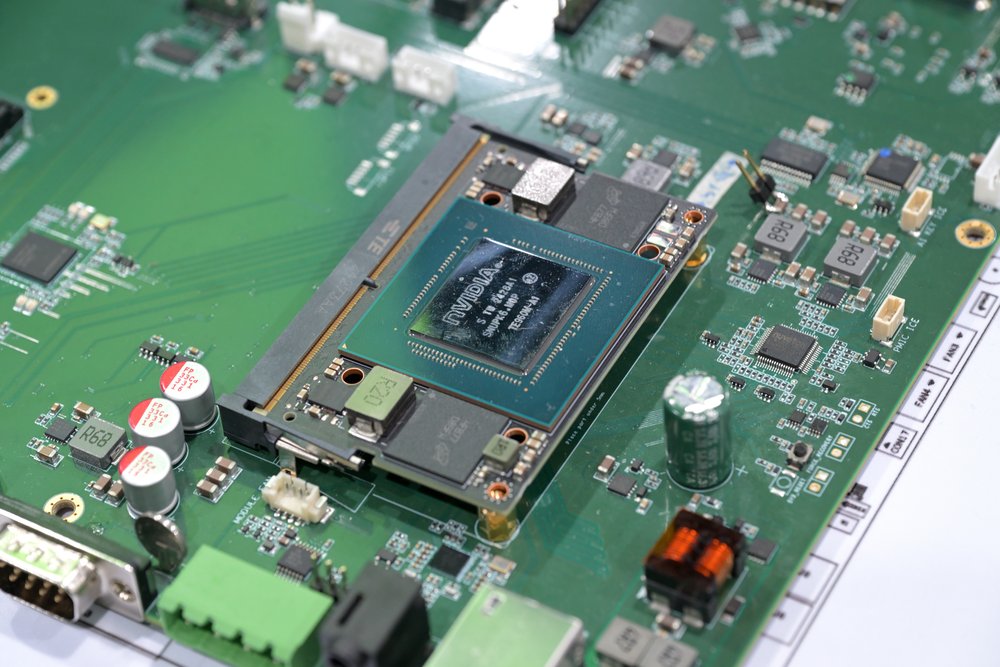
A Jetson Orin NX module, photographed at Computex 2025 — the same module Zipline uses two of, per the delivery-drone example below, and the smaller, lower-power sibling to Jetson AGX Thor in NVIDIA's current lineup.
Photo: 4300streetcar, CC BY 4.0, via Wikimedia CommonsWho signed on at launch
Named early-access and evaluation partners at launch spanned a wide slice of the robotics industry, shown below.
Named launch partners
- Adopters at launch: Agility Robotics, Amazon Robotics, Boston Dynamics, Caterpillar, Figure, Hexagon, Medtronic, and Meta
- Evaluating at launch: 1X, John Deere, OpenAI, and Physical Intelligence
05Market position and competition
NVIDIA's estimated share
NVIDIA's Jetson platform is estimated to hold roughly 39% of edge AI computing revenue, by one market-research estimate worth treating as directional rather than precise — no research firm with a fully public, checkable methodology was found publishing a comparable figure, though it's broadly consistent with Jetson's widely reported position as the default choice for high-end robotics compute.
The organized challengers
The clearest organized challenge comes from Qualcomm, whose Dragonwing IQ10 series (introduced at CES 2026) is explicitly positioned as a lower-power alternative for robots that don't need Thor's full compute ceiling; Intel has taken a different approach with a dedicated Robotics business unit built around more than 130 commercial design partnerships and an open-platform pitch that avoids competing head-on with NVIDIA's brand; and NXP is building out edge-AI capability through its Kinara acquisition and a new "Neural Axis" chip architecture.
Jetson (~39% share, est.)
The incumbent, with a decade-plus head start and the deepest software ecosystem (Isaac, CUDA). Thor is the current top-end module.
Dragonwing IQ10
Introduced at CES 2026, explicitly pitched as a lower-power, lower-cost alternative for robots that don't need Thor's full compute ceiling.
Intel Robotics business unit
More than 130 commercial design partnerships, pitched as an open-platform alternative that avoids competing head-on with NVIDIA's brand.
NVIDIA's own developer-adoption claims, a year apart
NVIDIA Newsroom, Aug 2025 / NVIDIA Blog, Jul 2026 — both self-reported, not independently audited
Related reading
AI Compute & Chips for Robots: Market Size and Players
How big the robot-compute-chip market actually is, and who's trying to challenge Jetson's lead.
06Where Jetson fits in the business
Jetson revenue isn't broken out on its own — NVIDIA reports it inside a combined "Automotive and Robotics" line that also includes the much larger DRIVE automotive business, and that whole combined line was worth about 1% of NVIDIA's total revenue in fiscal year 2026. NVIDIA's Isaac GR00T and DRIVE articles on this site cover that financial picture in full; the short version is that Jetson, like the rest of NVIDIA's physical-AI push, is a long-run platform bet layered on top of a data-center business that dwarfs it, not something NVIDIA needs to monetize today.
07Challenges ahead
Generational fragmentation
Generational fragmentation is a real, if unglamorous, cost of an eleven-year hardware lineage. Each Jetson generation (TK1, TX1/TX2, Xavier, Orin, Thor) uses a different JetPack software version with its own support window, meaning developers who build on an older module eventually face a forced migration to newer hardware to keep receiving updates — a maintenance burden that a genuinely new entrant, without a decade of legacy modules to support, doesn't carry.
Independent benchmarks are still scarce
Independent, apples-to-apples benchmarks against Qualcomm's and Intel's newer offerings are scarce. Most of the performance and market-share figures in this article — NVIDIA's own compute numbers, the roughly 39% share estimate, the developer-adoption claims — trace back to NVIDIA's own releases or to research firms without a fully public methodology, not to a neutral third-party lab running the same workload on all three platforms.
Is Thor's tradeoff right for every robot?
Whether Thor's price and power draw are the right tradeoff for every use case is genuinely contested. Qualcomm's explicit pitch for Dragonwing is that many robots don't need Thor's full compute ceiling and would rather have a cheaper, lower-power chip — a bet on the market fragmenting by workload rather than everyone converging on NVIDIA's top-end module.
08FAQ
What is Jetson actually used for?
Beyond humanoid-robot demos, the highest-volume commercial deployments are logistics and delivery: Serve Robotics' sidewalk delivery robots (100,000+ deliveries), Zipline's delivery drones (850,000+ deliveries), and Jetson-based machine vision for factory quality inspection (Elementary Robotics, whose customers include Toyota) are all named, NVIDIA-documented examples running at commercial scale today.
How is Jetson different from Isaac GR00T or DRIVE Thor?
Jetson is the hardware — a family of on-device AI compute modules NVIDIA has shipped since 2014. Isaac GR00T is software (a robot foundation model) that happens to run on Jetson hardware. DRIVE Thor is a separate, automotive-certified variant of NVIDIA's current Thor chip, built for cars specifically rather than general-purpose robotics.
What's the current top-end Jetson module?
Jetson AGX Thor, which reached general availability in August 2025. Built on NVIDIA's Blackwell GPU architecture, it delivers up to 2,070 FP4 teraflops in a 130-watt envelope, with a $3,499 developer kit.
Does NVIDIA actually dominate the edge-AI compute market?
By most accounts yes, though the precise number is soft: one market-research estimate puts Jetson's share of edge AI computing revenue at roughly 39%, but no research firm with a fully public, checkable methodology was found publishing a comparable figure — treat it as directional. Qualcomm, Intel, and NXP are the most visible organized challengers as of mid-2026.
09Sources
03. Hardware history (2014–2025)
04. The current generation: Jetson AGX Thor
Related articles
Company & Market Data
Company Deep Dives
Unitree
Figure AI
1X Technologies
Physical Intelligence
Skild AI
NVIDIA
- ›NVIDIA Isaac GR00T, Explained: What NVIDIA Actually Sells in Robotics
- ›NVIDIA DRIVE, Explained: The Automotive Platform Behind Mercedes-Benz, Uber, and a Dozen Other Automakers
- ›NVIDIA Jetson: The Decade-Old Hardware Lineage Behind Physical AI(this article)
- ›NVIDIA: A History of the GPU
- ›NVIDIA CUDA, Explained: The Software Behind NVIDIA's AI Moat
- ›Jensen Huang: From a Denny's Dishwasher to NVIDIA's CEO