Company & Robot DB
NVIDIA CUDA, Explained: The Software Behind NVIDIA's AI Moat
Key Takeaways
- CUDA (2006) is the software platform, not a chip — it lets developers write general-purpose code that runs directly on NVIDIA GPUs.
- A six-year head start before AI's GPU era began compounded into a software moat that rival chipmakers still haven't closed.
- NVIDIA says CUDA now underpins 6 million developers worldwide, though rivals like OpenAI's Triton are chipping at CUDA-specific lock-in.
01What CUDA actually is
CPU vs. GPU: a handful of big cores vs. thousands of small ones
A GPU's core advantage over a CPU is that it has thousands of small processing cores that can run the same operation on many pieces of data simultaneously, rather than a handful of cores optimized for running different operations one after another quickly. That's ideal for graphics — every pixel on screen needs similar math done to it — but before CUDA, using that same parallelism for anything else meant disguising the computation as a graphics operation and feeding it through OpenGL, an awkward, limited workaround.
CPU
A handful of large, general-purpose cores, each optimized to run many different operations one after another as fast as possible.
GPU
Thousands of small cores, each simple, but all able to run the same operation on different pieces of data at the same time.
Illustrative proportions, not any specific chip's real core count.
CUDA's 2006 launch
CUDA, launched in November 2006, is a platform — a set of extensions to C and C++ (and later Python, Fortran, and others), a compiler, and a runtime — that lets a developer write code that runs directly on a GPU's parallel cores, organized into a grid of thousands of concurrent "threads," without pretending it's a graphics task. That single change is what let researchers outside computer graphics start pointing GPUs at physics simulations, protein folding, and eventually neural networks.
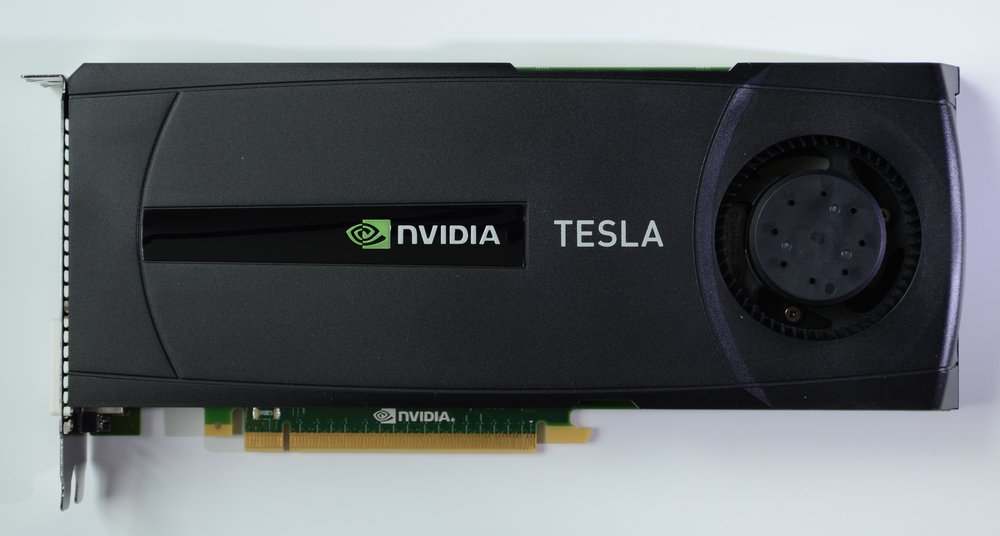
A Tesla-branded NVIDIA compute GPU — the product line NVIDIA sold specifically for CUDA workloads (science, simulation, and later deep learning) rather than gaming, years before "AI chip" was a category anyone talked about.
Photo: Raysonho, CC0, via Wikimedia Commons02From a compiler to a library empire
CUDA itself is only the base layer. What actually gets used in production is a stack of specialized libraries NVIDIA built on top of it over two decades, each one optimized for a specific class of problem.
CUDA's library stack
- cuBLAS and cuFFT — linear algebra and signal processing, from CUDA's earliest years
- cuDNN (2014) — deep-learning primitives (convolutions, activation functions) that later powered the AI boom
- NCCL — coordinates communication across thousands of GPUs in a single training run
- TensorRT — optimizes a trained model to run inference as fast as possible
- RAPIDS — extends CUDA-accelerated computing to data science workloads that used to require a CPU cluster
Each of those libraries represents years of NVIDIA engineers hand-tuning performance for NVIDIA's own hardware — the kind of optimization work a competitor has to redo from scratch for its own chips.
| Year | Event |
|---|---|
| 2006-11 | CUDA 1.0 launches alongside the Tesla GPU architecture |
| 2007 | cuBLAS and cuFFT ship — the first widely used CUDA math libraries |
| 2012 | AlexNet, trained on CUDA-programmed GPUs, wins ImageNet and reshapes machine learning |
| 2014 | cuDNN launches, providing hand-tuned primitives specifically for deep learning |
| 2015 | NCCL ships, coordinating communication across many GPUs in a single training run |
| 2016 | TensorRT launches, optimizing trained models for fast inference |
| 2018 | RAPIDS launches, extending CUDA-accelerated computing to data science workloads |
| 2026-01 | NVIDIA builds a Triton-to-Tile-IR backend, letting OpenAI's Triton compile directly to CUDA Tile IR |
| 2026-04 | NVIDIA marks CUDA's 20th anniversary at GTC, citing 6 million developers |
03The scale of the ecosystem today
CUDA, in numbers
NVIDIA marked CUDA's 20th anniversary at GTC in April 2026, stating the platform now underpins 6 million developers worldwide — a self-reported figure, not independently audited, but consistent with CUDA's widely reported status as the default platform researchers learn first.
The flywheel, and a backward-compatibility promise
CEO Jensen Huang framed CUDA's economics as a "flywheel": two decades of cumulative CUDA-compatible GPU deployments create the installed base that attracts developers and new applications, which in turn justifies buying more CUDA-compatible hardware. NVIDIA also states that CUDA code written for its original 2006-era GPUs still runs, unmodified, on current-generation hardware — a specific backward-compatibility claim, and one of the reasons a codebase built on CUDA rarely needs to be rewritten as NVIDIA's hardware moves forward.
NVIDIA's own retrospective on CUDA's first 20 years (April 2026), released at GTC alongside the "6 million developers" and "CUDA flywheel" framing discussed in the section below.
04The moat: why switching away is hard
Years of small, hardware-specific decisions
None of NVIDIA's individual libraries are impossible to replicate in principle — competitors have built comparable ones. What's hard to replicate is the accumulation: production AI systems built on CUDA typically embed years of small, hardware-specific decisions — kernel optimizations tuned to NVIDIA's specific memory hierarchy, mixed-precision training paths built around NCCL's assumptions, debugging and profiling workflows built around NVIDIA's own tools (Nsight), and CI/CD pipelines that assume CUDA is present. None of that shows up in a chip's spec sheet, and all of it has to be redone, at real engineering cost, to move to a different platform.
PyTorch and TensorFlow were built CUDA-first
The two most widely used deep-learning frameworks, PyTorch and TensorFlow, were also built CUDA-first, and while both have since added support for other backends, CUDA remains the best-supported, best-documented path through either.
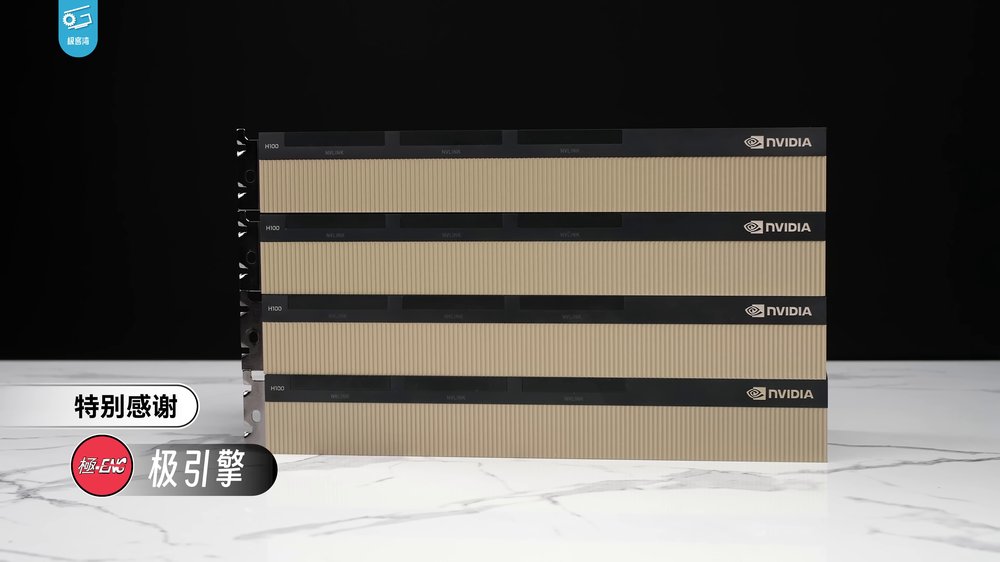
The H100 (2022) — NVIDIA's own framing is that CUDA code written in 2006 still runs on current-generation hardware like this, just far faster, a backward-compatibility claim discussed in the section below.
Photo: Geekerwan, CC BY 3.0, via Wikimedia Commons05Cracks in the moat
Triton: a portable kernel language
The clearest challenge to CUDA lock-in isn't a rival chip — it's a rival abstraction layer. OpenAI's Triton, a Python-based language for writing GPU kernels, lets a developer write code once and get near-competitive performance across different hardware, and is now the default kernel-generation path inside PyTorch's own compiler (torch.compile) — meaning a growing share of new PyTorch code no longer touches CUDA-specific code directly.
NVIDIA's response, and a contested read on strategy
NVIDIA's own response, previewed at GTC 2026, is CUDA Tile IR and a backend that lets Triton compile directly to it — NVIDIA frames this as collaborative, since Triton's own tile-based programming model maps naturally onto Tile IR, letting developers get NVIDIA-specific speedups without leaving Triton. Some of CUDA's own original engineering team have pushed back publicly, arguing NVIDIA's related cuTile language is aimed more directly at pulling developers away from Triton than NVIDIA's public framing suggests — a genuinely contested read on NVIDIA's own strategy, not a settled one.
The alternatives, as of 2026
CUDA
20 years of accumulated libraries, tooling, and documentation. The default first platform for most AI researchers, and the best-supported backend in PyTorch and TensorFlow.
ROCm
PyTorch, vLLM, and SGLang all carry official ROCm support as of 2026, with AMD reporting large generation-over-generation inference gains — real progress on well-supported workloads, though the broader library ecosystem still trails CUDA's.
Triton
A portable, Python-based kernel language rather than a chip platform — now the default kernel-generation path inside PyTorch's own compiler, and arguably the most direct erosion of CUDA-specific lock-in to date.
oneAPI
Intel's cross-architecture software platform spanning CPUs, GPUs, and other accelerators — positioned as an open alternative, though with a smaller installed base and library ecosystem than either CUDA or ROCm.
06Why CUDA matters
CUDA itself isn't a product NVIDIA sells or breaks out revenue for — it's free to use, and its return shows up entirely in NVIDIA's hardware sales, which the market values accordingly. NVIDIA's overall market-cap trajectory and data-center revenue are covered in full in this site's GPU history article; the point specific to CUDA is that its ecosystem depth, not any one chip's raw specifications, is the hardest part of NVIDIA's position for a rival chipmaker to match.
Related reading
NVIDIA: A History of the GPU
NVIDIA's own market-cap trajectory and data-center revenue, in full.
07Challenges ahead
Market-share estimates vary by source
Market-share figures for CUDA's dominance vary widely by source and aren't independently audited — different analyst estimates of NVIDIA's AI-accelerator share range from roughly 75% to the high 80s depending on methodology and time period, and none publishes a fully transparent, checkable methodology. Treat any single number as directional.
AMD's ROCm is closing the gap
AMD's ROCm platform has closed real ground: as of 2026, PyTorch, vLLM, and SGLang all carry official ROCm support, and AMD reports substantial inference-performance gains generation-over-generation — meaning for specific, well-supported workloads, the practical performance gap with CUDA has narrowed, even if the broader ecosystem (documentation, tooling maturity, edge-case library coverage) remains behind.
Whether Triton erodes the moat remains unresolved
Whether portable compilers like Triton ultimately erode CUDA's moat or get absorbed into it remains genuinely unresolved, for the reasons laid out in the cracks-in-the-moat section above.
Related reading
NVIDIA Jetson
The edge-AI hardware lineage that predates the physical-AI boom by over a decade.
08FAQ
Is CUDA a chip or software?
Software. CUDA is a parallel-computing platform — language extensions, a compiler, and a runtime — that lets developers write code that runs directly on NVIDIA GPU hardware. It's free to use; NVIDIA's return on it comes entirely through GPU hardware sales.
Why can't competitors just copy CUDA?
The individual pieces (compiler, libraries) can be and have been approximated by rivals like AMD's ROCm. What's hard to replicate is 20 years of accumulated production code built around CUDA-specific assumptions — kernel optimizations, debugging tooling, and framework support — that would all need re-engineering to move to another platform, at real cost and risk.
Does OpenAI's Triton threaten CUDA?
It's the most direct erosion of CUDA-specific lock-in seen so far — Triton lets developers write portable GPU kernels and is now the default kernel-generation path in PyTorch's compiler. Whether NVIDIA's own Triton-to-Tile-IR backend neutralizes that threat or responds to a real one is genuinely disputed, as the cracks-in-the-moat section above discusses in more detail.
09Sources
03. The scale of the ecosystem today
05. Cracks in the moat
Related articles
Company & Market Data
Company Deep Dives
Unitree
Figure AI
1X Technologies
Physical Intelligence
Skild AI
NVIDIA
- ›NVIDIA Isaac GR00T, Explained: What NVIDIA Actually Sells in Robotics
- ›NVIDIA DRIVE, Explained: The Automotive Platform Behind Mercedes-Benz, Uber, and a Dozen Other Automakers
- ›NVIDIA Jetson: The Decade-Old Hardware Lineage Behind Physical AI
- ›NVIDIA: A History of the GPU
- ›NVIDIA CUDA, Explained: The Software Behind NVIDIA's AI Moat(this article)
- ›Jensen Huang: From a Denny's Dishwasher to NVIDIA's CEO