Company & Robot DB
The History of 1X Technologies
01Founding
1X's founder, Bernt Øivind Børnich, has said he decided by age 11 that he wanted to build humanoid robots, later studying robotics and nano-electronics at the University of Oslo. He founded Halodi Robotics in Moss, Norway, in May 2014 with co-founders Phuong Nguyen (then-CTO, a robotics PhD from the University of Ulsan) and machinist Jørgen Sundell, after board member Pål Løken approached the technical team looking to back a robotics venture.
Halodi's early years weren't spent building humanoids directly — the company first developed its own actuator technology, the Revo1, a cable-driven differential transmission paired with low-friction motors that rejected the costly high-ratio harmonic gears used elsewhere in the field. That actuator work underpinned Halodi's first product, EVE, a wheeled humanoid that began commercial deployment around 2020 — including a 2020 partnership with Everon by ADT to deploy 150–250 EVE units for overnight security guarding of US commercial buildings, 1X's earliest real commercial traction.
EVE, 1X's earlier wheeled humanoid — the commercial and security product line that predates NEO and funded the company's pivot toward home robotics.
Photo: courtesy of 1X- 2014
Halodi Robotics founded
Actuator R&D in Moss, Norway
- 2020
EVE deployed commercially
Wheeled humanoid for security work
- 2023
Rebrands to 1X
Pivot toward home robotics begins
- 2024-25
NEO Beta & Gamma
Legged home-robot prototypes
- 2026
NEO ships, Hayward factory opens
Preorders sell out, US production begins
02The pivot toward the home
The company rebranded from Halodi Robotics to 1X Technologies, officially announced July 3, 2023, with Børnich framing the new name around a design philosophy: "unlike other androids that have to slow down to be functional, 1X's models work at 1x speed." Some secondary accounts place the underlying strategic pivot toward home robotics earlier, around 2022–early 2023, ahead of that formal announcement.
OpenAI's venture arm led a $23.5 million Series A2 in March 2023, at a $210 million post-money valuation — one of OpenAI's earliest bets on humanoid robotics, alongside Figure. A $100 million Series B followed in January 2024, led by EQT Ventures with Samsung NEXT and the OpenAI Startup Fund again participating; CEO Børnich called it the company's first chance to offer its team a financial payout for their work. By September 2025, 1X was reportedly in talks for a round of up to $1 billion at a valuation of at least $10 billion — nearly 48 times its Series A2 valuation less than two and a half years earlier — though as of this writing no source confirms that round has formally closed, and no valuation has been publicly disclosed for the intervening Series B.
Confirmed funding rounds by post-money valuation
1X official announcements / TechCrunch
Funding rounds
Series A2
$23.5M led by the OpenAI Startup Fund, at a $210M post-money valuation — one of OpenAI's earliest humanoid-robotics bets.
Series B
$100M led by EQT Ventures, with Samsung NEXT and the OpenAI Startup Fund participating.
SourceTechCrunch, Jan 2024
Series C (in talks, Sep 2025)
Reportedly in talks to raise up to $1B at a valuation of at least $10B — no source confirms this round has formally closed as of this writing.
03The product line
1X's product line moved in two distinct phases. EVE, the wheeled commercial humanoid, was 1X's revenue-generating product through the early 2020s, deployed for security and logistics work. The home-robotics pivot began in earnest with NEO Beta, unveiled in August 2024 — a legged, 165cm, 30kg humanoid with a soft, cushioned exterior. NEO Gamma followed in February 2025, with 1X claiming a 10x hardware-reliability improvement and a 10-decibel noise reduction versus Beta, alongside a new in-house conversational model.
Preorders for the consumer version, simply named NEO, opened October 28, 2025, priced at $20,000 outright or $499 a month on a six-month-minimum subscription, with a $200 refundable deposit to join the queue. NEO weighs about 30kg, can lift 70kg and carry 25kg, and runs at 22 decibels of operating noise. 1X said the preorder queue sold out its entire first year of planned production — roughly 10,000 units, described as about $200 million in committed revenue — within five days.

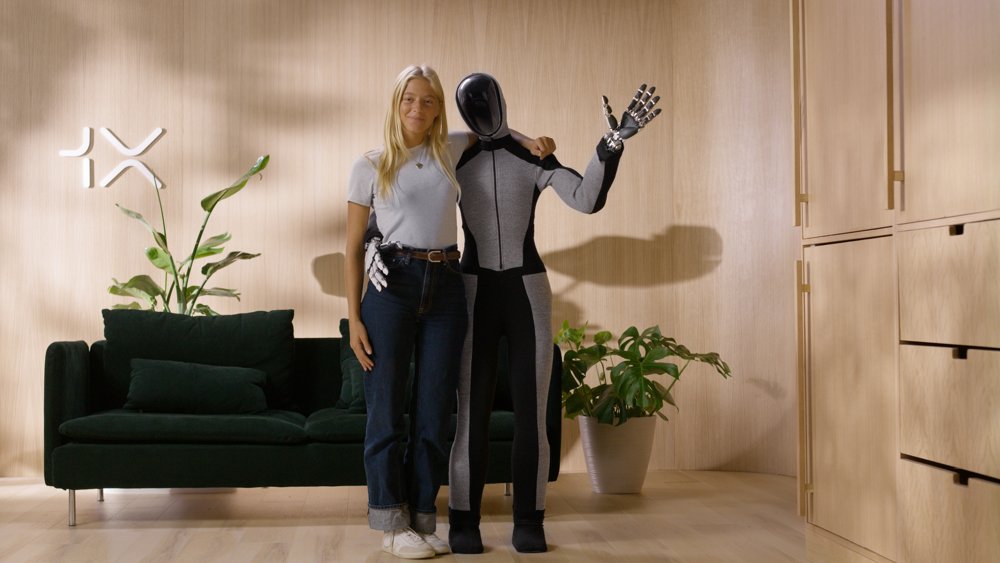
NEO in the home setting 1X designed it for — the company's official campaign photography for the robot's October 2025 preorder launch.
Photo: courtesy of 1X1X's official "Introducing NEO Gamma" reveal video (February 2025) — the generation discussed in section 03 below.
1X's official "NEO The Home Robot | Order Today" preorder launch video (October 2025).
04"A mixture of autonomy and teleoperation"
1X has been unusually direct, for the industry, about how much of NEO's current capability runs through a human operator rather than autonomous AI. Børnich has said plainly that "much of the work will be done by teleoperators in the beginning," and reporting on a Wall Street Journal test run found that none of the tasks NEO performed for the reporter were done autonomously. In a November 2025 interview, Børnich described NEO's operation as "a mixture of autonomy and teleoperation," citing internal figures of roughly 90-plus percent success in autonomous door-opening and about 80% for autonomously fetching objects — while defending human-assisted operation itself as potentially safer than hiring an outside cleaner, pointing to operator vetting, real-time manager oversight, audit trails, and anonymized interfaces that keep operators from seeing a resident's face or knowing which home they're controlling a robot in.
1X has also built in privacy controls specifically for this model: user-defined "no-go zones" that block a robot (and its operator) from certain rooms at the software level, default face-blurring in the operator's video feed, a visible light-ring indicator when a human has taken control, and local storage that lets an owner delete footage before it's uploaded. Even so, NEO's October 2025 launch drew sharp privacy criticism from multiple outlets, and one privacy lawyer quoted in coverage noted that data collected "ranges from the mundane... to the very personal" — real-time video of a home's layout and its occupants, including children — while critics have separately argued that face-blurring alone doesn't guarantee anonymity, since voice, behavior, and household patterns can still identify residents.
- User-defined "no-go zones" block a robot and its operator from certain rooms at the software level.
- Default face-blurring in the teleoperator's video feed, plus a visible light-ring indicator whenever a human has taken control.
- Local storage lets an owner review and delete footage before it's uploaded to the cloud.
05A US factory and scaling
1X consolidated its previously split Sunnyvale, California and Moss, Norway teams into a new 80,000-square-foot Palo Alto headquarters, announced in July 2025. It followed that with a dedicated NEO factory in Hayward, California — a 58,000-square-foot facility built out in roughly three months, beginning full-scale production on April 30, 2026, with initial capacity of 10,000 units a year and a stated target of 100,000 units a year by the end of 2027, backed by a larger facility planned for San Carlos, California. As of a report published the day the Hayward line opened, robots coming off it were still being routed to internal testing and validation rather than customer homes — actual deliveries against the sold-out preorder queue had not yet begun.
1X's headcount has grown quickly alongside that buildout — from roughly 388 employees at the end of 2024 to about 654 a year later, and past 1,000 by mid-2026 on one third-party tracker's count, with more than 200 of those specifically staffing the new Hayward factory.
Manufacturing and headcount
| Year | Event |
|---|---|
| 2014-05 | Halodi Robotics founded in Moss, Norway |
| 2020 | EVE deployed for overnight security work via Everon/ADT |
| 2023-03 | $23.5M Series A2 led by OpenAI Startup Fund |
| 2023-07 | Rebrands from Halodi Robotics to 1X Technologies |
| 2024-01 | $100M Series B led by EQT Ventures |
| 2024-08 | NEO Beta unveiled |
| 2025-02 | NEO Gamma unveiled |
| 2025-07 | New Palo Alto HQ consolidates prior sites |
| 2025-10 | NEO preorders open at $20,000; sell out in 5 days |
| 2026-04 | Hayward, CA NEO factory begins full-scale production |
06A Western alternative, positioned against Chinese rivals
1X's push has increasingly taken on a geopolitical framing. In June 2026, after the US House Select Committee on China publicly warned that Chinese humanoid maker Unitree posed a national-security concern — tied to a proposed bill, the GUARD Act, that would restrict "adversary-built" robotics — 1X accelerated the release of a NEO developer platform, with Børnich framing it explicitly as filling a gap for Western developers: "The West having a proper humanoid development platform is too important for the future of humanity for us to gate-keep."
That framing puts 1X in a three-way race with distinctly different playbooks: Figure AI, backed by a $39 billion valuation, has been an outspoken critic of teleoperation-reliant demos and positions itself as autonomy-first; Tesla's Optimus remains further from market, with no confirmed commercial-sales date as of mid-2026; and 1X has instead leaned into transparency about its own reliance on human operators as a selling point rather than something to hide, betting that an openly hybrid approach can reach paying customers faster than a purely autonomous one.
07FAQ
Who founded 1X Technologies, and when?
Bernt Øivind Børnich founded the company as Halodi Robotics in Moss, Norway, in May 2014, alongside co-founders Phuong Nguyen and Jørgen Sundell. It rebranded to 1X Technologies in July 2023 as it pivoted from commercial/security robots toward home humanoids.
Is NEO actually autonomous?
Not fully, and 1X says so openly. CEO Bernt Børnich has described NEO's operation as "a mixture of autonomy and teleoperation," with a human operator handling much of the work today — citing roughly 90%+ autonomous success for door-opening and about 80% for fetching objects, with the rest routed to remote human operators under privacy controls like face-blurring and no-go zones.
How much does NEO cost?
$20,000 outright with priority 2026 delivery, or $499/month on a six-month-minimum subscription, with a $200 refundable deposit to join the preorder queue. 1X said its first year of planned production sold out within five days of preorders opening in October 2025.
How much has 1X Technologies raised?
Confirmed rounds total roughly $123.5M — a $23.5M Series A2 (Mar 2023, $210M valuation) and a $100M Series B (Jan 2024). A further round of up to $1B at a $10B+ valuation was reported in talks as of September 2025, but no source confirms it has closed.
08Sources
01. Founding
02. The pivot toward the home
03. The product line
04. "A mixture of autonomy and teleoperation"
05. A US factory and scaling
06. A Western alternative, positioned against Chinese rivals
Related articles
1X Technologies company profileHow Figure AI's autonomy-first approach comparesWhere 1X fits on the physical AI landscape mapCompany Deep Dives
Unitree
Figure AI
1X Technologies
- ›The History of 1X Technologies(this article)
Physical Intelligence
Skild AI
NVIDIA
- ›NVIDIA Isaac GR00T, Explained: What NVIDIA Actually Sells in Robotics
- ›NVIDIA DRIVE, Explained: The Automotive Platform Behind Mercedes-Benz, Uber, and a Dozen Other Automakers
- ›NVIDIA Jetson: The Decade-Old Hardware Lineage Behind Physical AI
- ›NVIDIA: A History of the GPU
- ›NVIDIA CUDA, Explained: The Software Behind NVIDIA's AI Moat
- ›Jensen Huang: From a Denny's Dishwasher to NVIDIA's CEO