Company & Robot DB
Palmer Luckey: From Oculus to Anduril
01Early life
Palmer Freeman Luckey was born September 19, 1992, in Long Beach, California, and grew up there — homeschooled, along with his three siblings, by his mother Julie; he was reportedly the only one of the four who never went back to a traditional classroom. As a teenager he ran a small business buying, repairing, and reselling damaged iPhones and other electronics, plowing much of the proceeds into an unusual hobby: buying up discontinued military- and research-grade head-mounted displays — expensive virtual-reality hardware most people had never heard of — from eBay, Craigslist, and government-surplus auctions.
By his own account and his family's, that collection grew into dozens of headsets, alongside prototypes Luckey built himself; some retellings round the total to "50-plus," though that figure blends purchased hardware with his own builds rather than counting one clean series. Around 2010–2011, that hobby led Mark Bolas — a VR researcher at the University of Southern California's Institute for Creative Technologies and a veteran of headset maker Fakespace — to bring the teenage Luckey on as a low-paid intern at USC's Mixed Reality Lab, where he worked alongside military- and research-grade prototypes for a couple of years before leaving in mid-2012 to pursue his own headset full-time.
02The Kickstarter that built modern VR
Luckey's own prototype — after dozens of earlier iterations built in his family's driveway camper trailer — became the Oculus Rift. In mid-2012 he founded Oculus VR alongside Brendan Iribe, Michael Antonov, and Nate Mitchell (reports vary on the exact incorporation month, with different sources citing April, June, and July 2012). The turning point came at E3 that June, when id Software co-founder John Carmack publicly demoed a prototype Rift running Doom 3: BFG Edition — an endorsement from one of gaming's most respected technical minds that gave the unproven headset instant credibility.
On the strength of that momentum, Oculus launched a Kickstarter campaign on August 1, 2012, seeking $250,000. It closed 30 days later having raised $2,437,429 from 9,522 backers — turning "Oculus Rift" into a household name in gaming years before the consumer headset ever shipped, and setting the template for crowdfunded hardware startups that followed.
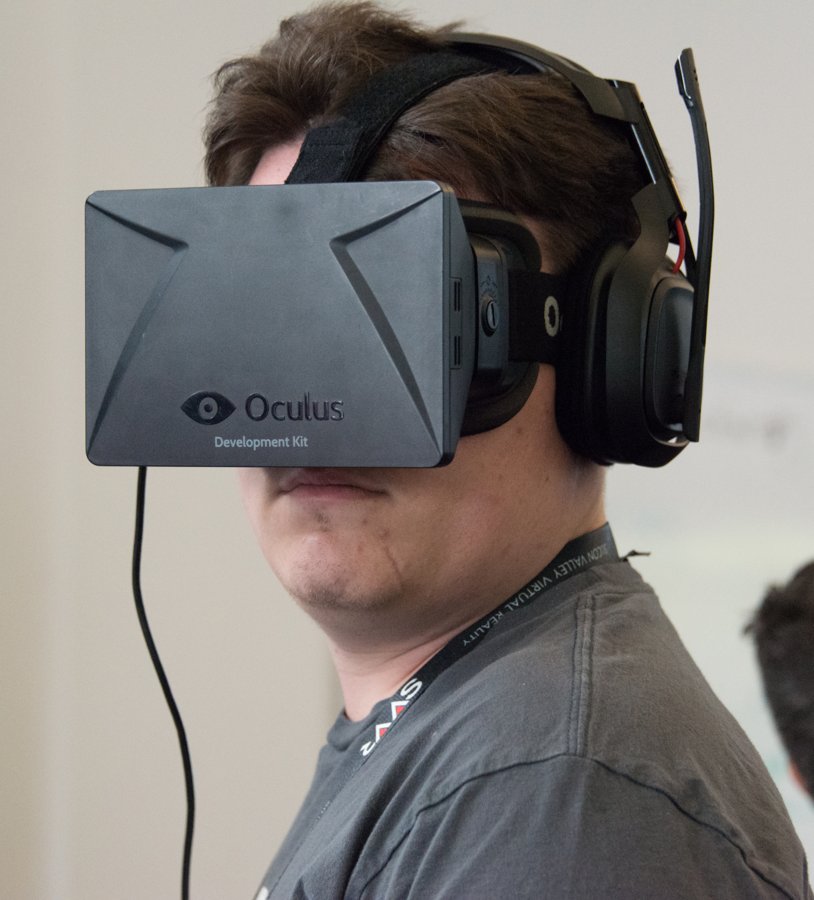
Luckey wearing an Oculus Rift DK1 at the Silicon Valley Virtual Reality Conference, 2014 — roughly two years after the Kickstarter campaign that funded the headset's development.
Photo: Dcoetzee, CC0, via Wikimedia Commons03The Facebook sale and the lawsuit
On March 25, 2014, Facebook announced it would acquire Oculus VR for approximately $2 billion: $400 million in cash, roughly 23.1 million shares of Facebook stock (valued around $1.6 billion at signing), and up to $300 million more tied to milestones. Luckey was 21. Reaction from Oculus's own Kickstarter backers was sharply negative — CNN Money, CBS News, and CNBC all ran stories the next day quoting backers who felt betrayed that a campaign they'd funded to keep VR independent had ended with a sale to Facebook.
The deal also triggered a lawsuit: ZeniMax Media, the parent company of id Software, sued Oculus in May 2014, alleging misappropriation tied to technology and code contributed by id co-founder (and by-then Oculus CTO) John Carmack. A Texas jury returned its verdict in February 2017: $500 million in total, but notably not on the trade-secrets claim itself — the jury found no trade-secrets violation, and instead awarded damages for breach of a non-disclosure agreement, copyright infringement, and false designation of origin, split across Oculus VR ($300 million), Luckey personally ($50 million), and Iribe ($150 million). A judge later reduced the total to $250 million, and Facebook and ZeniMax settled in December 2018 on undisclosed terms.
04The 2016 donation and his exit
In September 2016, The Daily Beast revealed that Luckey had donated $10,000 to Nimble America, a pro-Trump group behind anti-Hillary-Clinton billboards and internet memes (in later interviews, Luckey has sometimes cited a $9,000 figure instead; no contemporaneous 2016 source uses that number, so treat it as his own later rounding rather than a correction). He posted an apology two days later — "I am deeply sorry that my actions are negatively impacting the perception of Oculus and its partners" — and said he had no plans to donate further. It didn't stop the backlash: several independent VR developers, including Scruta Games and Tomorrow Today Labs, publicly said they'd drop Oculus support until Luckey was gone, and he was a conspicuous no-show at Oculus's own developer conference, OC3, the following month.
What happened next is genuinely disputed. A Wall Street Journal investigation published in November 2018, citing unnamed sources and internal emails, reported that Facebook executives pressured Luckey to publicly endorse libertarian candidate Gary Johnson — not Clinton — as a way to distance the company from the Trump association without taking a partisan side, and that he was pushed out over the following months once he wouldn't cooperate; the same report said his exit package was valued at upwards of $100 million. Facebook has consistently denied any of this was political: a company spokesperson told Fox Business in November 2018 that Luckey's "departure was not due to his political views," and Mark Zuckerberg told the US Senate under oath in April 2018 that Luckey's exit "was not because of a political view." Facebook confirmed the departure on March 31, 2017. Luckey himself has stopped short of confirming the WSJ's account but has acknowledged being bound by a confidentiality arrangement tied to his exit: "I got paid an enormous amount of money to not talk about a lot of things that happened," he said on the Voices of VR podcast in 2023, "and I'm actually okay with the law allowing me to enter into that contract."
05Building Anduril
Luckey co-founded Anduril Industries in 2017 alongside Trae Stephens, Matt Grimm, Brian Schimpf, and Joe Chen — its corporate history, funding, and product lines are covered in full in our full history of Anduril. What's specific to Luckey is his role: Anduril's own leadership page lists him simply as "Founder," not CEO or CTO. Schimpf has held the CEO title since incorporation and runs day-to-day operations; Stephens is Executive Chairman. Luckey has said the press consistently gets this wrong because his own story makes "a much easier story" than Schimpf's — "the CEO is Brian," he told Fortune in May 2026, describing Schimpf as the low-profile operator actually running the company Luckey is most publicly associated with.
That mismatch between Luckey's public visibility and his formal title runs through most coverage of Anduril, including press materials that occasionally slip and call him "CEO" regardless of the company's own org chart.
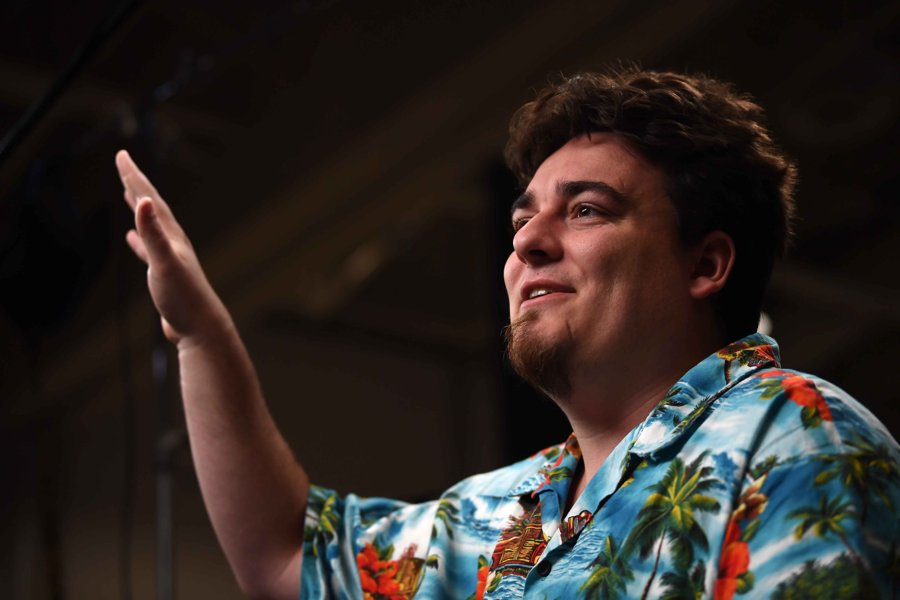
Luckey at the Collision tech conference in Toronto, May 2019 — about two years into building Anduril, the defense company he founded after leaving Facebook.
Photo: Stephen McCarthy / Collision, CC BY 2.0, via Wikimedia Commons- Consistent personal style since his Oculus days: Hawaiian shirts, shorts, and sandals — including at formal defense-industry trade shows.
- Anduril's own leadership page lists his title as "Founder," not CEO or CTO; Brian Schimpf has held the CEO title since 2017.
- No formal US government advisory or appointed role documented for Luckey personally — unlike Anduril co-founder Trae Stephens, who has served on the Pentagon's Defense Innovation Board.
06Personal life and net worth
Luckey's public image has stayed remarkably consistent since his Oculus days: Hawaiian shirts, shorts, and sandals, even at defense-industry trade shows where the dress code otherwise runs toward suits. "I wear a lot of Hawaiian shirts because I like them, and I can get away with it," he told NPR in 2024 — a deliberate, gamer-nerd contrast to the buttoned-up culture of the traditional defense contractors Anduril competes against.
His net worth is harder to pin down than his wardrobe. Forbes' tracker placed him at roughly $3.5 billion as of early-to-mid 2026; other trackers with less rigorous methodology have put the figure as high as $5–6 billion, and Bloomberg's Billionaires Index does not appear to carry a standing entry for him at all. Whatever the exact number, it has scaled with Anduril's valuation, which climbed from roughly $2 billion in 2020 to $61 billion by May 2026 — detailed in the funding chart of Anduril's company history, linked below.
Politically, Luckey has remained an active and public Republican donor since the 2016 episode that cost him his Facebook job: he gave $100,000 to Donald Trump's 2017 inauguration fund, hosted a Trump reelection fundraiser at his Newport Beach home in October 2020, and donated roughly $400,000 toward Trump's 2024 campaign while co-hosting another fundraiser that June — on top of reported contributions to Republican party committees and congressional candidates that this article hasn't independently verified against primary FEC records. (In one lighter footnote, he also twice donated $500 to progressive Rep. Alexandria Ocasio-Cortez's campaign in 2019, widely read as a troll; her campaign returned the money.) Despite his visibility, Luckey has not held any formal US government advisory or appointed role — that distinction belongs to Anduril co-founder Trae Stephens, who has served on the Pentagon's Defense Innovation Board.
Palmer Luckey, by the numbers
| Year | Event |
|---|---|
| 1992 | Born September 19 in Long Beach, California; homeschooled |
| 2010-11 | Joins USC's Institute for Creative Technologies as a teenage intern |
| 2012 | Founds Oculus VR; John Carmack demos a Rift prototype at E3 |
| 2012-08 | Oculus Rift Kickstarter launches, raises $2.4M from 9,522 backers |
| 2014-03 | Facebook announces ~$2B acquisition of Oculus VR |
| 2016-09 | Daily Beast reveals his $10,000 donation to pro-Trump group Nimble America |
| 2017-03 | Facebook confirms his departure |
| 2017-04 | Co-founds Anduril Industries |
| 2025-10 | Unveils the EagleEye AR headset at the AUSA conference |
| 2025-12 | Personally sanctioned by China over Taiwan arms sales |
07Recent moves and the ethics debate
Luckey has stayed in the public eye through Anduril's recent expansion. At the AUSA defense conference in October 2025, he unveiled EagleEye, a family of AI-linked mixed-reality headsets built with Meta, Oakley, Qualcomm, and Gentex as the successor to the Microsoft-built IVAS program Anduril took over from the US Army — describing it as more than new hardware: "we're giving them a new teammate," he said of the AI layer built into the display. In January 2026 he appeared at CES largely away from defense topics, discussing his separate retro-gaming hardware venture and what he's called an overrated obsession with "innovation" in consumer tech design (reported by a single outlet; treat as illustrative rather than exhaustively confirmed). On December 26, 2025, China's Ministry of Foreign Affairs personally sanctioned Luckey — alongside nine other US defense executives — over a US arms package to Taiwan that included Anduril systems, freezing any assets he holds in China and barring him from entering the country, including Hong Kong and Macao.
Luckey has also become one of the most visible public defenders of autonomous weapons. In a CBS 60 Minutes segment that aired May 18, 2025, he argued the moral framing critics apply is backwards: "There's no moral high ground to making a land mine that can't tell the difference between a school bus full of children and Russian armor," he told correspondent Sharyn Alfonsi. "It's not a question between smart weapons and no weapons. It's a question between smart weapons and dumb weapons." He's made a similar case for autonomy reducing the number of soldiers exposed to risk — "if I can have one guy command and controlling a hundred aircraft, that's a lot easier than having to have a pilot in every single one" — and for arming US allies as deterrence, so they can be, in his words, "prickly porcupines that nobody wants to step on." Critics, including the long-running Stop Killer Robots campaign, argue that framing understates how autonomy erodes meaningful human control over lethal decisions — a debate examined in more detail in Anduril's company history, linked below.
CBS 60 Minutes' May 2025 segment on Anduril and Luckey's case for autonomous weapons, discussed in section 07 below. Note: CBS's own video title calls Luckey "Anduril CEO" — a common press error; his actual title is Founder, and Brian Schimpf (shown in the same segment) is Anduril's CEO.
08FAQ
Is Palmer Luckey the CEO of Anduril?
No. Anduril's own leadership page lists Luckey's title as "Founder." Brian Schimpf has held the CEO title since the company's 2017 founding and runs day-to-day operations; Trae Stephens is Executive Chairman. Luckey has said press coverage frequently gets this wrong because his own public profile makes an easier story than Schimpf's.
Why did Palmer Luckey leave Facebook?
Facebook has maintained his 2017 departure was unrelated to politics. A 2018 Wall Street Journal investigation, citing unnamed sources, reported he was pressured over his 2016 donation to a pro-Trump group and pushed out when he wouldn't publicly back a different candidate — an account Facebook has denied, including in Mark Zuckerberg's sworn 2018 Senate testimony. Luckey himself has acknowledged being bound by a confidentiality arrangement tied to his exit but hasn't confirmed the WSJ's specific account.
How did Palmer Luckey get rich?
First from Facebook's roughly $2 billion acquisition of Oculus VR in 2014, when he was 21; then from his ownership stake in Anduril Industries, the defense company he co-founded in 2017, which reached a $61 billion valuation by May 2026. Forbes estimated his net worth at roughly $3.5 billion in early-to-mid 2026, though other trackers cite higher figures.
What does Palmer Luckey believe about autonomous weapons?
He argues autonomy makes weapons more discriminating, not less humane — telling CBS's 60 Minutes in 2025, "there's no moral high ground to making a land mine that can't tell the difference between a school bus full of children and Russian armor." Critics, including the Stop Killer Robots campaign, argue this framing understates how greater autonomy erodes meaningful human control over lethal decisions.
09Sources
01. Early life
02. The Kickstarter that built modern VR
03. The Facebook sale and the lawsuit
04. The 2016 donation and his exit
05. Building Anduril
06. Personal life and net worth
07. Recent moves and the ethics debate
Related articles
Company Deep Dives
Unitree
Figure AI
1X Technologies
Physical Intelligence
Skild AI
Anduril
- ›The History of Anduril Industries
- ›Palmer Luckey: From Oculus to Anduril(this article)
NVIDIA
- ›NVIDIA Isaac GR00T, Explained: What NVIDIA Actually Sells in Robotics
- ›NVIDIA DRIVE, Explained: The Automotive Platform Behind Mercedes-Benz, Uber, and a Dozen Other Automakers
- ›NVIDIA Jetson: The Decade-Old Hardware Lineage Behind Physical AI
- ›NVIDIA: A History of the GPU
- ›NVIDIA CUDA, Explained: The Software Behind NVIDIA's AI Moat
- ›Jensen Huang: From a Denny's Dishwasher to NVIDIA's CEO