Segment Deep Dives
Humanoid Robots: Size and Disputed Shipments
01How the market formed
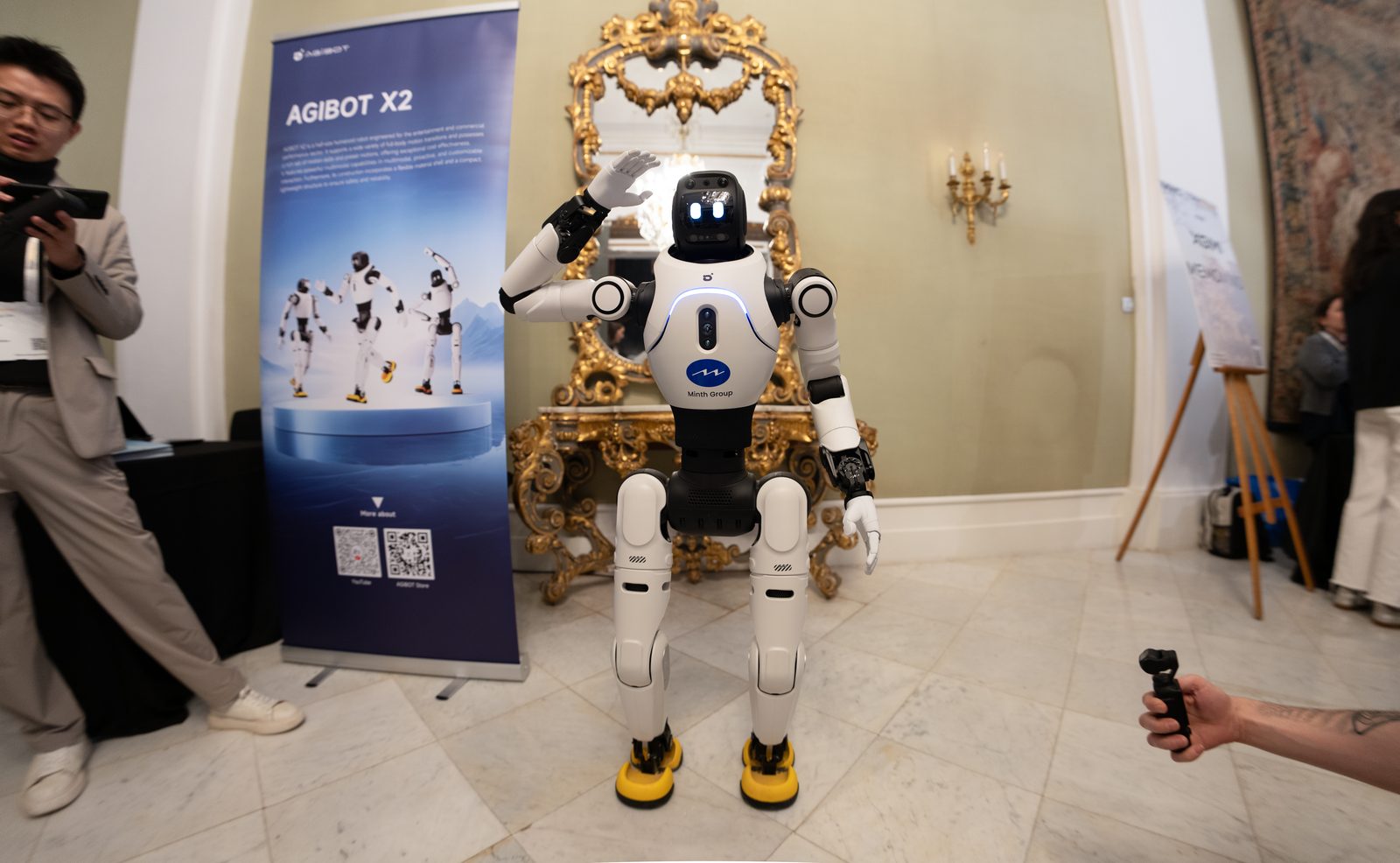
AgiBot's X2 humanoid on display at Mobile World Congress 2026 — the Shanghai-based maker Omdia ranked #1 by 2025 shipment volume, ahead of Unitree.
Photo: JJxFile, CC BY 4.0, via Wikimedia CommonsHumanoid robots spent decades as a research curiosity before anyone treated them as a market. Honda quietly ended its ASIMO program in 2018 after 32 years of development that never reached commercial deployment, and Boston Dynamics' Atlas — the robot behind the viral parkour and backflip videos — remained a DARPA-funded research platform, not a product for sale. That changed on August 19, 2021, when Tesla used its AI Day event to reveal a humanoid concept it called Optimus. The reveal was closer to a statement of intent than a working robot, but it's the moment most industry observers point to as when "humanoid" turned from a research topic into an investable business category. Figure AI, founded the following year by a team that drew engineers from Boston Dynamics, Tesla, and Google DeepMind, was one of the first startups built explicitly around that new framing.
02Funding and IPOs
Within about a year of each other, three very different ways of financing a humanoid robot company all played out. In China, UBTech Robotics listed on the main board of the Hong Kong Stock Exchange on December 29, 2023, becoming the first publicly traded humanoid-robot maker anywhere. In the US, Figure AI raised $675 million in a Series B round in February 2024, at a $2.6 billion valuation, with Microsoft, the OpenAI Startup Fund, Nvidia, Jeff Bezos, and Intel Capital among the investors — alongside a collaboration agreement with OpenAI to build AI models for the robot. And in South Korea, Samsung Electronics took a different route entirely: rather than fund a startup, it built a stake in an existing humanoid maker, buying 10.2% of Rainbow Robotics (a 2011 spin-out from KAIST's Humanoid Robot Research Center) for roughly $40 million in January 2023, then steadily increasing that stake — reaching 35% and making Samsung the company's largest shareholder — while setting up a Future Robotics Office reporting directly to CEO Lee Jae-yong.
Three ways to bankroll a humanoid, one year apart
The first humanoid-robot maker to go public, debuting on the exchange's main board.
Microsoft, OpenAI, and Nvidia back a $2.6B valuation, plus an OpenAI model partnership.
SourceCNBC, Feb 2024
From a 10.2% stake to 35% and largest shareholder, without funding a startup of its own.
SourceSamsung Newsroom
03Commercialization
A robot that can walk isn't the same as a robot someone pays to use, and the gap between those two milestones took another two-plus years to close. Agility Robotics' Digit became the first humanoid in a formal commercial deployment when it signed a multi-year Robots-as-a-Service agreement with logistics operator GXO in June 2024 — Robots-as-a-Service, or RaaS, means the customer rents the robot by the month or by the task instead of buying it, so the maker books revenue over years rather than at delivery — by mid-2026, Digit units at GXO's Flowery Branch, Georgia facility had moved over 100,000 totes, and a separate deployment at bearing maker Schaeffler's Cheraw, South Carolina plant had run daily eight-hour factory shifts for roughly 15 consecutive months. Tesla's Optimus program illustrates how wide the gap between target and delivery can still be: the company set a public target of 5,000 units built for internal factory use in 2025, but by its own account had only built "hundreds" by year-end — a shortfall it's now trying to close with public 2026 targets of 50,000 to 100,000 units and a next-generation Optimus 3 slated to enter production at its Fremont factory around July–August 2026.
Optimus: target vs. reported actual, 2025
04Mass production and shipments
While Western makers were still measuring output in the hundreds, Chinese manufacturers scaled into the thousands. Shanghai-based AgiBot, founded in 2023, and Hangzhou-based Unitree — which had spent seven years building quadruped "robot dogs" before entering the humanoid market — both moved from prototype to volume production over 2024–2025, backed by a domestic supply chain for motors, reducers, and sensors that Western makers still mostly import. The result shows up directly in the shipment count: global humanoid shipments reached roughly 13,318 units in 2025, an increase of nearly 480% over 2024 by Omdia's count, with Chinese manufacturers accounting for close to 90% of that total. Analyst firm TrendForce expects the pace to keep accelerating, forecasting that global shipments will exceed 50,000 units in 2026, growth of more than 700% year over year. TrendForce doesn't publish its own 2025 figure, so that growth rate can't be lined up against Omdia's 13,318 units directly. The same forecast projects Unitree and AgiBot alone capturing close to 80% of China's domestic shipments in 2026.
Global humanoid robot shipments, 2025–2035
05Key players
Even the basic question of who ships the most humanoid robots doesn't have a single agreed answer. Analyst firm Omdia's General-Purpose Embodied Intelligent Robot report ranked AgiBot first for 2025, crediting it with 5,168 units and a 39% share of global shipments, followed by Unitree at 4,200 units (32%) and UBTech at 1,000. Unitree disputes that count directly, self-reporting more than 5,500 units shipped and claiming the volume crown for itself — a gap that comes down to differences in what each side counts as a shipped, revenue-generating unit rather than a demo or pilot placement. Figure AI, by contrast, shipped roughly 150 robots in 2025 — a fraction of either Chinese company's volume, reflecting a strategy built around a small number of higher-value enterprise deployments rather than manufacturing scale.
Two rankings, two winners: the 2025 shipment count
AgiBot ranks #1
5,168 units, 39% of global 2025 shipments — Unitree ranked #2 at 4,200 units (32%).
SourceOmdia, via TechNode
Self-reports 5,500+ units shipped in 2025, disputing Omdia's count directly.
SourceGasgoo
2025 shipment leaders (reported units)
5,168 units Omdia, via TechNode (Jan 2026)
1,000 units Omdia, via TechNode (Jan 2026)
150 units Forbes (Apr 2026)
| Company | Country | Metric | 2025 shipments |
|---|---|---|---|
| AgiBot (Zhiyuan Robotics) | CN | Units sold (2025) | 5,168 units Omdia, via TechNode (Jan 2026) |
| Unitree Robotics | CN | Units sold (2025) | 4,200 units Omdia, via TechNode (Jan 2026) — Unitree disputes this, self-reporting 5,500+ units |
| UBTECH Robotics | CN | Units sold (2025) | 1,000 units Omdia, via TechNode (Jan 2026) |
| Figure AI | US | Units sold (2025) | 150 units Forbes (Apr 2026) |
Figure's "Introducing Helix" (Feb 2025) — the vision-language-action model behind Figure AI's shipped units above.
06Price and listed makers
Two questions come up more than any other about this segment, and neither is answered by a shipment table. The first is price. Unitree publishes its own, and the spread inside a single maker's lineup is wide: roughly $5,900 for the R1, a stripped-down developer platform, up to around $90,000 at the top of the range, with the G1 at roughly $16,000 sitting in between as the model built for volume. Most Western makers don't publish list prices at all, because they aren't selling units off a shelf — Agility's Digit reaches customers through the Robots-as-a-Service arrangement described above, where the number that matters is a monthly rate rather than a sticker price.
The second is which of these companies are publicly traded. Of the makers named in this article, three are: UBTech Robotics (9880.HK, Hong Kong), Tesla (TSLA), and Rainbow Robotics (277810, KOSDAQ) — the last of which is the route Samsung Electronics (005930, KOSPI) took into the segment rather than building its own. Figure AI, AgiBot, Agility Robotics, and Neura Robotics were all still private as of this writing. Unitree filed for a Shanghai STAR Market listing that received final regulatory approval in July 2026, with the trading debut not yet set. Nothing here is a recommendation — it's just which names have a ticker behind them and which don't.
07Market size
Ask five research firms for the size of the humanoid robot market and expect five different answers — not because any one of them is wrong, but because they're measuring different things. Grand View Research put the global market at roughly $1.55 billion in 2024, counting hardware alone; DataBridge Market Research put the same year at roughly $3.65 billion, apparently using a broader scope. MarketsandMarkets, whose multi-year series is used for the chart below, estimates $2.92 billion in 2025, growing to $15.26 billion by 2030 and $50.27 billion by 2035 — a 39.2% compound annual growth rate over the first stretch. Goldman Sachs, using its own scope and methodology, separately projects the market will reach $38 billion by 2035 (more than sixfold its own earlier $6 billion estimate) on the back of roughly 1.4 million cumulative shipments. For the same year, that's a 1.3x spread against MarketsandMarkets' figure — a useful gauge of how far two credible methodologies can land apart. None of these numbers should be read as more precise than the methodology behind it.
Global humanoid robot market size, MarketsandMarkets estimate (USD)
Data note: Market-size estimates for this segment vary by 2–3x across research firms depending on scope (hardware only vs. hardware + software + services) — Grand View Research put the 2024 global market at ~$1.55B, DataBridge Market Research at ~$3.65B for the same year. The shipment ranking above also has an open dispute: analyst firm Omdia ranks AgiBot #1 for 2025 (5,168 units, 39% share), while Unitree self-reports 5,500+ units and claims the volume crown itself. Both figures are shown; neither is presented as the single settled count. The `shipmentVolume` series above also mixes counting methodologies across years — the 2025 point is Omdia's count (13,318 units), while TrendForce's 2026 forecast (>50,000 units) uses TrendForce's own separate, lower count of 2025 shipments as its baseline, so the two points aren't on a strictly comparable year-over-year basis.
Market data as of 2026-07
08By region
The regional split in this segment isn't just about who's ahead — it's about which part of the problem each region is actually betting on. China has bet on manufacturing scale and vertical integration: Unitree makes more than 95% of its components in-house, and the country's dense electronics supply chain lets AgiBot, UBTech, and others iterate and cut cost quickly. The US has bet on software and AI: Figure's OpenAI partnership, 1X's backing from OpenAI, and Tesla's in-house Full Self-Driving stack all treat the robot's "brain" as the differentiator, at the cost of building fewer, more expensive units. Europe, led by Germany's Neura Robotics — which raised roughly $1.4 billion in a single 2026 round, among the largest robotics rounds ever — is betting on cognitive humanoids purpose-built for European manufacturing rather than either the US or Chinese playbook.
Japan, historically the country that built ASIMO, is playing a different position entirely. Analyst firm TrendForce describes Japan as concentrating on the core components — actuators, sensors, control systems — that raise the barrier to entry, citing Harmonic Drive's joint reducers as the example; both US and Chinese humanoid makers still depend on that layer. Complete-system work hasn't stopped: the same report points to Kawasaki Heavy Industries' Kaleido 9 humanoid (30 kg payload, VR-teleoperated) on the Japanese side. It just isn't aimed at the shipment race China and the US are running.
China
- 2023AgiBot founded; UBTech lists on the HKEX
- 2024Unitree launches the ~$16,000 G1
- 2025~90% of global humanoid shipments
United States
- 2021Tesla reveals Optimus at AI Day
- 2024Figure AI raises $675M with OpenAI, Microsoft, Nvidia
- 2024Agility's Digit begins paid work at GXO
Germany
- 2026Neura Robotics raises ~$1.4B, among the largest robotics rounds ever
Japan
- 2000Honda unveils ASIMO
- 2018Honda ends the ASIMO program
- 2025TrendForce: Japan focuses on core components, not complete robots
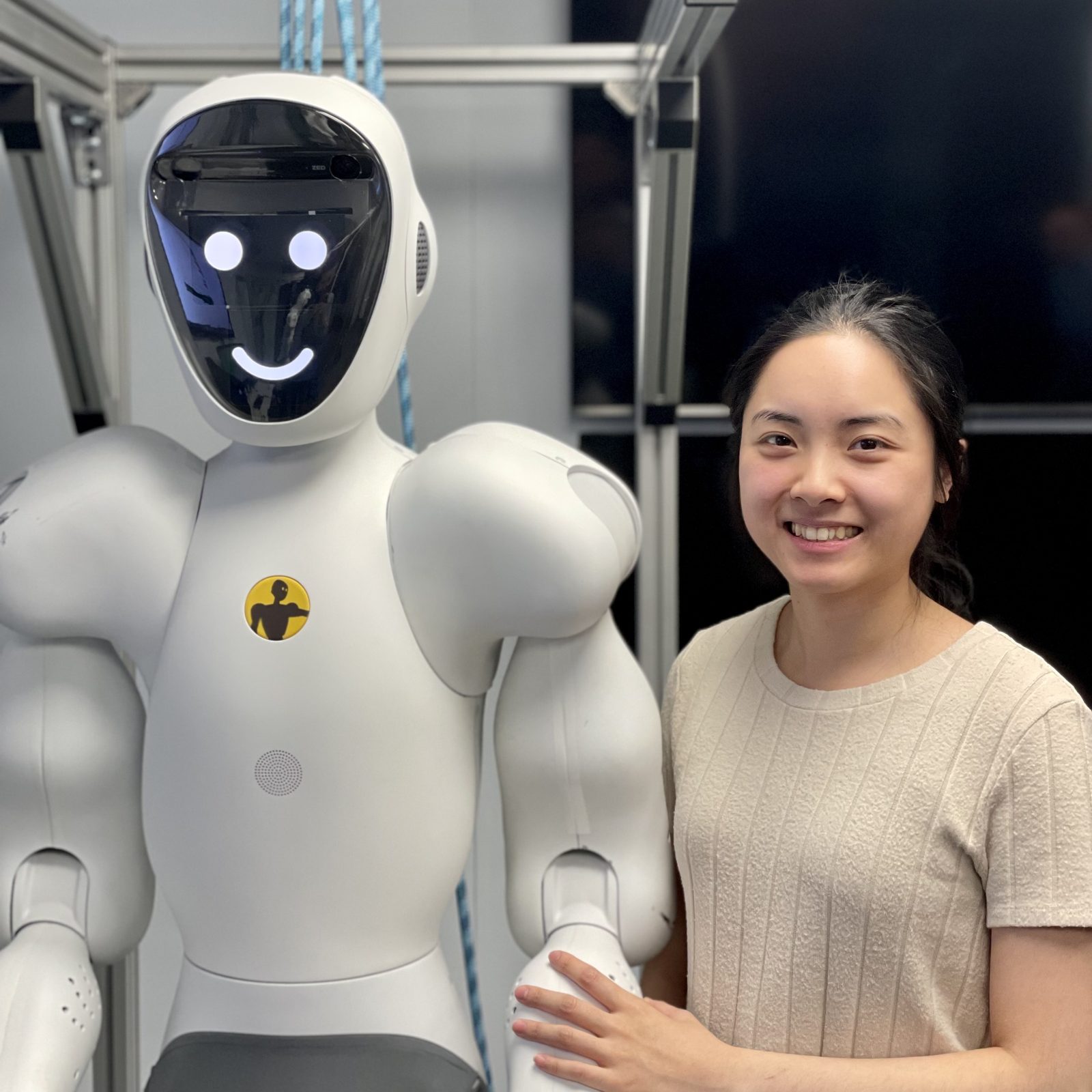
A perception engineer at Halodi Robotics, the Norwegian humanoid maker that rebranded as 1X Technologies in 2023 — the same 1X named above as one of the OpenAI-backed bets on humanoid "brains" over hardware volume.
Photo: Nicholas-halodi, CC BY-SA 4.0, via Wikimedia Commons09Challenges ahead
The cost curve
Whether this segment scales may depend less on any market-size forecast than on the manufacturing cost curve. Goldman Sachs found humanoid manufacturing costs fell roughly 40% in a single year, from a $50,000–$250,000 range to $30,000–$150,000, against the 15–20% annual decline its analysts had expected; the driver is mostly the same components-cost decline that has already played out in quadruped robots and electric vehicles. On that basis, the bank estimates a plausible labor-substitution rate of 5–15% for car manufacturing and dangerous jobs like disaster rescue and nuclear reactor work, which would imply global demand of 1.1 million to 3.5 million units — well above its own base-case 2035 shipment forecast.
Profitability at scale
What's still unresolved isn't whether a humanoid can walk, carry a tote, or work an eight-hour shift — Digit and Optimus have each demonstrated that in some form. It's whether any maker, in any region, can build and sell these robots at a large enough scale to be profitable — a question the shipment and market-size numbers above don't yet answer either way.
10Timeline at a glance
| Year | Region | Event |
|---|---|---|
| 2000 | JP | Honda unveils ASIMO |
| 2018 | JP | Honda ends the ASIMO program |
| 2021 | US | Tesla reveals Optimus at AI Day, igniting the funding boom |
| 2022 | US | Figure AI founded |
| 2023-01 | KR | Samsung takes its first stake in Rainbow Robotics (10.2%) |
| 2023 | CN | AgiBot founded in Shanghai |
| 2023-12 | CN | UBTech lists on the HKEX — first humanoid-robot stock |
| 2024-02 | US | Figure AI raises $675M Series B at a $2.6B valuation |
| 2024-04 | US | Boston Dynamics unveils the all-electric Atlas |
| 2024-06 | US | Agility's Digit begins paid work at GXO — first commercial humanoid deployment |
| 2024 | CN | Unitree launches the ~$16,000 G1 humanoid |
| 2025 | Global | Global shipments reach ~13,318 units, ~90% from Chinese makers |
| 2025 | KR | Samsung becomes Rainbow Robotics' largest shareholder (35%) |
| 2026 | DE | Neura Robotics raises ~$1.4B Series C |
| 2026 | Global | TrendForce forecasts shipments will exceed 50,000 units, using its own separate count |
11FAQ
How many humanoid robots shipped in 2025?
Analyst firm Omdia counted roughly 13,318 units globally, up nearly 480% from 2024, with Chinese manufacturers accounting for close to 90% of the total. Individual company counts are disputed — see the shipment-leaders section above.
Who makes the most humanoid robots?
It depends who's counting. Analyst firm Omdia ranked AgiBot first for 2025 (5,168 units), followed by Unitree (4,200) and UBTech (1,000) — but Unitree disputes this, self-reporting over 5,500 units and claiming the volume lead itself.
How big is the humanoid robot market?
It depends heavily on which analyst firm's scope you use — estimates for 2024–2025 alone range from roughly $1.55B (Grand View Research, hardware only) to $3.65B (DataBridge Market Research, broader scope). MarketsandMarkets projects $2.92B in 2025 growing to $15.26B by 2030.
Which humanoid robots are actually deployed and doing paid work today?
Agility Robotics' Digit is the clearest case, running paid Robots-as-a-Service work at GXO (since June 2024) and Schaeffler (daily eight-hour shifts since early 2025), among other customers. Most other makers, including Tesla's Optimus, remain earlier in the pilot-to-scale transition.
12Sources
01. How the market formed
03. Commercialization
06. Price and listed makers
08. By region
09. Challenges ahead
Related articles
Articles
- ›The History of the Robot Industry
- ›From Robot Dogs to Humanoids
- ›Humanoid Robot Actuators & Hands
- ›Tesla Optimus
- ›Unitree's Humanoid Robots: H1, G1, H2, and R1
- ›Sensors & Perception for Robots: Market Size and the LiDAR Race
- ›Quadruped Robots: The 46x Price Gap
- ›Robot Foundation Models: Market Size, Players, and the Funding Boom
- ›Actuators & Precision Reducers: Market Size and Players
Company & Market Data
Segment Deep Dives
All Segment Deep Dives articles →Humanoid & Mobility
- ›Humanoid Robots: Size and Disputed Shipments(this article)
- ›Quadruped Robots: The 46x Price Gap
- ›AGV vs AMR: Market Size and Fleet Scale
- ›Drone Market: Size and the DJI Question