Segment Deep Dives
Exoskeletons: Market Size, Players, and a Wave of Financial Distress
01Three different businesses
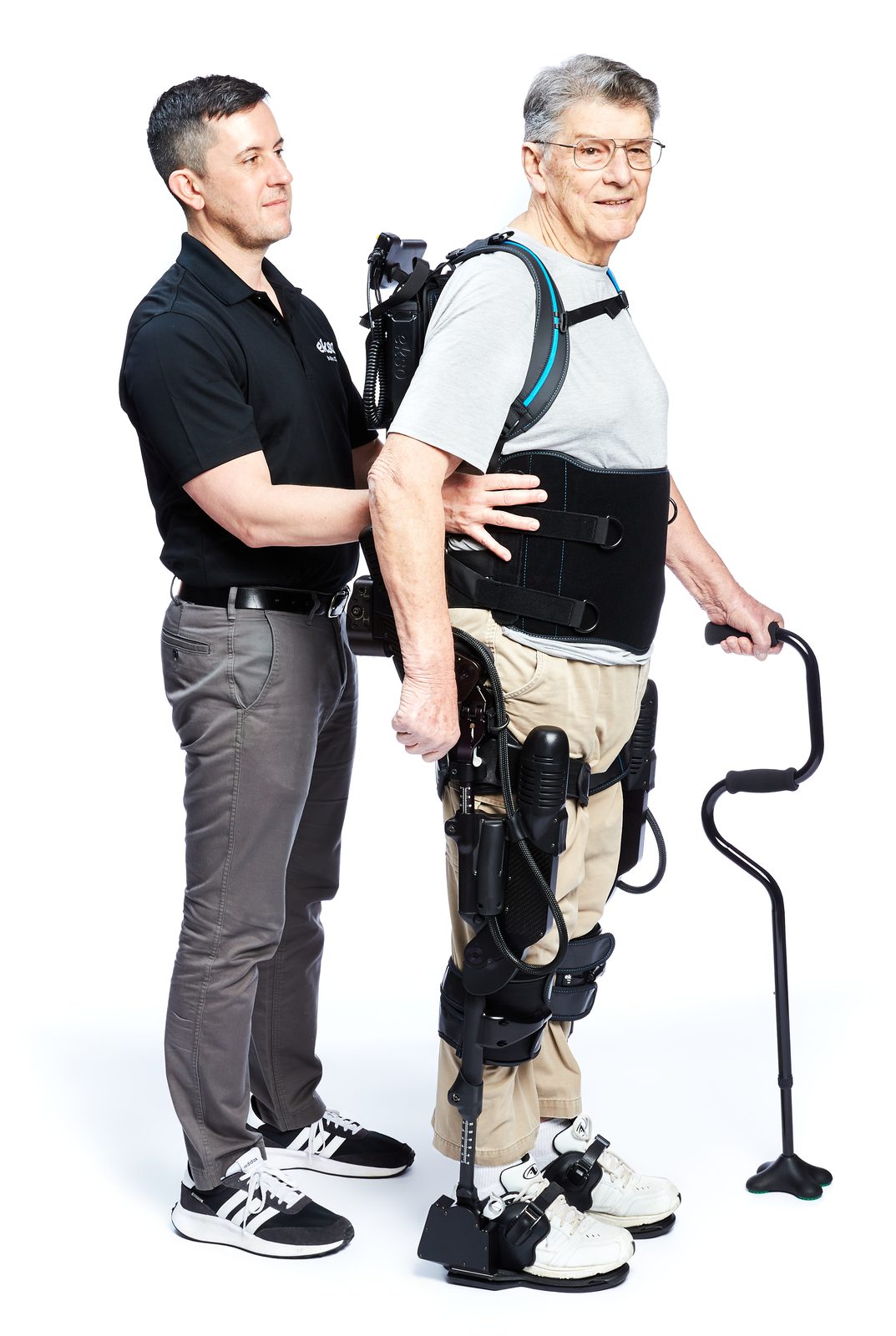
A patient using Ekso Bionics' EksoNR rehabilitation exoskeleton — the product behind the company's $12.8 million FY2025 revenue, even as it no longer trades as an independent exoskeleton pure-play.
Photo: AriceEB, CC BY-SA 4.0, via Wikimedia CommonsA medical exoskeleton like ReWalk (now sold by Lifeward) or Ekso Bionics' EksoNR helps someone with a spinal cord injury or stroke-related paralysis stand and walk, sold through hospitals and rehab clinics and often billed like a medical device because, legally, it is one. An industrial exoskeleton like German Bionic's Cray X or Levitate's Airframe is closer to a piece of PPE — it doesn't restore lost function, it reduces strain on an otherwise able-bodied warehouse or factory worker's back and shoulders over a full shift. A third category, defense exoskeletons, traces back to the earliest DARPA-funded research in the category and continues today in programs like Lockheed Martin's ONYX. These three businesses have almost nothing in common commercially — different customers, different regulatory paths, different sales cycles — but they're consistently lumped into one "exoskeleton market" by research firms, which is part of why sizing this segment is unusually messy.
Medical / rehabilitation
ReWalk (Lifeward), Ekso Bionics EksoNR, Cyberdyne HAL — regulated as medical devices, sold through hospitals and rehab clinics.
Industrial / occupational
German Bionic Cray X, Levitate Airframe — closer to PPE, reduce strain for able-bodied warehouse/factory workers.
Defense
Lockheed Martin ONYX and successors to the DARPA-funded HULC/XOS lineage — augment a soldier's load-carrying capacity.
02How the market formed
Sarcos traces its exoskeleton work back to 1983, and its DARPA-funded XOS exoskeleton program was accepted in 2006, the same research lineage that led to Raytheon acquiring the company in November 2007. Berkeley Bionics, founded in 2005 as a UC Berkeley spinoff by Homayoon Kazerooni and colleagues, built BLEEX, another DARPA-funded exoskeleton, and its Human Universal Load Carrier (HULC) program was licensed to Lockheed Martin in 2009 — Berkeley Bionics later renamed itself Ekso Bionics and went public via reverse merger in January 2014. Japan's Cyberdyne, founded in 2004 as a University of Tsukuba spinoff by Yoshiyuki Sankai, took its HAL exoskeleton down a medical-device regulatory path instead: HAL received EU CE marking in August 2013, Japan's national health insurance system approved coverage in January 2016, and the US FDA cleared it in May 2024 — more than two decades after the company's founding. ReWalk Robotics' exoskeleton received FDA clearance for personal use in June 2014, the first exoskeleton cleared for that specific use case.
03Market size
Precedence Research estimates the global exoskeleton market at roughly $579.5 million in 2025, growing to $2.6 billion by 2035. That number needs an unusually large caveat even by this site's standards: narrower "medical exoskeleton only" estimates from other firms run under $250 million, while the broadest "wearable robotic exoskeleton" framings run into the tens of billions of dollars — a spread of more than 100x depending entirely on what's counted, not on any real disagreement about underlying demand.
Global exoskeleton market size, Precedence Research estimate (USD)
Data note: Market-size estimates for this segment vary by more than 100x depending on scope: narrower "medical exoskeleton only" estimates run under $250 million, while the broadest "wearable robotic exoskeleton" framings run into the tens of billions — the series above (Precedence Research) sits in between and shouldn't be read as more authoritative than the others, just internally consistent across its own two years. A frequently repeated claim that Ekso Bionics holds roughly 17% market share, and a separate claim that the top five companies control roughly 50% of segment revenue, could not be traced to any primary or independently verifiable source during this review and are deliberately excluded from marketShare — read the revenue figures above as each company's own reported scale, not a market-share ranking. This segment has also seen unusual financial distress recently: Sarcos exited the exoskeleton/robotics hardware business entirely in November 2023, rebranding as Palladyne AI (an AI software company); German Bionic filed for insolvency in November 2025 before being acquired by Archimedes Partners; and Ekso Bionics merged into Applied Digital's cloud/GPU business as ChronoScale Corp in May 2026, with its exoskeleton line continuing only as a subsidiary. All three of the companies in the marketShare array above carry going-concern or restructuring caveats in their own recent filings — treat the revenue figures as a snapshot of a segment currently under real financial pressure, not a stable baseline.
Market data as of 2026-07
04Where they get used
Verified industrial deployments remain modest in scale but real: Ford ran roughly 75 Ekso Bionics EksoVest units across 15 plants starting in 2018, Boeing has used the same product on its own assembly lines, and Toyota deployed more than 350 Levitate Airframe units across two plants, with the company's own study finding a 20% reduction in muscle load. Injury-reduction claims vary in rigor — a 2026 trade-press report on a Vanderbilt-affiliated study found a 62% reduction in strain/sprain injuries across five distribution centers using HeroWear devices, while the independent, lab-based NIOSH has found 10–44% reductions in back muscle activity but cautions those come from small-sample lab studies rather than field validation. One widely repeated claim — that Amazon has deployed exoskeletons across its warehouses — could not be traced to any confirmed source; treat it as unverified.
Confirmed industrial pilots, in numbers
05Key players
With no independently verified market-share breakdown available for this segment (see the data note below), the closest comparison is each public company's own reported revenue. Japan's Cyberdyne led at roughly $29 million for the fiscal year ended March 2025 (converted from ¥4.38 billion). Lifeward, the company formerly known as ReWalk Robotics, reported $22.0 million for FY2025, down 14.1% year-over-year. Ekso Bionics reported $12.8 million for FY2025, down 28.6% — and, notably, is no longer an independent exoskeleton pure-play as of May 2026 (see below). All three companies' own recent filings carry going-concern or restructuring language.
Public exoskeleton companies by reported revenue
| Company | Country | Metric | Revenue |
|---|---|---|---|
| CYBERDYNE | JP | Revenue (FY2025) | $29.2M Nikkei, citing Cyberdyne IR materials — fiscal year ended March 2025, ¥4.38B converted at ~¥150/$1 (not an official USD figure) |
| Lifeward (ReWalk Robotics) | US | Revenue (FY2025) | $22.0M Lifeward, FY2025 Form 10-K (SEC EDGAR) — down 14.1% YoY, with going-concern language |
| Ekso Bionics | US | Revenue (FY2025) | $12.8M Ekso Bionics, FY2025 Form 10-K (SEC EDGAR) — down 28.6% YoY, with going-concern language; company merged into Applied Digital's ChronoScale Corp (CHRN) in May 2026 |
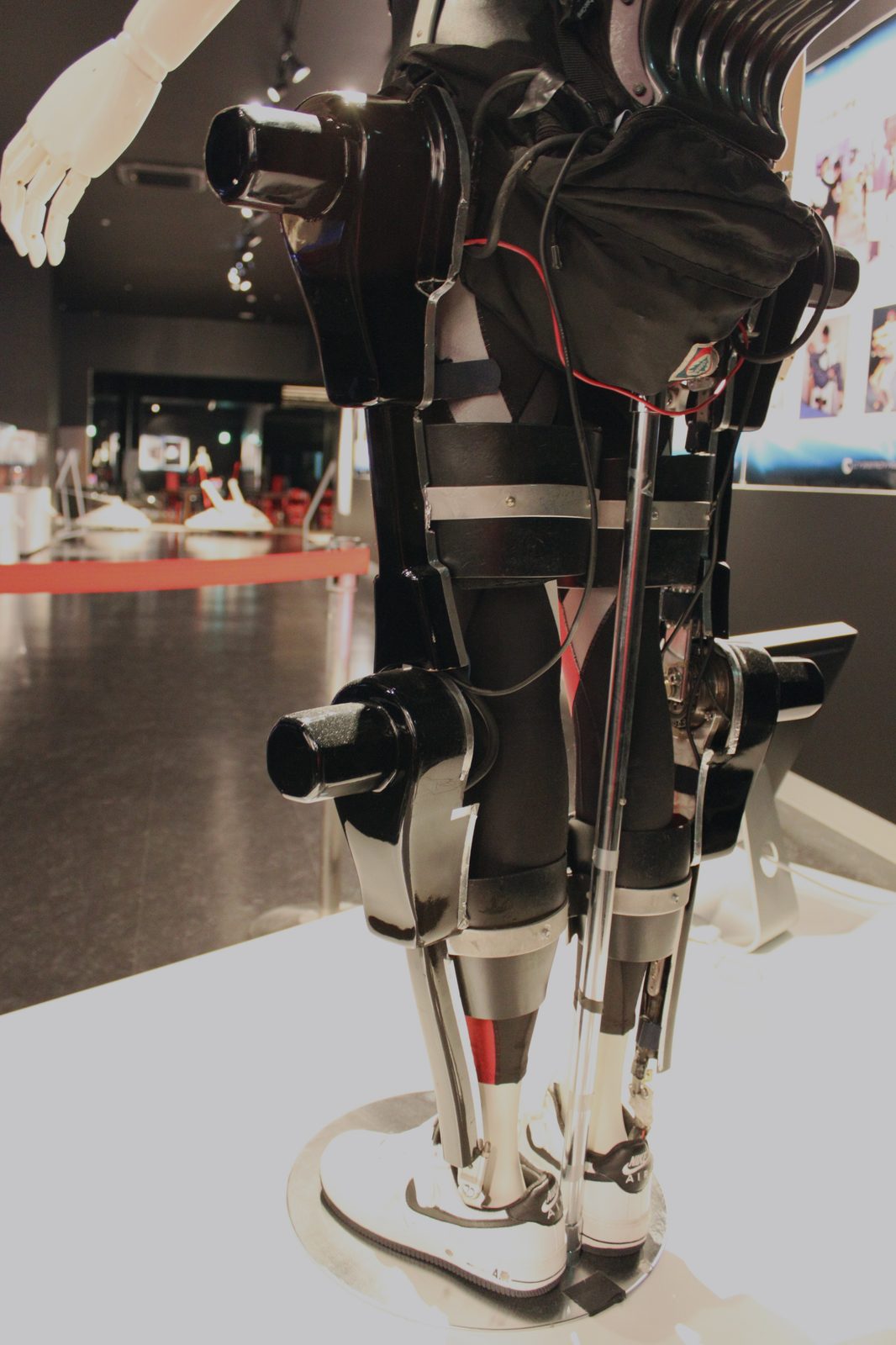
Cyberdyne's HAL (Hybrid Assistive Limb) — the Japanese exoskeleton that leads the segment in reported revenue at roughly $29 million for the fiscal year ended March 2025.
Photo: Yuichiro C. Katsumoto, CC BY 2.0, via Wikimedia CommonsEkso Bionics' own demo of the EksoNR rehabilitation exoskeleton — a clinical, revenue-generating product from one of the three companies above, despite the going-concern language in its recent filings.
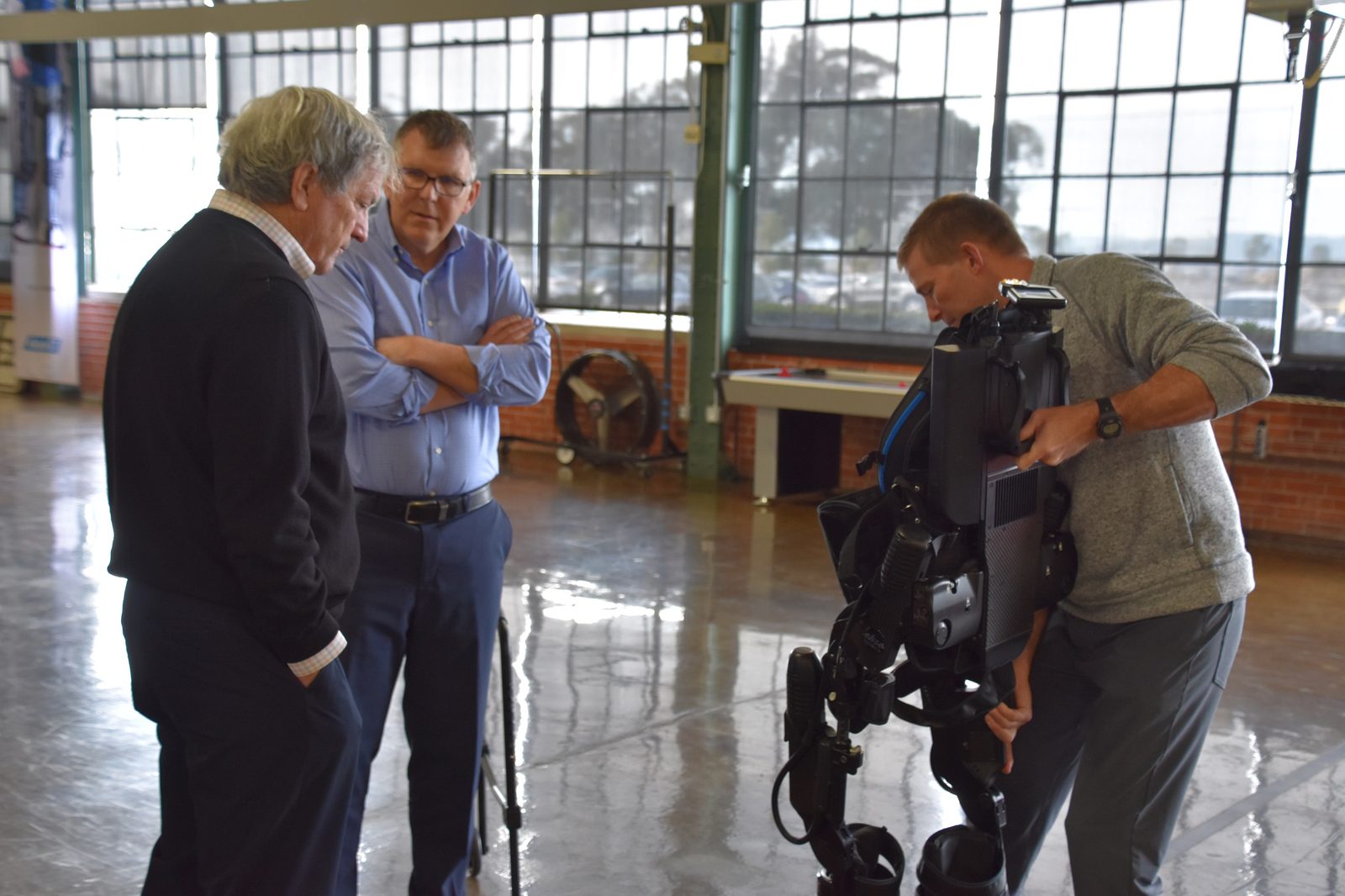
Ekso Bionics' Richmond, California facility, visited by U.S. Rep. Mark DeSaulnier — before the company's May 2026 merger into Applied Digital's ChronoScale Corp ended its run as an independent exoskeleton maker.
Photo: Office of Rep. Mark DeSaulnier, Public domain, via Wikimedia Commons06Distress and pivots
In a span of roughly two and a half years, three of the segment's most recognizable companies went through some form of crisis or strategic retreat. Sarcos exited the exoskeleton and robotics hardware business entirely in November 2023, laying off roughly 150 people and rebranding itself as Palladyne AI — an AI software company with no hardware product line of its own. German Bionic, a well-funded industrial-exoskeleton maker that had raised roughly $16.3 million in a late-2023 Series A, filed for insolvency in a German court in November 2025 after a funding round fell through, before being acquired by Archimedes Partners. And in May 2026, Ekso Bionics — one of the segment's oldest and most recognized names — merged into Applied Digital's cloud/GPU computing business, becoming a subsidiary of the newly renamed ChronoScale Corp rather than an independent, publicly traded exoskeleton company. None of these are proof the underlying technology doesn't work — Ford, Boeing, and Toyota's pilots above are real, ongoing deployments — but they're a genuine signal that the current crop of dedicated exoskeleton companies has struggled to turn real-world pilots into sustainable, standalone businesses.
07Challenges ahead
The open question for this segment is whether the 2023–2026 wave of distress represents a shakeout before real commercial scale — the way earlier physical AI segments consolidated around a smaller set of stronger players — or a more basic signal that exoskeletons, medical and industrial alike, haven't yet found a business model that supports standalone companies at scale. Cyberdyne's two-decade path from founding to FDA clearance, and its position as the only company in the table above still growing revenue from a dedicated exoskeleton business, is the strongest existing evidence that a sustainable exoskeleton company is possible — just apparently a much slower build than most of physical AI.
08Timeline at a glance
| Year | Region | Event |
|---|---|---|
| 1983 | US | Sarcos begins exoskeleton-related research |
| 2004 | JP | Cyberdyne founded as a University of Tsukuba spinoff |
| 2005 | US | Berkeley Bionics (later Ekso Bionics) founded |
| 2006 | US | Sarcos' DARPA-funded XOS exoskeleton program accepted |
| 2013-08 | EU | Cyberdyne's HAL receives EU CE marking |
| 2014-01 | US | Ekso Bionics goes public via reverse merger |
| 2014-06 | US | ReWalk receives FDA clearance for personal use — a first for the category |
| 2016-01 | JP | Japan's national insurance system approves coverage for HAL |
| 2023-11 | US | Sarcos exits exoskeleton/robotics hardware entirely, rebrands as Palladyne AI |
| 2024-05 | US | Cyberdyne's HAL receives US FDA clearance |
| 2025-11 | DE | German Bionic files for insolvency, later acquired by Archimedes Partners |
| 2026-05 | US | Ekso Bionics merges into Applied Digital's ChronoScale Corp |
09FAQ
How big is the exoskeleton market?
Precedence Research estimates roughly $579.5 million globally in 2025, growing to $2.6 billion by 2035 — though estimates from other research firms range from under $250 million to tens of billions of dollars depending entirely on how narrowly or broadly "exoskeleton" is defined.
Why are so many exoskeleton companies in financial trouble?
Between November 2023 and May 2026, Sarcos exited the hardware business entirely (rebranding as Palladyne AI), German Bionic filed for insolvency before being acquired, and Ekso Bionics merged into an unrelated cloud/GPU computing company. All three of the segment's public companies carry going-concern language in recent filings — a sign the segment has struggled to turn real pilots into sustainable standalone businesses so far, not necessarily that the underlying technology doesn't work.
What's the difference between a medical and an industrial exoskeleton?
A medical exoskeleton (ReWalk/Lifeward, Ekso Bionics, Cyberdyne's HAL) restores lost mobility for patients with paralysis and is regulated as a medical device. An industrial exoskeleton (German Bionic, Levitate) is closer to PPE — it reduces strain for able-bodied workers over a shift rather than restoring lost function.
10Sources
04. Where they get used
Related articles
Segment Deep Dives
All Segment Deep Dives articles →Humanoid & Mobility
Industrial & Field Applications
- ›Robotic Arms: Market Size, Players, and Installations
- ›Warehouse & Logistics Automation: Market Size and Players
- ›Exoskeletons: Market Size, Players, and a Wave of Financial Distress(this article)
- ›Surgical Robots: Market Size, Players, and Procedure Growth