Segment Deep Dives
Quadruped Robots: The 46x Price Gap
01Two different businesses
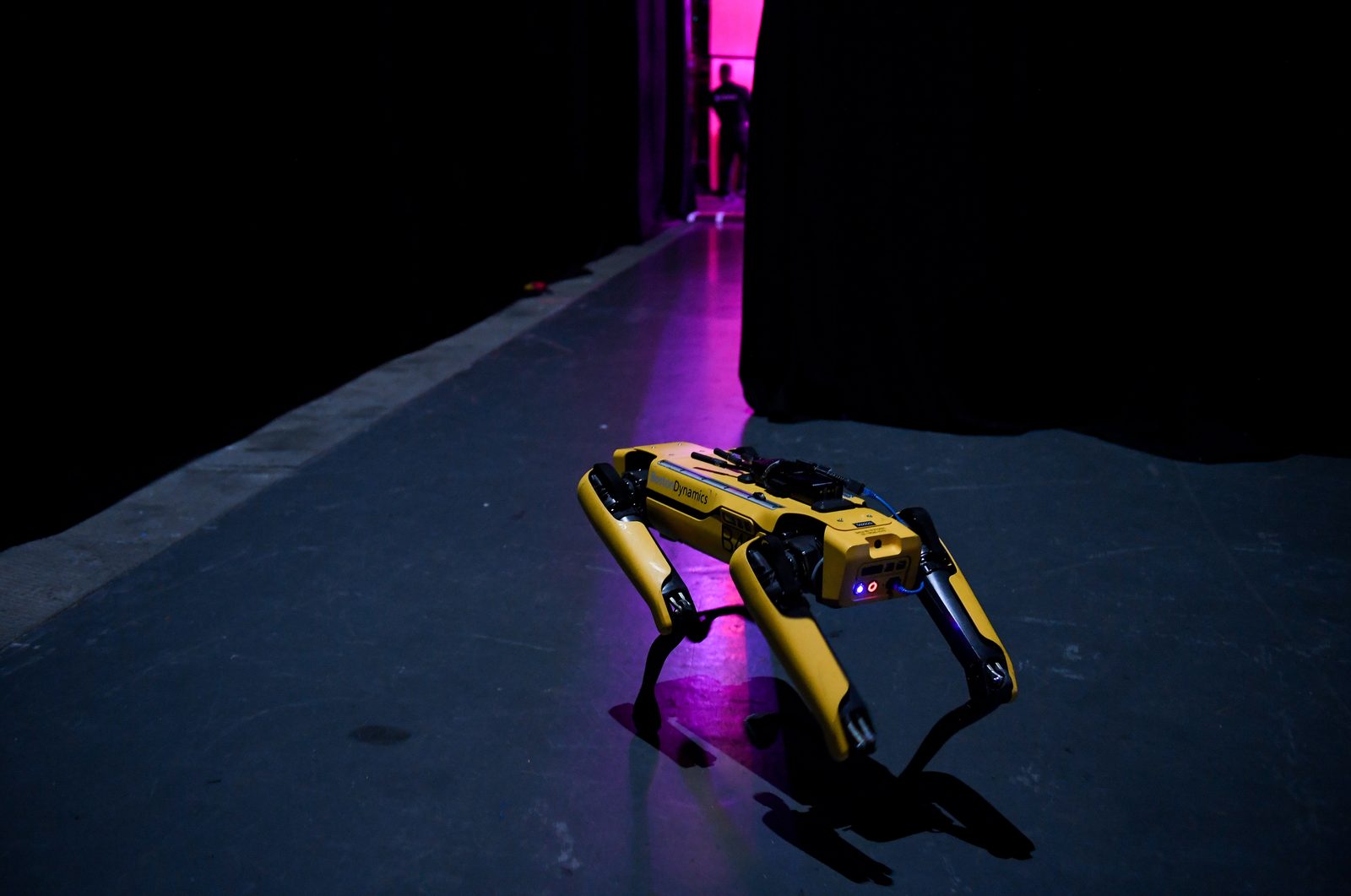
Boston Dynamics' SpotMini, an early public-facing version of the platform that became the commercially sold Spot in 2020, priced at $74,500.
Photo: Web Summit, CC BY 2.0, via Wikimedia CommonsA quadruped robot's basic job — walk on uneven terrain a wheeled robot can't handle, without the cost and complexity of two-legged balance — is the same whether it costs $1,600 or $74,500. What differs is everything around that core capability: certification for hazardous environments, payload and sensor integration, support contracts, and reliability guarantees that industrial customers pay a premium for and hobbyists don't need. Certification is the least visible of those and the hardest to copy — ANYbotics' ANYmal X, for instance, is approved to ATEX and IECEx Zone 1, the standards covering areas where an explosive gas atmosphere is likely in normal operation, which is what lets it walk around a live refinery at all. Approval of that kind constrains the hardware from the start and is granted by third-party bodies, not the manufacturer. That gap is why this segment, unlike most others on this site, doesn't really have a single leaderboard — it has two, and they barely touch.
02How the market formed
Boston Dynamics, founded in 1992 as an MIT Leg Lab spinoff, spent its first two decades on defense-funded research rather than commercial products — BigDog, a DARPA-backed quadruped unveiled in 2004, was shelved for being too loud for combat use, and its successor LS3 met a similar fate around 2015. The company changed hands twice in the years that followed: Google's parent Alphabet acquired it in December 2013 (price undisclosed), then sold it to SoftBank in June 2017 (also undisclosed). Spot, the quadruped that finally became a real commercial product, reached limited availability in September 2019 and went on general US sale in June 2020 at $74,500. In December 2020, Hyundai Motor Group agreed to buy a controlling stake from SoftBank, a deal valuing Boston Dynamics at $1.1 billion and closing in June 2021 with Hyundai paying roughly $880 million for about 80%, SoftBank retaining the rest. The share movements between those two dates were not disclosed; by June 2026, when Hyundai bought out SoftBank for $325 million, the stake remaining to buy was 9.65%, giving Hyundai full ownership for the first time since the company's MIT origins. Unitree, founded in China in August 2016, took a very different path: it launched its first Go-series consumer quadruped, the Go1, in 2021, followed by the Go2 in 2023 at a starting price of roughly $1,600 — a fraction of Spot's cost, aimed at hobbyists, researchers, and developers rather than certified industrial deployments. Switzerland's ANYbotics, an ETH Zurich Robotic Systems Lab spinoff founded in 2016, took a third path, building its ANYmal platform specifically for industrial inspection from the start rather than starting from a research or consumer product.
03Market size
Precedence Research estimates the global quadruped robot market at $3.12 billion in 2025, growing to $17.53 billion by 2035 — an 18.8% compound annual growth rate. That figure should be read with real caution: Data Intelo separately sizes what it calls the same category at roughly $541 million for 2025, nearly a sixth of Precedence's estimate, likely reflecting different assumptions about what counts as a "quadruped robot" (research and defense platforms alongside commercial units, for instance) rather than a factual disagreement about the market itself.
Global quadruped robot market size, Precedence Research estimate (USD)
Data note: Market-size estimates for this segment vary enormously: Precedence Research (used above) puts the 2025 market at $3.12 billion, while Data Intelo puts the same nominal category at roughly $541 million for the same year — a nearly 6x gap likely reflecting different scope definitions (e.g. whether defense/research quadrupeds are counted alongside commercial units). Unitree's unit-sold figures above come from trade-press coverage (SemiAnalysis, citing disclosures in Unitree's IPO prospectus), not a direct Unitree press release — the company's own January 2026 sales clarification addressed humanoid shipments specifically and did not disclose quadruped-specific figures. Boston Dynamics' cumulative Spot fleet size is deliberately excluded from this array: the company's own product page states "over 1,500 robots in customer hands" with no date attached, while a third-party tracker separately reports "3,000+ deployed globally" as of 2026 — a 2x discrepancy between an undated company claim and an unverified aggregator figure, not a clean sourced data point. IDC separately estimates roughly 20,000 quadruped units shipped worldwide in 2024, with China accounting for about 70% of volume — a country-level, not company-level, figure from a single (paywalled) report, so it isn't included as a marketShare entry here.
Market data as of 2026-07
04The 46x price gap
Unitree's Go2 starts at roughly $1,600 for the base "Air" configuration, with Pro and X variants running $2,800–$5,990 and research/EDU configurations exceeding $11,000. Boston Dynamics' Spot launched at $74,500 in 2020 — a gap of roughly 46x between Unitree's entry price and Spot's, even before accounting for Spot's payload and software add-ons, which push the total further. The two aren't really pricing the same product: Spot ships with certifications, support infrastructure, and payload integration built for hazardous industrial environments that a hobbyist robot doesn't need and a research lab often can't afford, while Go2's low price is explicitly aimed at volume — reaching developers and hobbyists who'd never consider a five- or six-figure purchase.
Two robots, two very different price tags
Consumer/prosumer tier. Pro/X variants $2,800–$5,990; EDU/research configs $11,000+.
Certified industrial tier, before payload/software add-ons push the total higher.
Boston Dynamics footage of Spot operating in the kind of certified industrial settings (factories, substations, foundries) that account for its price premium over consumer-tier quadrupeds like the Go2.
05Unitree's shipment volume
The clearest sign of how far apart these two tiers really are in scale: Unitree's own quadruped unit sales, as disclosed in the trade press coverage of its IPO filing, grew from roughly 7,200 units in 2023 to roughly 23,700 units in 2024 — a more than threefold increase in a single year. Those figures come from trade-press reporting on Unitree's own disclosures, not a company press release; Unitree's official January 2026 sales clarification addressed humanoid shipments specifically and didn't break out quadruped-specific numbers. Boston Dynamics doesn't publish a comparable annual figure — its website states "over 1,500 robots in customer hands" with no date attached, while a third-party tracker separately reports "3,000+ deployed globally" as of 2026, a cumulative fleet size (not an annual sales rate) that isn't precisely dated or independently confirmed either way.
Unitree quadruped units sold, trade-press estimate (units)
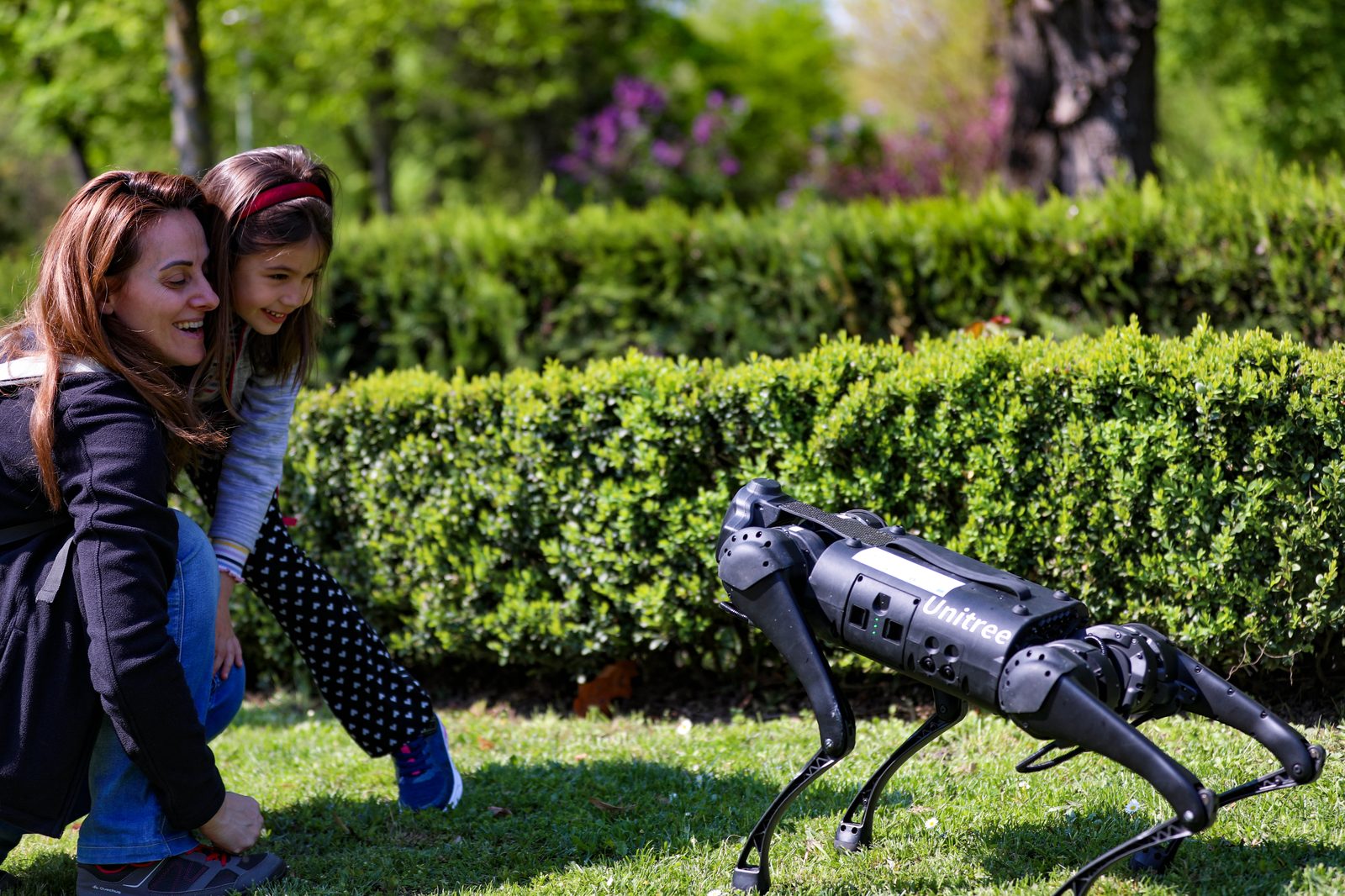
A Unitree quadruped robot (Go1 generation) demonstrated during Romanian Land Forces Day 2023 — a predecessor to the Go2, which starts at roughly $1,600.
Photo: Sgt. Amber Edwards / U.S. Army, Public domain, via Wikimedia Commons06Industrial deployments
Outside the consumer/prosumer tier, a handful of companies are building real industrial-inspection businesses around quadrupeds. ANYbotics reports more than 200 ANYmal units in active deployment across oil and gas, mining, power, and metals customers, performing thousands of inspections weekly, and raised over €127 million cumulatively through September 2025 to fund ANYmal X, a hazardous-zone-certified variant with customer deliveries planned for 2026. China's Deep Robotics reports roughly 600 deployments across more than 40 countries and, per Frost & Sullivan data cited in its IPO prospectus, ranks #1 globally in industrial-quadruped application revenue specifically — a narrow category; in overall quadruped revenue the same data puts it second. Ghost Robotics, majority-acquired by South Korea's LIG Nex1 for $240 million in a June 2024 deal, supplies its Vision 60 platform to defense customers, including a reported 100-plus-unit contract with an unnamed Asian government in December 2025 — a case where the customer is a government defense budget rather than an industrial-inspection buyer.
Industrial quadruped deployment, by the numbers
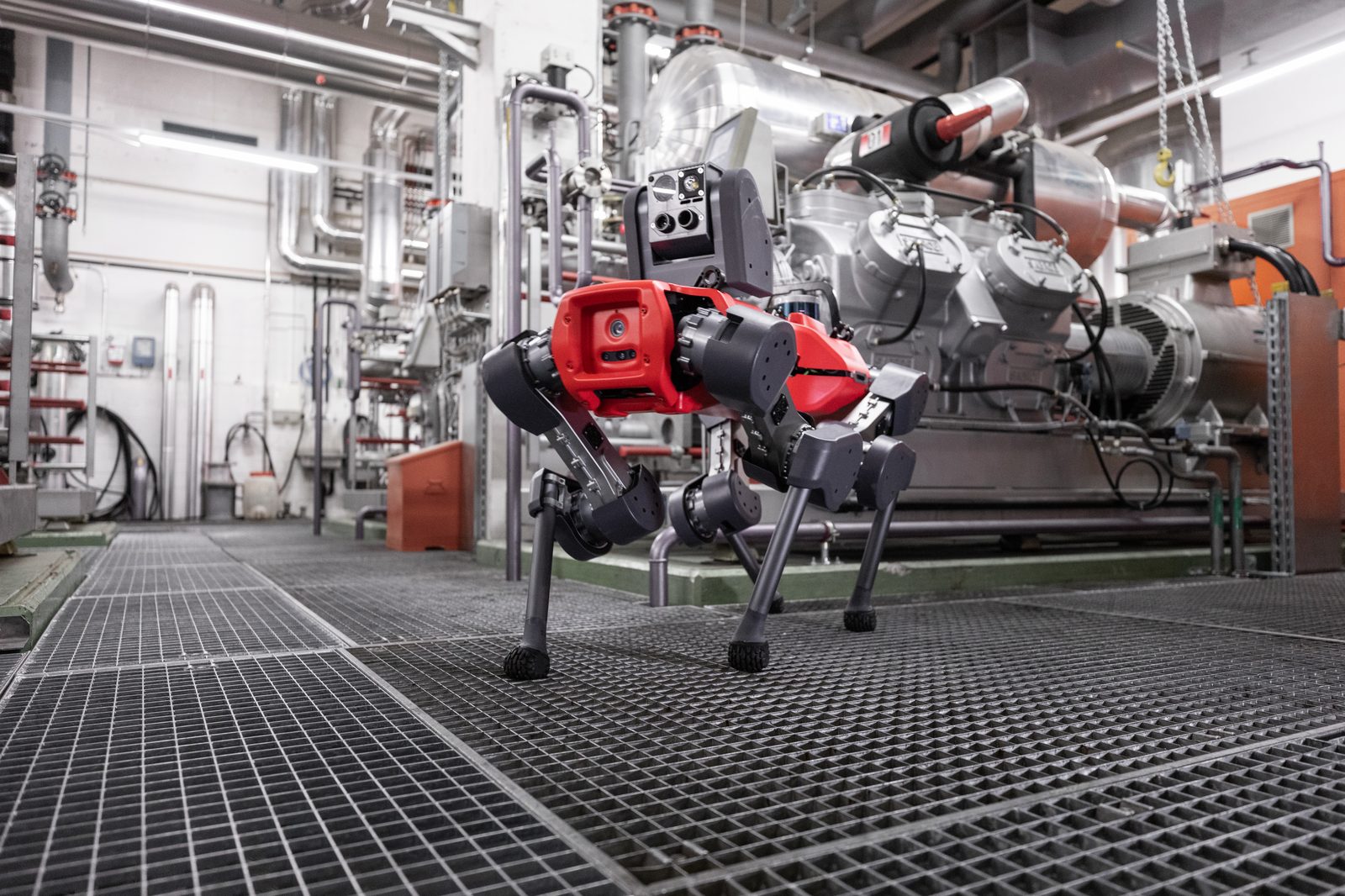
ANYbotics' ANYmal, an ETH Zurich spinoff platform with over €127 million in cumulative funding as of September 2025, deployed for industrial inspection work.
Photo: ANYbotics, CC BY-SA 4.0, via Wikimedia Commons07Challenges ahead
The open question for this segment isn't whether Unitree's low-cost volume threatens Boston Dynamics or ANYbotics directly — the price and certification gap is wide enough that the two tiers barely compete for the same sale today. It's whether that gap narrows over time. Deep Robotics' Frost & Sullivan-reported #1 ranking in industrial-quadruped revenue specifically — not just consumer volume — is an early signal that the move from hobbyist product to certified industrial competitor may already be underway, not a hypothetical for the future.
A second force is pulling in the same direction, and it isn't price. Procurement concerns about data handling, security, and supply-chain transparency in Chinese-made units are opening room for domestic alternatives market by market — the same dynamic behind the US drone restrictions covered in the drone segment article. Japan's RT Corporation started a domestic quadruped program on exactly that reasoning, reporting inquiries from more than 20 critical-infrastructure operators and manufacturers after it announced an open-hardware quadruped with the University of Tokyo in December 2024; its first R&D model, Mujina, was shown at the 2025 International Robot Exhibition. Whether that becomes a real third tier or stays a set of nationally-procured niches is unresolved.
08Timeline at a glance
| Year | Region | Event |
|---|---|---|
| 1992 | US | Boston Dynamics founded as an MIT Leg Lab spinoff |
| 2004 | US | BigDog, a DARPA-funded quadruped, unveiled (later shelved) |
| 2013-12 | US | Google's Alphabet acquires Boston Dynamics |
| 2016 | CH | ANYbotics founded as an ETH Zurich spinoff |
| 2016-08 | CN | Unitree Robotics founded |
| 2017-06 | US | SoftBank acquires Boston Dynamics from Alphabet |
| 2020-06 | US | Spot goes on general US sale at $74,500 |
| 2021 | CN | Unitree launches the Go1 |
| 2021-06 | KR | Hyundai Motor Group completes acquisition of a controlling stake in Boston Dynamics |
| 2023 | CN | Unitree launches the Go2, starting around $1,600 |
| 2024-06 | KR | LIG Nex1 acquires a majority stake in Ghost Robotics for $240M |
| 2025-09 | CH | ANYbotics reaches over €127M in cumulative funding |
| 2026-06 | KR | Hyundai buys SoftBank's remaining stake, taking full ownership of Boston Dynamics |
09FAQ
How big is the quadruped robot market?
Precedence Research estimates $3.12 billion globally in 2025, growing to $17.53 billion by 2035 — though estimates vary enormously across research firms depending on scope (a separate estimate puts the same nominal category at roughly a sixth of that size).
Why is Boston Dynamics' Spot so much more expensive than Unitree's Go2?
Spot ($74,500 at launch) targets certified industrial inspection with support infrastructure and payload integration for hazardous environments; Go2 (from ~$1,600) targets hobbyists, researchers, and developers, prioritizing volume over the certifications and support Spot's price includes.
Who leads in quadruped unit sales?
Unitree, by a wide margin on volume — trade-press reporting on its IPO filing put quadruped sales at roughly 23,700 units in 2024, up from about 7,200 in 2023. On industrial-application revenue specifically, Frost & Sullivan data cited in Deep Robotics' IPO prospectus ranks Deep Robotics #1, a narrower category than overall volume.
10Sources
05. Unitree's shipment volume
07. Challenges ahead
Related articles
Segment Deep Dives
All Segment Deep Dives articles →Humanoid & Mobility
- ›Humanoid Robots: Size and Disputed Shipments
- ›Quadruped Robots: The 46x Price Gap(this article)
- ›AGV vs AMR: Market Size and Fleet Scale
- ›Drone Market: Size and the DJI Question