Segment Deep Dives
AI Compute & Chips for Robots: Market Size and Players
01The base layer
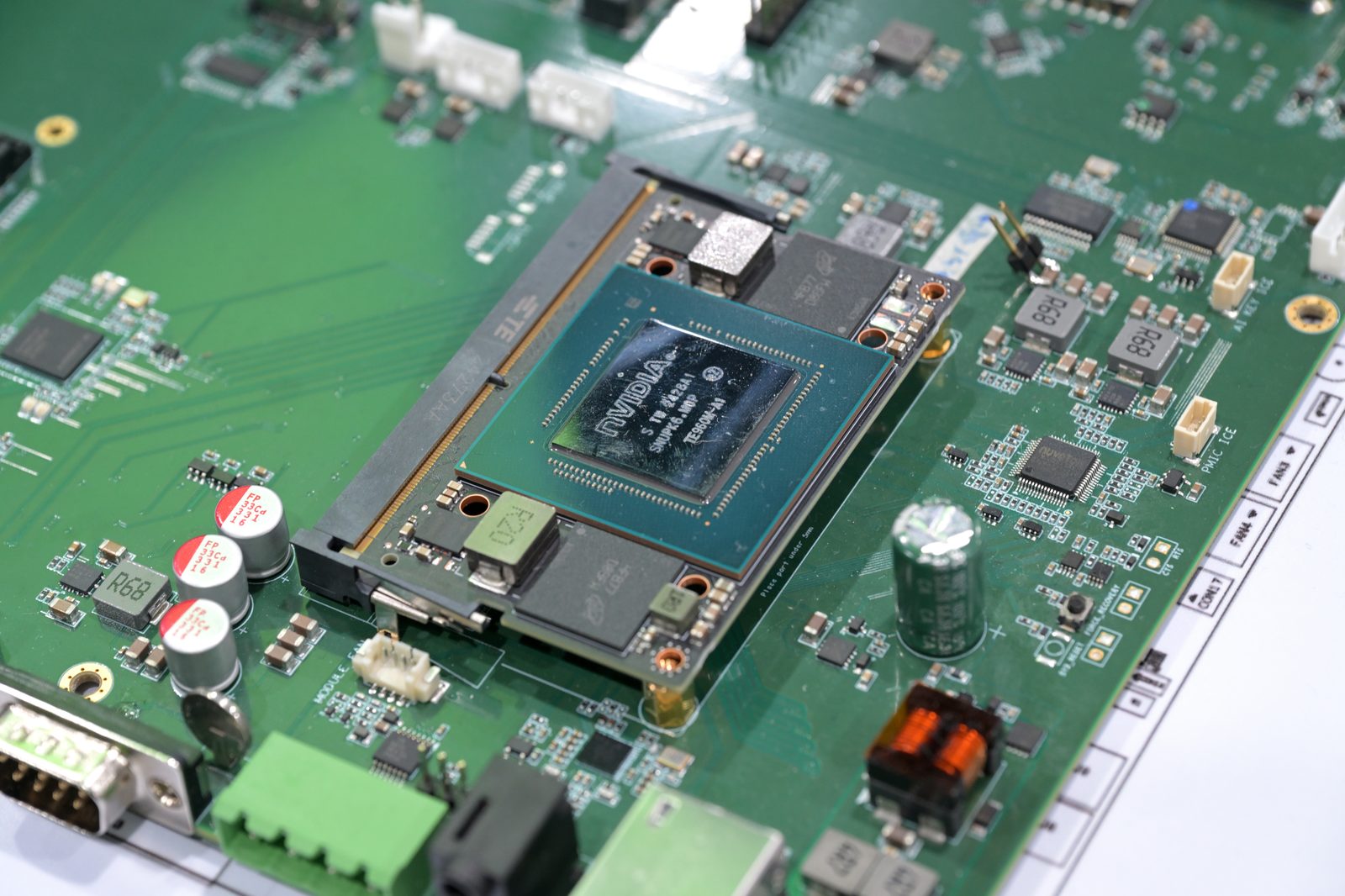
An NVIDIA Jetson Orin NX module, photographed at Computex 2025 — a smaller sibling of the Jetson AGX Thor module now shipping for humanoid and robot compute.
Photo: 4300streetcar, CC BY 4.0, via Wikimedia CommonsHumanoids, quadrupeds, delivery robots, and drones all need one thing in common: an onboard computer capable of running perception, planning, and control in real time, within a power and weight budget that fits inside a battery-powered machine. That's a fundamentally different chip design problem from training a large language model in a data center, and it's given rise to its own supplier market, separate from (though built on some of the same underlying silicon as) the broader AI chip industry.
02NVIDIA's head start
NVIDIA has shipped its Jetson line of edge AI compute modules since 2014, more than a decade before "humanoid robot" became a mainstream investment category, giving it a long runway to build both hardware and the software ecosystem — the Isaac robotics platform and Omniverse simulation tools — that make Jetson the default choice rather than just an option. That lead compounded in August 2025 with the general availability of Jetson AGX Thor, built on NVIDIA's Blackwell GPU architecture: up to 2,070 FP4 teraflops of AI compute in a 130-watt power envelope, at a $3,499 developer-kit price. Early adopters and evaluators named at launch include Agility Robotics, Amazon Robotics, Boston Dynamics, Caterpillar, Figure, Hexagon, Medtronic, Meta, 1X, John Deere, OpenAI, and Physical Intelligence — a list that spans nearly every segment covered elsewhere on this site.
Jetson Thor, in numbers
03Market size
Grand View Research estimates the global edge AI chip market at $27.3 billion in 2025, growing to $36.2 billion in 2026 and $291.8 billion by 2033 — one of the steepest growth curves of any segment on this site (a 34.7% compound annual growth rate), reflecting how early-stage this specific compute category still is relative to robot hardware itself.
Global edge AI chip market size, Grand View Research estimate (USD)
Data note: Sourcing for this segment is thinner than most others on this site. The 39% figure for NVIDIA's Jetson platform comes from a single market-research report without a well-established, checkable methodology (unlike, say, IFR's industrial-robot installation counts) — it's included because it's the most specific figure found and is broadly consistent with NVIDIA's widely reported position as the dominant supplier of high-end robotics compute, but it should be read as directional rather than precise. No shipment-volume (units/year) series is included: unlike robots, edge AI compute modules aren't tracked as a unit count by any research firm found during sourcing — revenue and market-size estimates are what's actually published. Qualcomm, Intel, and NXP are named challengers in the article prose, but none currently has a comparably specific, sourceable market-share figure to add here.
Market data as of 2026-07
04NVIDIA's challengers
NVIDIA's Jetson platform is estimated to hold roughly 39% of edge AI computing revenue, by one market-research estimate — a figure worth treating as directional rather than precise, since no research firm with a fully public, checkable methodology was found publishing a comparable number, but it's broadly consistent with NVIDIA's widely reported position as the default choice for high-end robotics compute. The clearest challenge so far comes from Qualcomm, which introduced its Dragonwing IQ10 series at CES 2026, explicitly positioned as a lower-power alternative for robots that don't need Thor's full 2,000-teraflop ceiling, and formalized a long-term robotics partnership with Germany's Neura Robotics in March 2026. Intel has taken a different approach, standing up a dedicated Intel Robotics business unit with more than 130 commercial design partnerships and an open-platform strategy that avoids competing head-on with NVIDIA's brand or Qualcomm's automotive credibility. NXP, meanwhile, is building out edge-AI neural processing capability through its acquisition of Kinara and a new "Neural Axis" chip architecture.
| Company | Country | Metric | Share |
|---|---|---|---|
| NVIDIA (Jetson) | US | Revenue share (2023-2024) | ~39% Market-research estimate, edge AI computing revenue — lower-confidence single source, see note |
The challengers, and their angle
Power-efficient alternative for robots that don't need Thor's full performance ceiling.
Intel Robotics
Dedicated business unit, 130+ design partnerships, open-platform positioning.
NXP Neural Axis
Built out via the Kinara acquisition, targeting edge-AI neural processing.
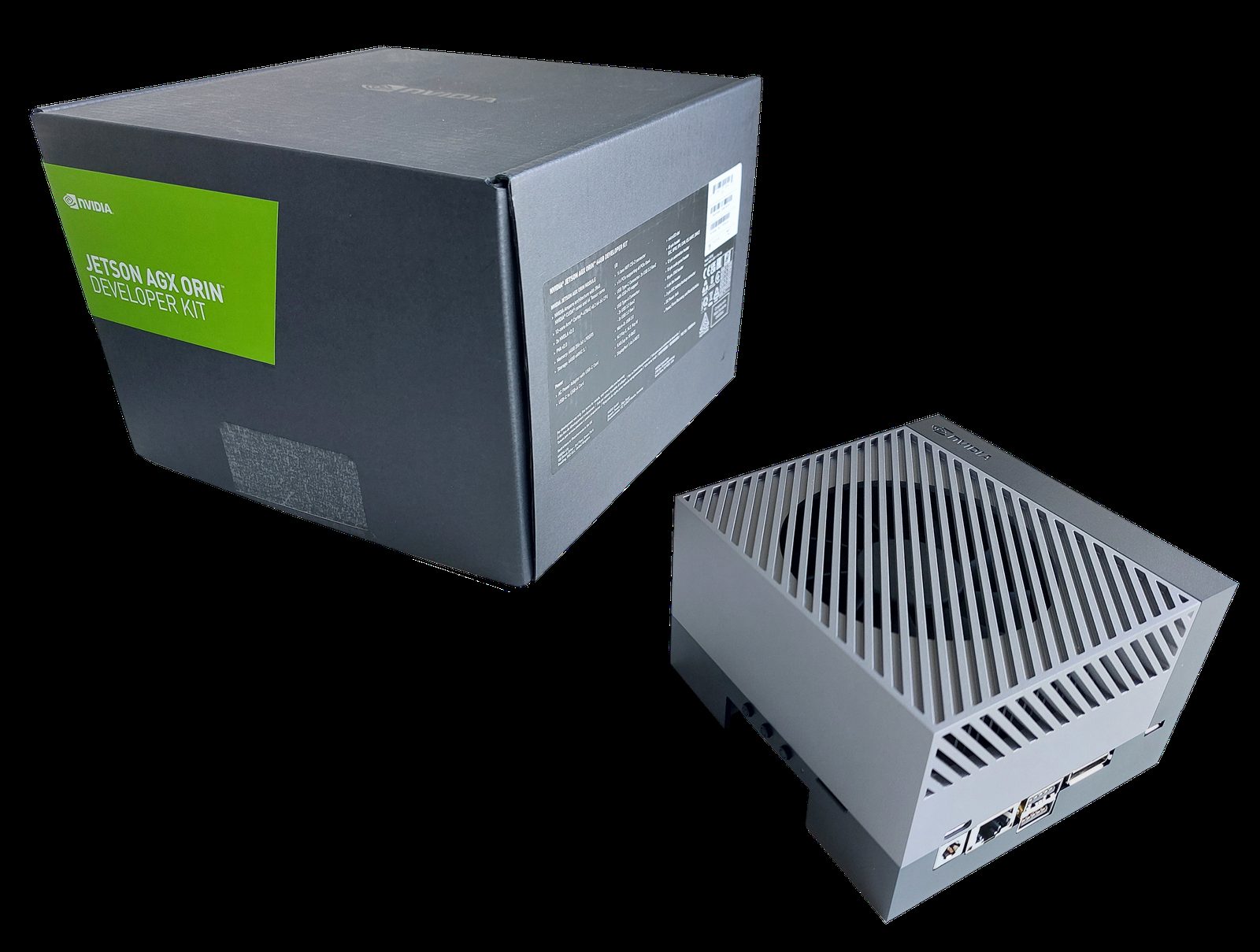
An NVIDIA Jetson AGX Orin developer kit — the previous-generation embedded compute module ahead of Jetson AGX Thor (Blackwell), which became generally available in August 2025.
Photo: Auledas, CC BY 4.0, via Wikimedia Commons05Challenges ahead
The open question isn't whether NVIDIA leads — it clearly does, on both hardware performance and the software ecosystem built around it. It's whether the segment ends up looking like industrial robot arms, where a stable oligopoly held its position for decades, or like humanoid shipments, where a dominant leader's numbers get disputed and chipped away within a couple of years. Qualcomm and Intel are betting on efficiency and openness rather than raw performance to make that case; whether either strategy actually shifts revenue share, rather than just design-win headlines, is what the next couple of years of this segment's data will have to show.
06Timeline at a glance
| Year | Region | Event |
|---|---|---|
| 2014 | US | NVIDIA ships its first Jetson edge AI compute module |
| 2025-08 | US | Jetson AGX Thor (Blackwell) becomes generally available |
| 2026-01 | US | Qualcomm unveils Dragonwing IQ10 at CES |
| 2026-03 | DE | Qualcomm formalizes a long-term robotics partnership with Neura Robotics |
07FAQ
How big is the edge AI chip market for robots?
Grand View Research estimates $27.3 billion globally in 2025, growing to $36.2 billion in 2026 and $291.8 billion by 2033 — a 34.7% compound annual growth rate.
What chip do most robots actually use?
NVIDIA's Jetson line, most recently Jetson AGX Thor (released August 2025), is the default choice for high-end robotics compute across nearly every segment — humanoids, quadrupeds, drones, and industrial arms alike — with an estimated 39% share of edge AI computing revenue by one market-research estimate.
Is anyone actually challenging NVIDIA in robotics chips?
Qualcomm (Dragonwing IQ10, positioned on power efficiency), Intel (a dedicated Robotics business unit with 130+ design partnerships), and NXP (via its Kinara acquisition) are all building competing platforms, but none has published a market-share figure that rivals NVIDIA's reported position.
08Sources
02. NVIDIA's head start
Related articles
Segment Deep Dives
All Segment Deep Dives articles →Humanoid & Mobility
Industrial & Field Applications
Enabling Technology
- ›Robot Foundation Models: Market Size, Players, and the Funding Boom
- ›Actuators & Precision Reducers: Market Size and Players
- ›Sensors & Perception for Robots: Market Size and the LiDAR Race
- ›AI Compute & Chips for Robots: Market Size and Players(this article)