Segment Deep Dives
Robotic Arms: Market Size, Players, and Installations
01How the market formed
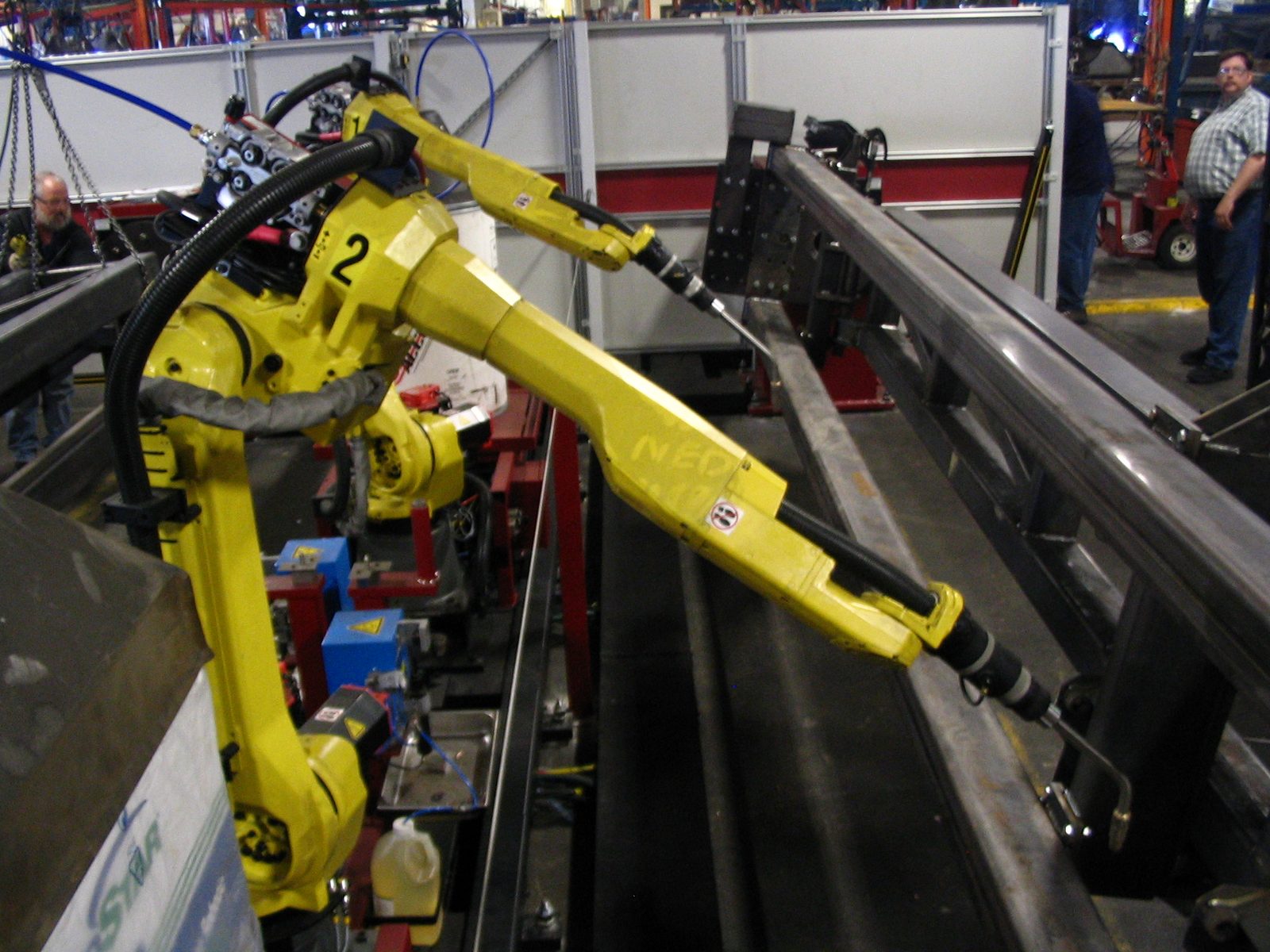
FANUC 6-axis welding robots — the kind of automotive-sector deployment that drove a 7% year-on-year installation decline in 2024 as automakers cut capital spending.
Photo: Phasmatisnox, CC BY 3.0, via Wikimedia CommonsThe engineering history of the robot arm — Unimate's 1961 debut at GM, Japan's 1980s manufacturing scale-up, Europe's ABB and KUKA entering in the 1970s — is covered in full elsewhere on this site. What matters for this segment as a market is what that history produced: by the 2020s, industrial robot arms had consolidated into a stable, profitable oligopoly. Four companies — Fanuc, Yaskawa, ABB, and KUKA, often called the "Big 4" — plus Japan's Epson in the smaller-arm category, have controlled the large majority of the market for over a decade, an unusually stable leadership group for a fast-moving technology sector.
02Cobots and the price war
The one genuine disruption to that stable order came from a new product category, not a new country. Denmark's Universal Robots launched the UR5 in 2008 — a robot arm safe enough to work alongside people without a safety cage, creating the "collaborative robot" (cobot) category now standard across light manufacturing. For over a decade, Universal Robots led that category largely unchallenged.
That changed in the 2020s, when Chinese manufacturers — Dobot, AUBO, JAKA, and others — entered with cobots priced 60–80% below Universal Robots' or Fanuc's equivalent hardware: a 5kg-payload Chinese cobot running roughly $7,000–$10,000 against $25,000–$35,000 for a comparable Western unit. Some, like AUBO, built that price gap on vertical integration, making over 90% of core components in-house. The pressure shows up directly in Universal Robots' own results: the company's 2025 revenue fell roughly 20%, which it attributed to continued price pressure from Chinese domestic brands and accelerating share loss in the Asia-Pacific region — even as it still led the global cobot category by revenue share.
Same payload class, a 2.5–5x price gap
Universal Robots UR5e (5kg class)
Roughly $25,000–$35,000 for a comparable Western-made cobot.
Chinese 5kg-class cobots (Dobot, AUBO, JAKA)
Roughly $7,000–$10,000 — a 60–80% discount for a comparable spec.
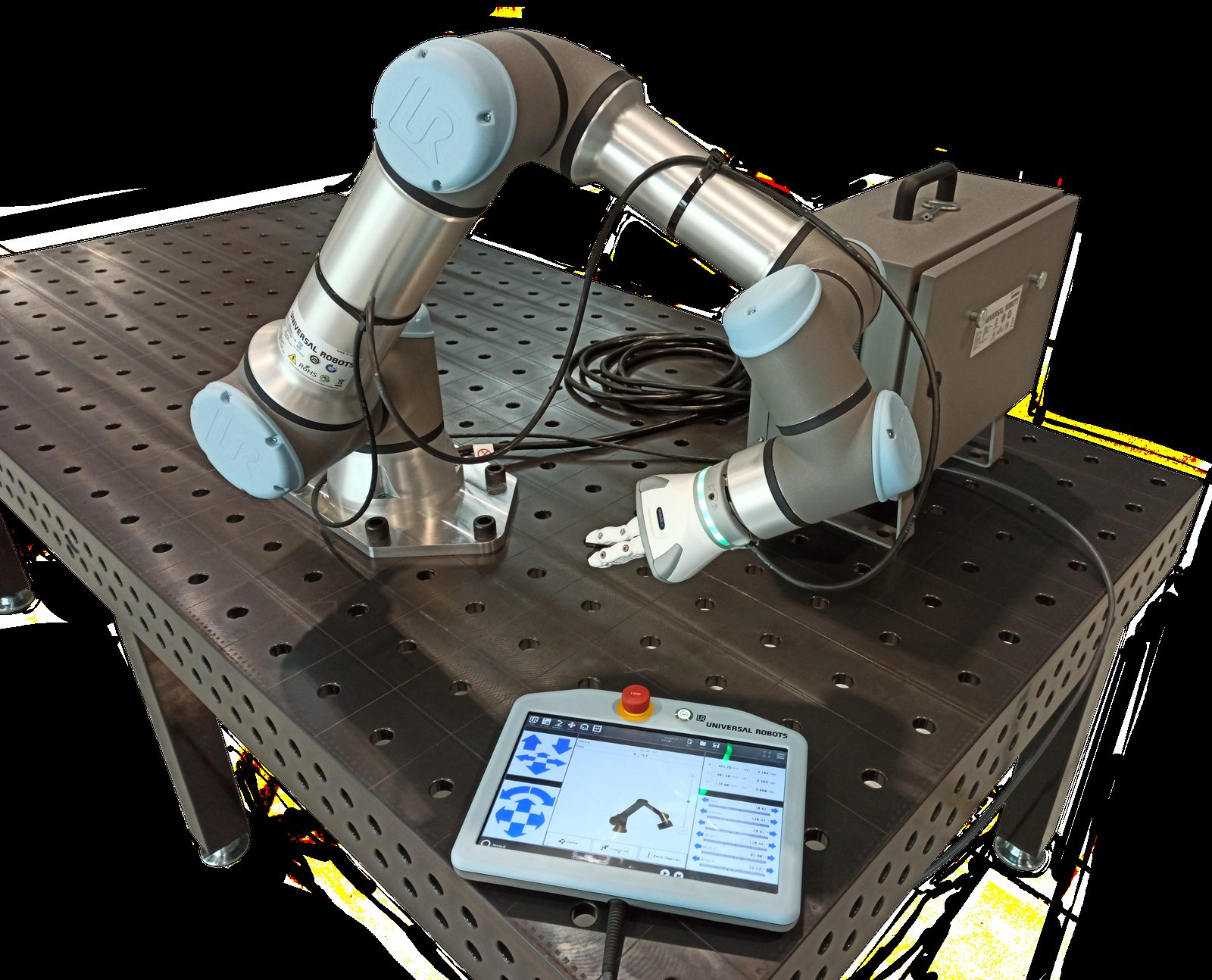
A Universal Robots UR16e — the cage-free "cobot" category the Danish company pioneered in 2008, now facing 60-80% price undercutting from Chinese rivals.
Photo: Auledas, CC BY-SA 4.0, via Wikimedia CommonsUniversal Robots on the cage-free "cobot" category it created in 2008 — the category now facing the sharpest price pressure from Chinese entrants.
03The 2024 dip
Global installations reached 542,000 units in 2024 — the second-highest total on record, just 2% below the all-time peak two years earlier, even though several individual markets fell. The automotive sector, the largest single buyer of industrial arms, cut installations 7% year-on-year to 126,000 units as automakers pulled back on capital spending; Japan's electronics sector installed fewer arms for a second straight year. None of the four largest national markets — China, Japan, the US, or Germany — grew in 2024. Analyst firm Interact Analysis and the International Federation of Robotics (IFR) both frame this as a cyclical pause tied to automotive and electronics capex, not a structural decline, and both expect a return to growth in 2025 as interest rates ease and manufacturing investment recovers more broadly.
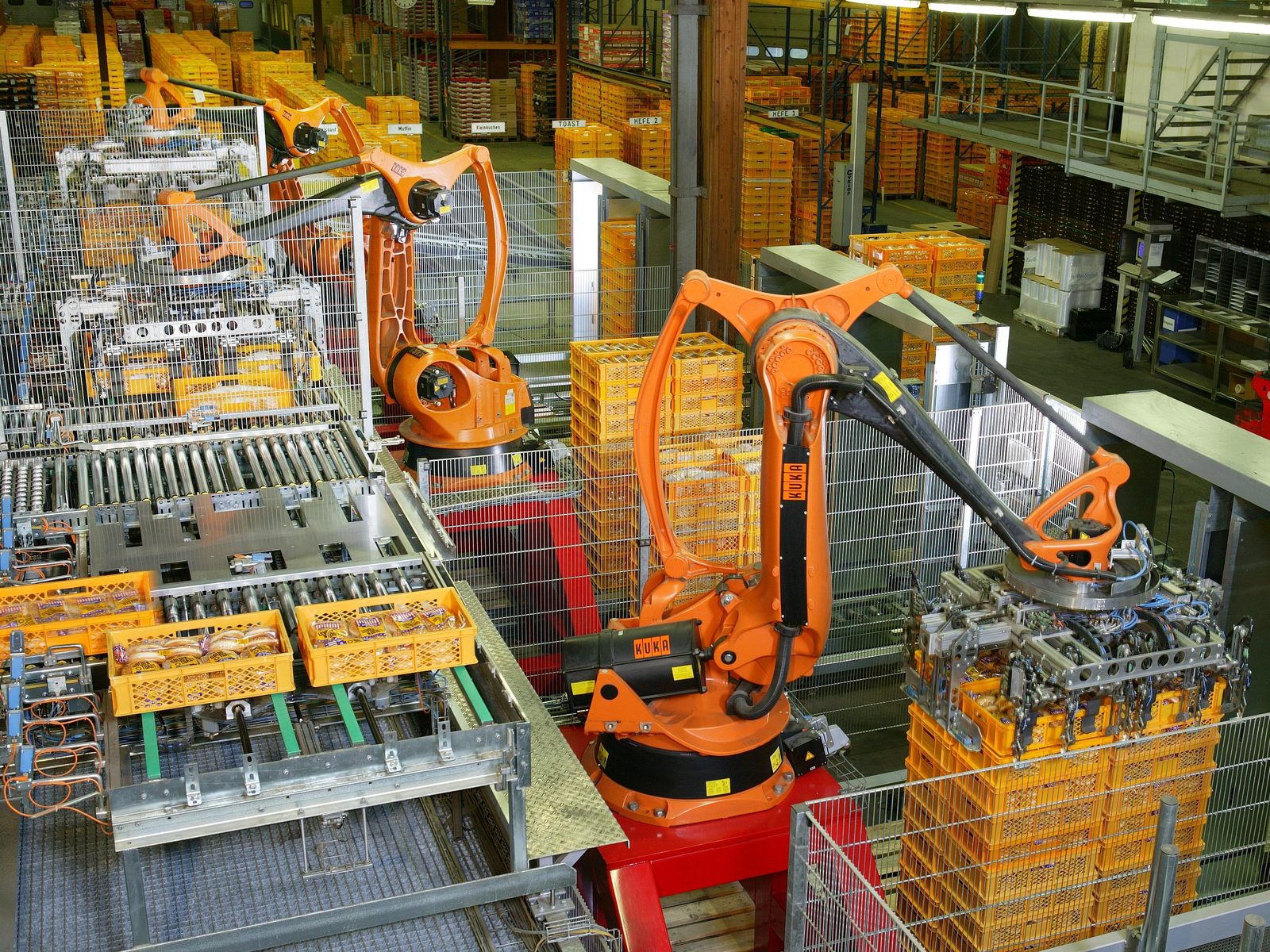
KUKA industrial robots palletizing bread — a typical high-volume, non-automotive application for traditional caged industrial arms.
Photo: KUKA Roboter GmbH / Bachmann, Public domain, via Wikimedia Commons04Market size and installations
However the pause is framed, the underlying trend lines are still up and to the right. Grand View Research puts the global industrial-robotics market at $33.9 billion in 2024, growing to $41.9 billion by 2026 and $60.6 billion by 2030 — a ~10.2% compound annual growth rate over that stretch. IFR's own installation count, the more direct physical measure, shows the same shape: 542,000 units in 2024, a projected 575,000 in 2025 (+6%), and more than 700,000 expected annually by 2028.
Global industrial-robotics market size, Grand View Research estimate (USD)
Global industrial robot installations, IFR World Robotics (units/year)
Data note: "Market share" means different things depending on what's counted. By revenue, ABB and Epson tied for the top spot in 2023 at 13% each, per Interact Analysis — Epson's share is driven almost entirely by small SCARA arms, a different product category from ABB's general-purpose arms. By units shipped, the "Big 4" (Fanuc, Yaskawa, ABB, KUKA) are estimated to control roughly three-quarters of volume — a different ranking again. None of this should be confused with which countries install the most arms: China alone accounted for 54% of 2024's global installations (IFR), even though no Chinese company appears in the top-6 maker ranking above — China's installations are a mix of the Big 4/Epson's local plants and (increasingly) domestic Chinese manufacturers, which IFR put at a 57% share of China's own market in 2024.
Market data as of 2026-07
05Key players
"Market share" answers a different question depending on how you count it. By revenue, ABB and Epson tied for the top spot in 2023 at 13% each, according to Interact Analysis — though Epson's share comes almost entirely from small SCARA arms, a lighter-duty category than ABB's general-purpose industrial arms. Fanuc followed at 11%, with Kawasaki and Yaskawa tied at 8% and KUKA at 6%. By units shipped rather than revenue, the picture shifts again: the Big 4 alone (Fanuc, Yaskawa, ABB, KUKA) are estimated to control roughly three-quarters of global volume. What's notable either way is the erosion at the edges — the top 10 vendors' combined share slipped from 64.6% in 2023 to 62.3% in 2024, as smaller and emerging players, including the Chinese cobot makers described above, made room for themselves.
Top industrial-arm makers by revenue share, 2023
- ABB13%
- Epson13%
- FANUC11%
- Kawasaki Robotics8%
- Yaskawa Electric8%
- KUKA6%
- Others / rest of market41%
| Company | Country | Metric | 2023 revenue share |
|---|---|---|---|
| ABB | CH | Revenue share (2023) | 13% Interact Analysis, via Statista |
| Epson | JP | Revenue share (2023) | 13% Interact Analysis, via Statista |
| FANUC | JP | Revenue share (2023) | 11% Interact Analysis, via Statista |
| Kawasaki Robotics | JP | Revenue share (2023) | 8% Interact Analysis, via Statista |
| Yaskawa Electric | JP | Revenue share (2023) | 8% Interact Analysis, via Statista |
| KUKA | DE | Revenue share (2023) | 6% Interact Analysis, via Statista |
06Where the arms go
Who makes the arms and who installs them are two different rankings entirely. China alone accounted for 295,000 installations in 2024 — 54% of the world total, and the highest single-country annual total ever recorded — despite no Chinese company appearing in the top-6 maker ranking above. That gap is closing from the inside: IFR estimates domestic Chinese manufacturers now hold a 57% share of China's own market, up from a smaller base a few years earlier, largely on the strength of cheaper components and government-backed manufacturing investment. Japan remained the second-largest market at 44,500 units (down 4%), followed by the US (34,200, down 9%), South Korea (30,600, down 3%), and Germany (27,000, down 5%) — Europe's largest single market. Every one of the next four largest markets after China shrank in 2024, underscoring how concentrated the segment's actual growth has become in one country.
China
- 2013Overtakes Japan as the world's largest market by annual installations
- 2024295,000 installations — 54% of the global total
- 2024Domestic manufacturers reach 57% of China's own market
Japan
- 1980sWorld's largest installed base — the "robot kingdom" era
- 202444,500 installations, 2nd-largest market
United States
- 1961First industrial robot in production use (Unimate at GM)
- 202434,200 installations, 3rd-largest market
Germany
- 1973KUKA builds one of the first six-axis electromechanical robots
- 202427,000 installations — Europe's largest market
07Challenges ahead
For most of this segment's history, the interesting question was how fast the market would grow. The more interesting question now is whether the Big 4 + Epson keep their grip on it. A stable oligopoly that held roughly two-thirds of the market for over a decade is now visibly eroding at the edges — first in cobots, where Chinese entrants have already taken real share from the category's inventor, and increasingly in China's broader arm market, where domestic manufacturers have gone from a minority to a majority of the country's own installations in a few years. Whether that pattern spreads from cobots and China into the rest of the segment, or stays contained to the categories and geography where it's already visible, is the open question the next few years of installation and share data will answer.
08Timeline at a glance
| Year | Region | Event |
|---|---|---|
| 1961 | US | First industrial robot in production (Unimate, at GM) |
| 1974 | SE | ABB launches the IRB 6, first microprocessor-controlled industrial robot |
| 2005 | DK | Universal Robots founded |
| 2008 | DK | Universal Robots launches the UR5, creating the "cobot" category |
| 2013 | CN | China overtakes Japan as the world's largest market by annual installations |
| 2022 | Global | Global installations hit an all-time high |
| 2024 | Global | Installations dip 2% from the 2022 peak to 542,000, on automotive/electronics capex weakness |
| 2024 | CN | Domestic Chinese cobot makers undercut Universal Robots by 60–80% on price |
| 2025 | DK | Universal Robots' revenue falls ~20% amid Chinese price competition |
| 2025 | Global | Installations forecast to grow 6% to 575,000 units, a return to growth |
09FAQ
How big is the industrial robotic-arm market?
Grand View Research estimates $33.9 billion globally in 2024, growing to $41.9 billion by 2026 and $60.6 billion by 2030. By physical installations rather than revenue, IFR counted 542,000 new industrial robots installed worldwide in 2024.
Who makes the most industrial robot arms?
It depends on the metric. By 2023 revenue, ABB and Epson tied for the top spot at 13% each (Interact Analysis), followed by Fanuc (11%), Kawasaki and Yaskawa (8% each), and KUKA (6%). By units shipped, the "Big 4" (Fanuc, Yaskawa, ABB, KUKA) together are estimated to control roughly three-quarters of global volume.
Which country installs the most industrial robots?
China, by a wide margin — 295,000 units in 2024, or 54% of the global total, more than Japan (2nd, 44,500), the US (3rd, 34,200), South Korea (4th, 30,600), and Germany (5th, 27,000) combined.
Why did industrial robot installations fall in 2024?
Mainly a pullback in capital spending by the automotive sector (-7% year-on-year) and continued weakness in Japan's electronics sector, not a structural decline — 2024's 542,000 units was still the second-highest total on record, and both IFR and Interact Analysis expect a return to growth in 2025.
10Sources
03. The 2024 dip
Related articles
Articles
Company & Market Data
Segment Deep Dives
All Segment Deep Dives articles →Humanoid & Mobility
Industrial & Field Applications
- ›Robotic Arms: Market Size, Players, and Installations(this article)
- ›Warehouse & Logistics Automation: Market Size and Players
- ›Exoskeletons: Market Size, Players, and a Wave of Financial Distress
- ›Surgical Robots: Market Size, Players, and Procedure Growth