Segment Deep Dives
Warehouse & Logistics Automation: Market Size and Players
01Where this fits
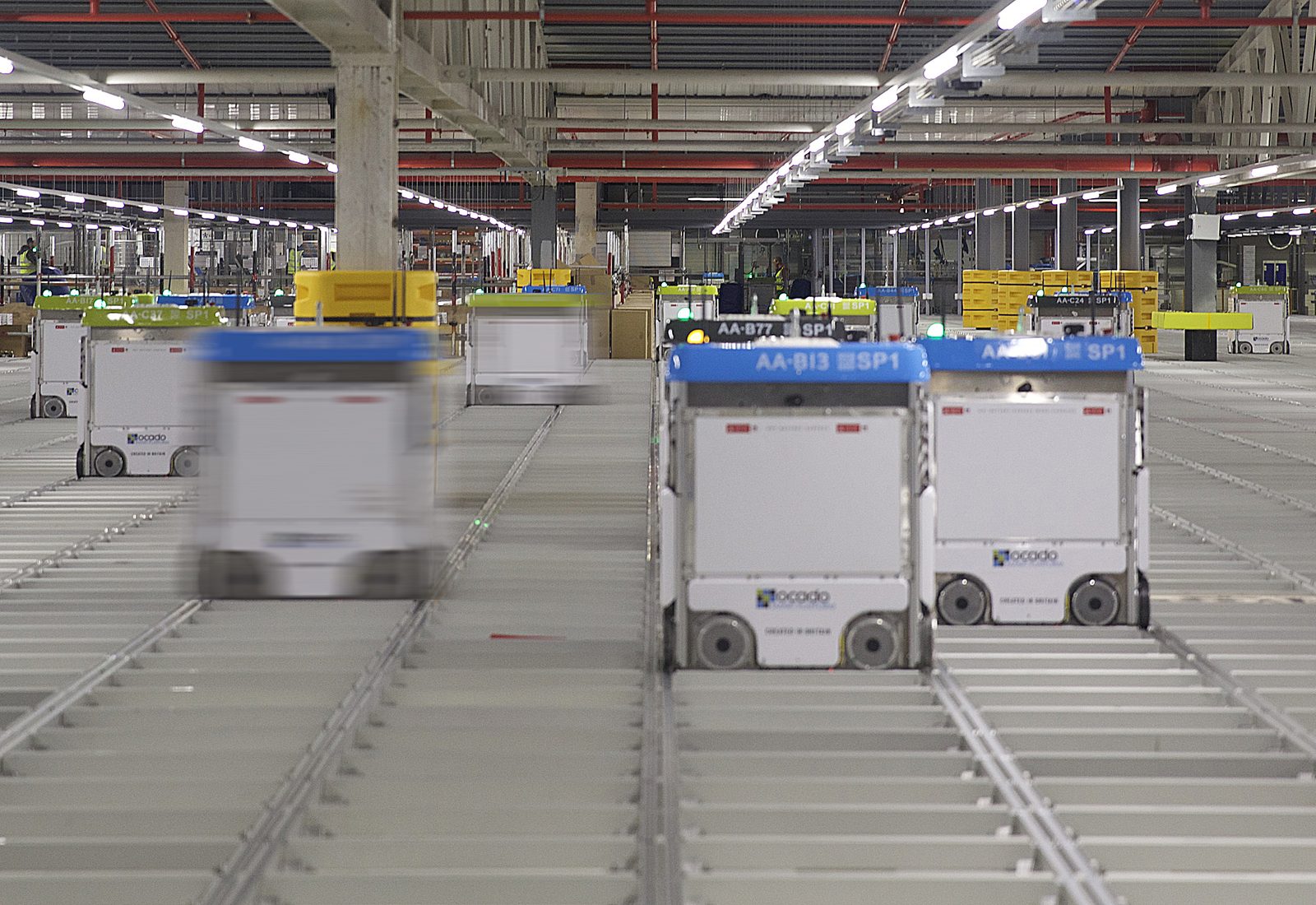
Ocado's grid robots retrieving grocery totes at up to 4 meters per second — the proprietary technology the UK grocer now licenses to retailers including Kroger and Coles.
Photo: Techwords, CC BY-SA 4.0, via Wikimedia CommonsThis segment overlaps with, but isn't the same as, the AMR/AGV segment covered elsewhere on this site. That segment is about individual mobile-robot vendors — companies that sell or operate fleets of robots. This one is about whole-system integration: automated storage and retrieval systems (AS/RS), sortation, conveyor networks, and goods-to-person systems, engineered and sold as one turnkey fulfillment center, often combining robots from multiple vendors (including AMR makers) into a single building-scale design. The distinction matters because the market and the players are largely different: this segment is roughly six times larger by revenue, and it's still led by decades-old industrial-engineering firms rather than the venture-funded robotics startups that dominate headlines.
02Ocado's licensing model
Britain's Ocado built its first automated grocery fulfillment center around a proprietary technology: a three-dimensional grid of storage crates, with a swarm of small robots moving across the top of the grid at up to 4 meters per second to retrieve items, coordinated by an AI "air traffic control" system. A single Customer Fulfilment Centre can process up to 65,000 grocery orders a week, at a pick accuracy and speed no manual warehouse can match. Ocado now operates more than 20 of these centers and, notably, doesn't just run them for its own grocery business — it licenses the technology to other retailers, including Kroger in the US and Coles in Australia, making Ocado as much a robotics licensing company as a grocery one.
Ocado Technology's own explainer on the grid-and-swarm-robot engineering behind the fulfillment-center numbers described above.
03Symbotic's customer concentration
Symbotic takes a different architectural approach — dense, cube-style automated storage combined with its own robots that retrieve and palletize goods — but the more striking story is its customer concentration. More than 84% of Symbotic's revenue in fiscal 2025 came from a single customer, Walmart. Rather than a risk Symbotic is trying to diversify away from, the relationship has deepened: in January 2026, Symbotic acquired Walmart's Advanced Systems and Robotics division for $200 million, with Walmart simultaneously investing $520 million into Symbotic to deploy AI-powered robotics across its distribution network. The result is a backlog of roughly $22.5 billion as of September 2025 — about ten times the company's annual revenue — plus a separate $7.5 billion, six-year commitment tied to its GreenBox joint venture. Few companies in physical AI, in any segment, have this much revenue effectively locked in with a single buyer.
Symbotic and Walmart, in numbers
Ocado's grid + license model
20+ centers, technology licensed to Kroger (US), Coles (Australia), and European grocers.
$22.5B backlog, 84%+ of FY2025 revenue from Walmart alone.
04Market size and key players
Fortune Business Insights estimates the global warehouse automation market at $31.2 billion in 2025, growing to $36.2 billion in 2026 and $119.9 billion by 2034. Despite Symbotic and Ocado's headlines, neither is the largest player by revenue: STIQ's 2025 global system-integrator ranking puts Dematic (owned by KION Group) first at roughly $3.24 billion, followed by Japan's Daifuku ($2.5B), the Netherlands' Vanderlande ($2.33B), Austria's Knapp ($2.18B), and Symbotic ($1.69B by STIQ's count — Symbotic's own SEC filings report a higher $2.25B for the same fiscal year, likely reflecting a different measurement period). What these five have in common, apart from Symbotic, is decades of industrial-engineering history predating the current physical AI funding wave by 30-plus years — this segment's incumbents built their position on automotive and pharmaceutical uptime contracts, not venture funding rounds.
Global warehouse automation market size, Fortune Business Insights estimate (USD)
Top system integrators by revenue, 2025
| Company | Country | Metric | Revenue |
|---|---|---|---|
| Dematic | US | Revenue (2025) | $3.24B STIQ, 2025 Global System Integrator Top 20 |
| Daifuku | JP | Revenue (2025) | $2.50B STIQ, 2025 Global System Integrator Top 20 |
| Vanderlande | NL | Revenue (2025) | $2.33B STIQ, 2025 Global System Integrator Top 20 |
| Knapp | AT | Revenue (2025) | $2.18B STIQ, 2025 Global System Integrator Top 20 |
| Symbotic | US | Revenue (2025) | $1.69B STIQ, 2025 Global System Integrator Top 20 |
Data note: "Market share" here is a revenue ranking among whole-system integrators (STIQ), not a percentage of total market size — the source doesn't publish the denominator needed to convert it to a clean share figure, so absolute revenue is shown instead. Individual companies' own reported figures don't always match STIQ's ranking exactly: Symbotic's own SEC filings report $2,247M in fiscal 2025 revenue (ended Sept 27, 2025), about $560M higher than STIQ's figure, likely reflecting a different measurement period or scope (STIQ's methodology isn't fully public). This ranking also excludes companies whose warehouse-automation business is one division within a much larger conglomerate (e.g. Honeywell Intelligrated, ranked lower on STIQ's list at $914M, sits inside Honeywell's far larger industrial business) rather than a standalone comparable entity.
Market data as of 2026-07
05Challenges ahead
The open question for this segment is whether Symbotic's model — deep, AI-driven automation tied to a small number of very large retail customers — spreads to more of the incumbent integrators, or whether the decades-old firms keep winning on breadth of customer base and service-network reliability instead. Symbotic's Walmart-scale backlog shows what's possible when one retailer commits fully to one automation partner; whether other retailers follow that pattern, or spread their automation spending across the older, more diversified integrators, is likely to reshape this ranking more than any new robot technology will.
06Timeline at a glance
| Year | Region | Event |
|---|---|---|
| 2000s | UK | Ocado develops its grid-based automated grocery fulfillment technology |
| 2023 | US | Ocado acquires 6 River Systems from Shopify, adding mobile robots to its portfolio |
| 2025-09 | US | Symbotic's backlog reaches ~$22.5B, driven overwhelmingly by Walmart |
| 2026-01 | US | Symbotic acquires Walmart's Advanced Systems and Robotics division for $200M |
07FAQ
How big is the warehouse automation market?
Fortune Business Insights estimates $31.2 billion globally in 2025, growing to $36.2 billion in 2026 and $119.9 billion by 2034 — roughly six times the size of the AMR vendor market covered separately on this site.
Who's the largest warehouse automation company?
By revenue, Dematic (owned by KION Group) leads STIQ's 2025 system-integrator ranking at roughly $3.24 billion, ahead of Daifuku, Vanderlande, Knapp, and Symbotic — despite Symbotic and Ocado getting more media attention.
Why is Symbotic so dependent on Walmart?
More than 84% of Symbotic's fiscal 2025 revenue came from Walmart, and the relationship has deepened rather than diversified — in January 2026 Symbotic acquired Walmart's own robotics division while Walmart invested $520 million back into Symbotic, part of a roughly $22.5 billion contract backlog.
Related articles
Segment Deep Dives
All Segment Deep Dives articles →Humanoid & Mobility
Industrial & Field Applications
- ›Robotic Arms: Market Size, Players, and Installations
- ›Warehouse & Logistics Automation: Market Size and Players(this article)
- ›Exoskeletons: Market Size, Players, and a Wave of Financial Distress
- ›Surgical Robots: Market Size, Players, and Procedure Growth