Segment Deep Dives
AGV vs AMR: Market Size and Fleet Scale
01AGV and AMR are not the same
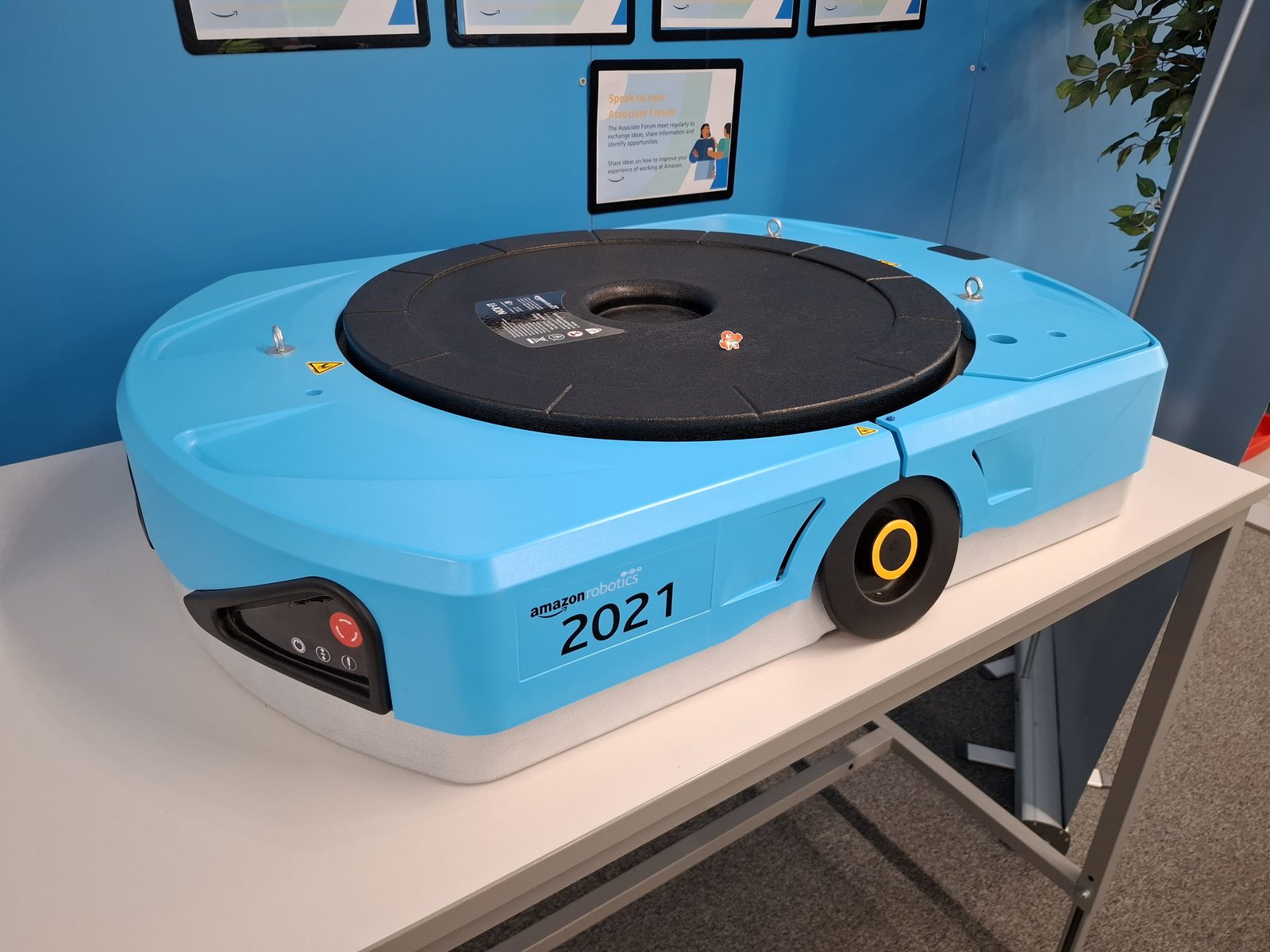
An Amazon Robotics "drive unit" — the Kiva-style orange pod-carrying robot at the core of Amazon's fleet, photographed at the BRS2 fulfillment center.
Photo: Auledas, CC BY 4.0, via Wikimedia CommonsThe two acronyms in this segment's name describe two different generations of technology. An AGV (automated guided vehicle) follows a fixed path — originally magnetic tape or embedded wires on the floor, later QR codes or reflective markers — and has done so since the technology's earliest industrial use in the 1950s.
An AMR (autonomous mobile robot) navigates dynamically using onboard sensors and mapping software (commonly SLAM — simultaneous localization and mapping), free to reroute around obstacles or changing warehouse layouts without any physical infrastructure.
The difference shows up when the site changes. An AGV needs its tape or markers relaid every time the layout moves; an AMR only needs its map rebuilt, and routes around an obstacle on its own. That removes the installation work, at the cost of more sensing and compute per unit.
AGV and AMR, side by side
Fixed path
Follows tape, buried wire, QR codes, or reflective markers. Cheap per unit, but the floor infrastructure has to be installed and relaid whenever the layout changes. In use industrially since the 1950s.
Maps and decides
Uses onboard sensors and SLAM to build its own map and route around obstacles. No floor infrastructure, so it adapts to layout changes, but sensing and compute make each unit more expensive.
The shift from AGV to AMR is, in miniature, the same story as the rest of physical AI: hand-coded, fixed behavior giving way to software that senses and adapts, and it's the AMR half of this segment that's driven almost all of the recent growth and funding.
02How the market formed
Kiva Systems, founded in 2003, built the model this entire segment now follows: orange mobile robots that carry entire shelving pods to a warehouse worker instead of sending the worker to the shelf. Amazon bought Kiva for roughly $775 million in 2012, renamed the unit Amazon Robotics, and rebuilt its own fulfillment centers around the idea — a bet that paid off dramatically, though not overnight. By June 2019, Amazon Robotics VP Brad Porter disclosed at the re:MARS conference that the company had deployed more than 200,000 robotic drives globally — a seven-year ramp from the Kiva acquisition to a meaningful fleet. Growth then accelerated: Amazon reported crossing 750,000 robots in June 2025, and on July 1, 2025, confirmed it had deployed its one-millionth robot, delivered to a fulfillment facility in Japan, operating across more than 300 facilities worldwide. Amazon Robotics VP Scott Dresser described the company as "the world's largest manufacturer and operator of mobile robotics" — accurate on pure numbers, though with an important caveat: none of those million robots are for sale.
One acquisition, a million robots later
Amazon's own overview of its current robot fleet — the captive deployment underlying the one-million-unit milestone described above.
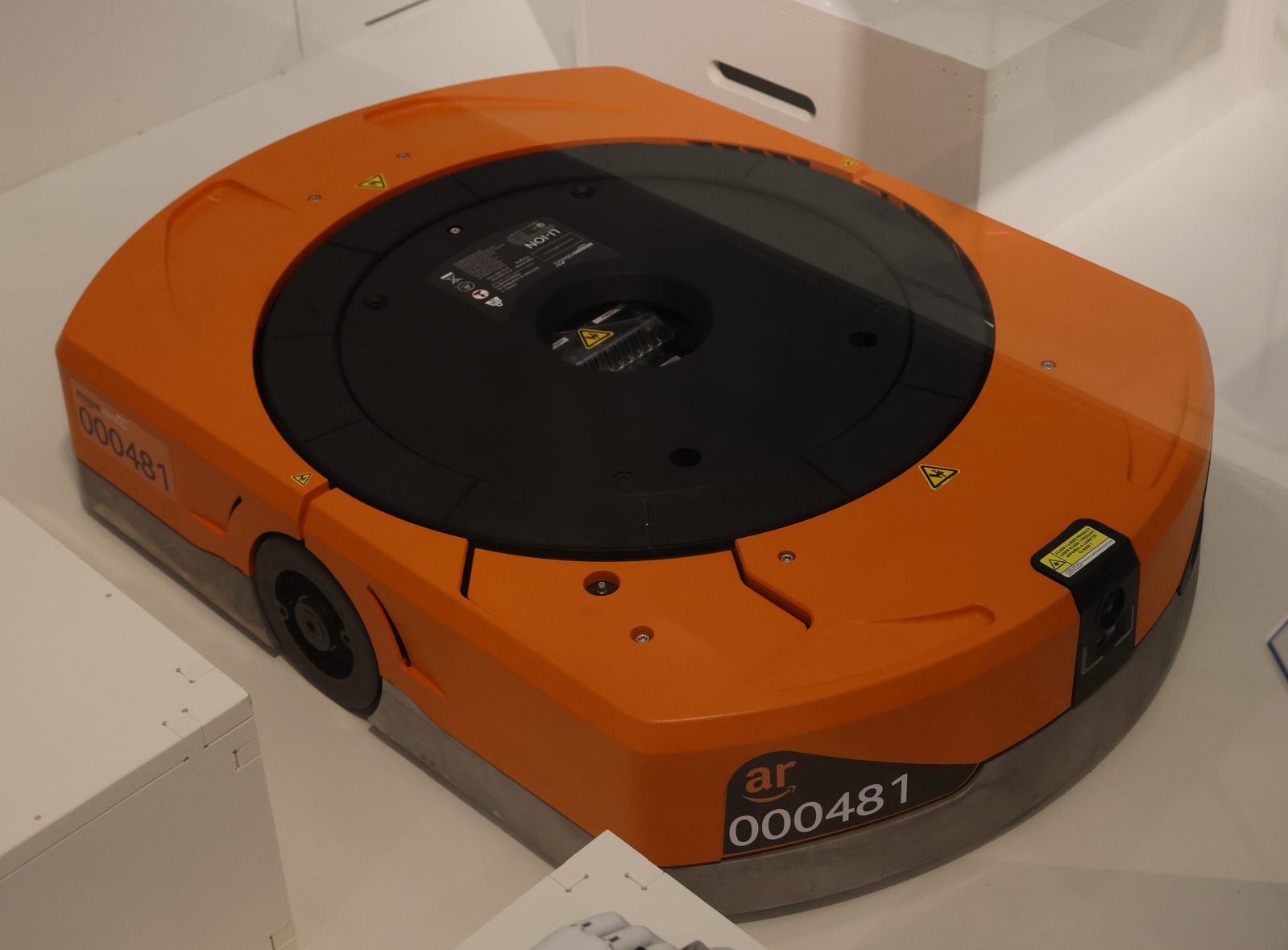
The scale of Amazon's captive AMR fleet on the warehouse floor — a fleet that crossed one million active units in July 2025, none of which are sold to other companies.
Photo: Geni, CC BY-SA 4.0, via Wikimedia Commons03Market size and key players
Grand View Research estimates the global AMR market at $4.7 billion in 2025, growing to $5.5 billion in 2026 and $14.0 billion by 2033. Translating that into deployed fleets is harder than it sounds, because the companies actually running robots split into two categories that don't compete for the same customers. Amazon Robotics operates a captive fleet — built for Amazon's own warehouses, never sold or leased elsewhere. Commercial vendors sell or lease AMRs to other companies' warehouses instead: China's Geek+ had delivered more than 66,000 robots to 40+ countries as of mid-2025, and Hai Robotics, also based in China, had reached roughly 17,000 cumulative units sold through 2024. None of these numbers are directly comparable to each other as a "market share" ranking — they answer different questions (whose warehouses run the most robots vs. who sells the most robots to someone else).
Global AMR market size, Grand View Research estimate (USD)
Deployed fleets, by company (cumulative units)
66,000 units Geekplus 2025 interim results
17,000 units Hai Robotics, 2025 Year-End Recap (cumulative sales through 2024)
| Company | Country | Metric | Cumulative deployed |
|---|---|---|---|
| Amazon Robotics | US | Deployed units (as of 2025-07) | 1,000,000 units TechCrunch / Amazon (Jul 2025) — captive fleet, not sold to other companies |
| Geek+ | CN | Deployed units (as of 2025-06) | 66,000 units Geekplus 2025 interim results |
| Hai Robotics | CN | Deployed units (as of 2024) | 17,000 units Hai Robotics, 2025 Year-End Recap (cumulative sales through 2024) |
Data note: These three companies aren't really competing for the same customers. Amazon Robotics' 1 million+ figure is a captive fleet built for Amazon's own warehouses, not a product sold or leased to other companies — it isn't comparable to Geek+ and Hai Robotics, which are commercial vendors selling/leasing AMRs to third parties. `shipmentVolume` (annual units) is omitted here because IFR's own World Robotics — Service Robots report, the closest thing to an industry-wide tracker, is explicitly sample-based ("NOT projected to the whole industry") and its transportation/logistics unit counts have shifted between report editions in ways that don't chain into a clean multi-year series — IFR reported ~113,000 transportation/logistics units for 2023 and ~103,000 for 2024, a net decline that may reflect classification changes as much as real-world volume. Revenue-share percentages for individual vendors (e.g. claims that one company holds a specific double-digit share) circulate in lower-confidence market reports without a clear, checkable methodology and are deliberately not reproduced here.
Market data as of 2026-07
04Chinese vendors go public
This segment reached a milestone the humanoid and robotic-arm segments hadn't, at least among the vendors: on July 9, 2025, Geek+ listed on the Hong Kong Stock Exchange under ticker 2590.HK — the first publicly listed company in the AMR warehouse-robotics market anywhere, and the largest IPO by a robotics company to date among H-shares, the class of Hong Kong-listed shares issued by mainland-Chinese companies. The Hong Kong public offering was oversubscribed more than 133 times, meaning investors bid for more than 133 times the stock on offer. Geek+ reported RMB 2.4 billion (roughly $330 million) in 2024 revenue ahead of the listing, making it the largest company by revenue among Hong Kong-listed robotics firms at the time.
First publicly listed AMR company anywhere; Hong Kong offering oversubscribed 133x.
SourceGeekplus, Jul 2025
Same month, a different kind of milestone — captive fleet scale, not a public offering.
SourceTechCrunch, Jul 2025
05The shift to Robots-as-a-Service
The purchasing model for this segment is changing almost as fast as the technology. Roughly 41% of new AMR deployments in 2025 used a Robots-as-a-Service (RaaS) structure — pay per robot per month or per task, rather than a capital purchase — up from 28% in 2023, and that share is projected to reach 62% by 2030. That shift lowers the barrier for a warehouse operator to try AMRs without a large upfront commitment, and it also changes how vendors report growth: a RaaS-heavy vendor's revenue trails its deployed-fleet size, since it's collecting payment over years rather than at the point of sale — one more reason unit counts and revenue-based "market share" tell different stories in this segment.
06Challenges ahead
Most segments on this site at least converge on a shortlist of names, even where the ranking between them is disputed. This one doesn't converge even that far, and may not for a while: the biggest operator isn't a vendor, the newest public company isn't the biggest operator, and the purchasing model itself is shifting under everyone's feet. What's actually being tested right now isn't which company wins — it's whether RaaS pricing lets a wave of mid-sized warehouse operators, not just giants like Amazon, adopt AMR fleets at the scale that's so far been mostly a story about one company's internal operation.
07Timeline at a glance
| Year | Region | Event |
|---|---|---|
| 2003 | US | Kiva Systems founded |
| 2012 | US | Amazon acquires Kiva Systems (~$775M) → Amazon Robotics |
| 2013 | CN | Geek+ founded |
| 2016 | CN | Hai Robotics founded |
| 2019-06 | US | Amazon discloses 200,000+ robots deployed globally, at re:MARS |
| 2025-06 | CN | Geek+ reports 66,000+ cumulative robots deployed to 40+ countries |
| 2025-06 | US | Amazon reports crossing 750,000 cumulative robots deployed |
| 2025-07 | CN | Geek+ lists on the HKEX — first publicly listed AMR company |
| 2025-07 | US | Amazon deploys its 1,000,000th robot |
08FAQ
What's the difference between an AGV and an AMR?
An AGV (automated guided vehicle) follows a fixed physical path — magnetic tape, wires, or markers on the floor. An AMR (autonomous mobile robot) navigates dynamically using onboard sensors and mapping software, without any fixed infrastructure. AMRs are the newer, faster-growing half of this segment.
How many robots does Amazon actually run?
More than 1 million, confirmed on July 1, 2025, across 300+ fulfillment facilities worldwide. Every one of them is part of Amazon's own captive fleet — Amazon Robotics doesn't sell or lease these systems to other companies.
How big is the AMR market?
Grand View Research estimates $4.7 billion globally in 2025, growing to $5.5 billion in 2026 and $14.0 billion by 2033.
09Sources
02. How the market formed
Related articles
Segment Deep Dives
All Segment Deep Dives articles →Humanoid & Mobility
- ›Humanoid Robots: Size and Disputed Shipments
- ›Quadruped Robots: The 46x Price Gap
- ›AGV vs AMR: Market Size and Fleet Scale(this article)
- ›Drone Market: Size and the DJI Question