Segment Deep Dives
Surgical Robots: Market Size, Players, and Procedure Growth
01How the market formed
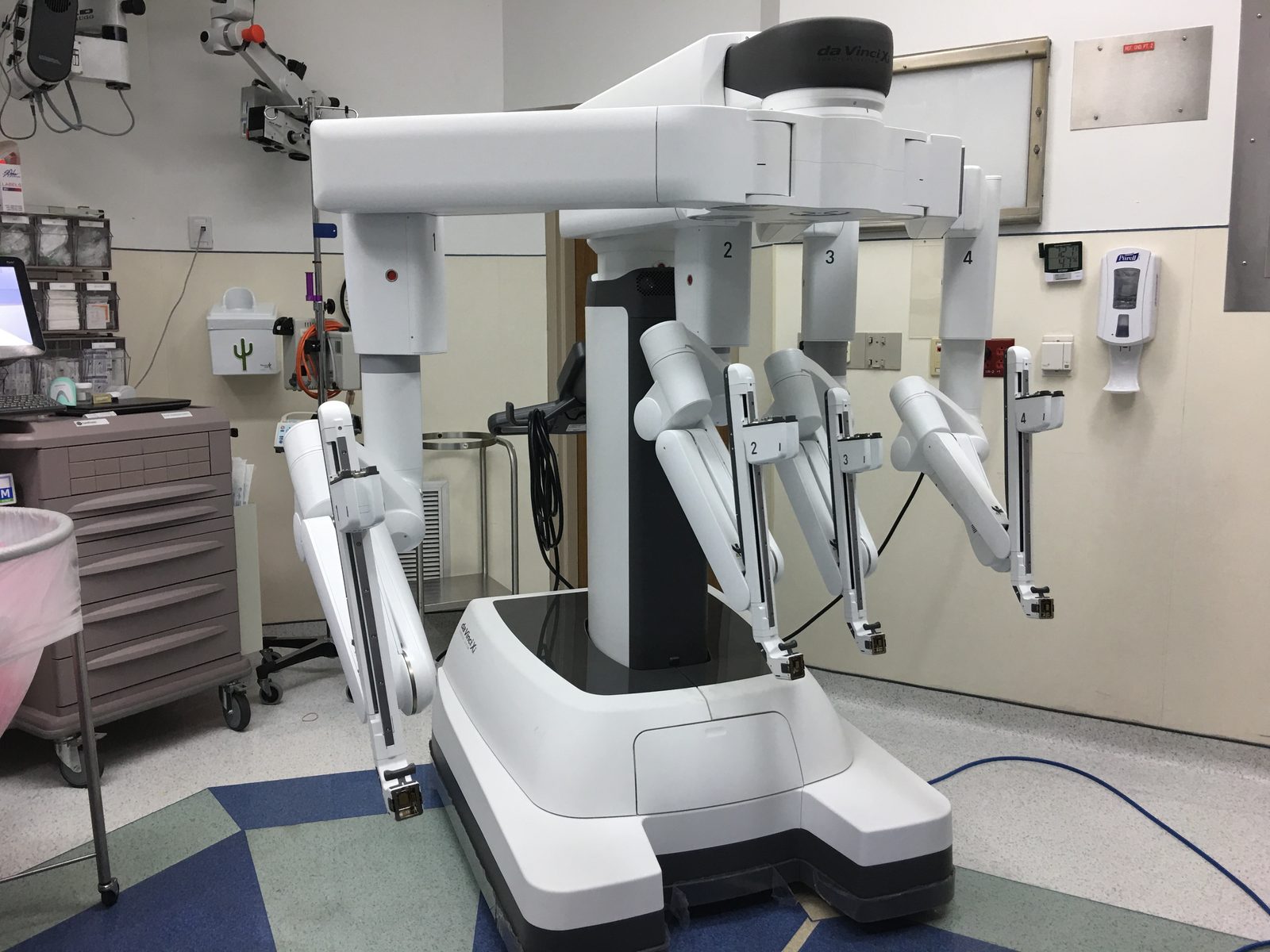
Intuitive Surgical's da Vinci Xi — the platform behind roughly 70-80% of soft-tissue robotic surgery, the company's own more directly comparable category.
Photo: Alvarogarciamd, CC BY-SA 4.0, via Wikimedia CommonsThe technology behind today's dominant surgical robot didn't start as a commercial product. Researchers Ajit Shah and Gary Guthart at SRI International developed a prototype robotic surgical system in the late 1980s with National Institutes of Health funding; the project drew interest from DARPA for a different reason entirely — the possibility of letting surgeons operate remotely on soldiers wounded on the battlefield. Surgeon Frederic Moll and engineers Robert Younge and John Freund licensed that research and incorporated Intuitive Surgical in 1995, refining the SRI prototype (nicknamed "Lenny," after Leonardo da Vinci) into a commercial product. The resulting da Vinci Surgical System launched in Europe in 1999 and, in 2000, became the first robotic surgery system cleared by the FDA for general laparoscopic surgery — the start of a lead in soft-tissue robotic surgery that no competitor has meaningfully closed in the 25 years since.
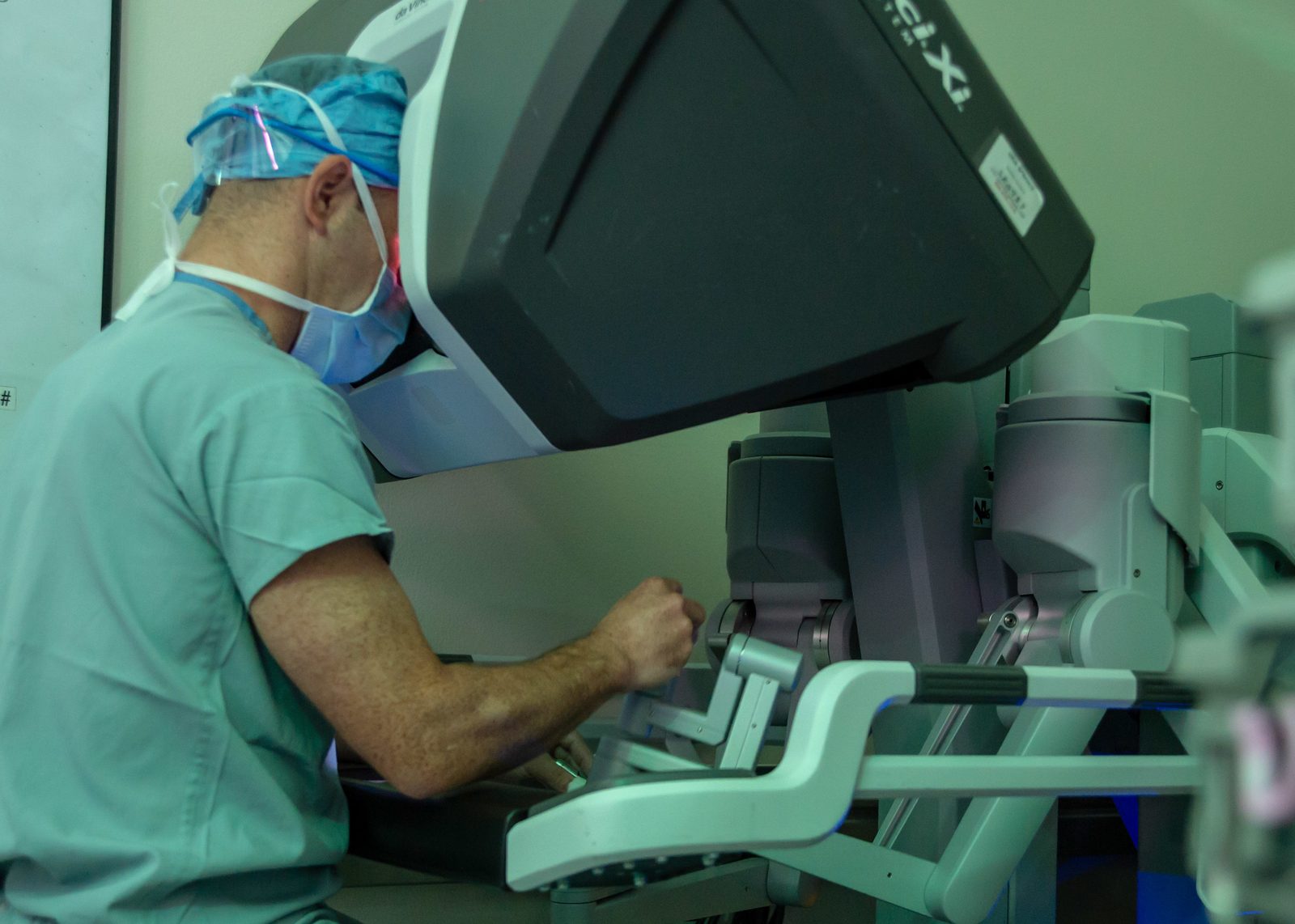
A surgeon at a robotic-surgery console — the human-in-the-loop side of the workflow, controlling the patient-side arms remotely rather than operating manually.
Photo: MC3 Jake Greenberg / U.S. Navy, Public domain, via Wikimedia Commons02The business model moat
What makes this segment different from most others in physical AI is the business model underneath it. Intuitive Surgical doesn't primarily make money selling robots — it places da Vinci and Ion systems with hospitals, often at a thin margin or even a loss-leading price, and then earns recurring revenue for the life of the system through per-procedure instruments, accessories, and service contracts. That model rewards installed base and procedure volume far more than it rewards a single system sale, which is exactly what shows up in the company's growth: more machines placed leads to more procedures performed on existing machines, which is a larger and stickier number than the placement count alone.
03Placements and procedure volume
Unlike most physical AI segments, where "shipment volume" comes from third-party analyst estimates that different firms count differently, Intuitive Surgical discloses exact system placements every quarter. The company placed 1,370 da Vinci systems in 2023, 1,526 in 2024, and 1,721 in 2025 — a real, reported trend, not a forecast. Procedure volume grew even faster: customers performed over 3.2 million procedures across Intuitive's platforms in 2025, up 19% from 2024, pushing the installed base past 12,100 systems (da Vinci and Ion combined) and cumulative lifetime da Vinci procedures past 17 million.
2025 in numbers
da Vinci systems placed per year, reported (units)
04Market size and key players
Precedence Research estimates the global surgical-robotics market at $12.5 billion in 2025, growing to $14.5 billion in 2026 and $50.3 billion by 2035. Intuitive Surgical's share of that market depends heavily on scope: roughly 60% of the broader "surgical robotics" category, which includes orthopedic systems like Stryker's Mako, but closer to 70–80% of soft-tissue robotic surgery specifically — da Vinci's actual category, and the more directly comparable figure. For most of the last two decades, that dominance went essentially unchallenged. That's now changing: Medtronic's Hugo received its first US FDA clearance, for urologic procedures, in December 2025 — the first major medtech company to challenge da Vinci in the US in over 20 years — while Johnson & Johnson's Ottava and CMR Surgical's Versius are pursuing their own regulatory clearances and early international rollouts.
Global surgical-robotics market size, Precedence Research estimate (USD)
~70% of soft-tissue robotic surgery Multiple analyst estimates, soft-tissue robotic surgery specifically
| Company | Country | Metric | Share |
|---|---|---|---|
| Intuitive Surgical | US | Revenue share (2025) | ~70% of soft-tissue robotic surgery Multiple analyst estimates, soft-tissue robotic surgery specifically |
The first real challengers, two decades in
First US FDA clearance (urologic procedures) — already used in 30+ countries for tens of thousands of procedures internationally.
J&J Ottava
Johnson & Johnson's own soft-tissue system, still pursuing regulatory clearance.
CMR Surgical Versius
Modular, lower-cost design; earliest adoption concentrated in Europe.
Intuitive's own introduction to da Vinci 5, the platform behind most of the roughly 60–80% share figures cited above, depending on how the market is scoped.
Data note: Unlike most other physical AI segments, this one has a single dominant player rather than a fragmented field. Intuitive Surgical's share is reported anywhere from ~60% (the broader "surgical robotics" market, which includes orthopedic systems like Stryker's Mako) to 70–80% (soft-tissue robotic surgery specifically, da Vinci's actual category) depending on how the market is scoped — the 70% figure above uses the narrower, more directly comparable definition. New entrants (Medtronic's Hugo, J&J's Ottava, CMR Surgical's Versius) don't yet have precise, comparable global share figures to add here — most are still in early commercial rollout (e.g. Medtronic's Hugo received its first US FDA clearance, for urologic procedures, in December 2025) rather than reporting installed-base numbers at Intuitive's scale.
Market data as of 2026-07
05Where the growth is
The US remains the center of gravity for this segment — still the largest single market and the base for essentially all of the new challengers' first regulatory clearances — but the growth is increasingly international. Intuitive's own 2025 results show international da Vinci procedures growing 23%, faster than the 15% growth in the US, as more health systems outside the US build out robotic surgery programs for the first time. Europe remains a smaller but distinct market, notable mainly as CMR Surgical's home base and the region where its modular, lower-cost Versius system has found its earliest adoption.
United States
- 2000da Vinci becomes the first robotic surgery system cleared by the FDA
- 2025US da Vinci procedures grow 15% — still the largest single market
- 2025-12Medtronic's Hugo receives its first US FDA clearance
International
- 1999da Vinci launches in Europe, ahead of US FDA clearance
- 2025International da Vinci procedures grow 23%, outpacing the US
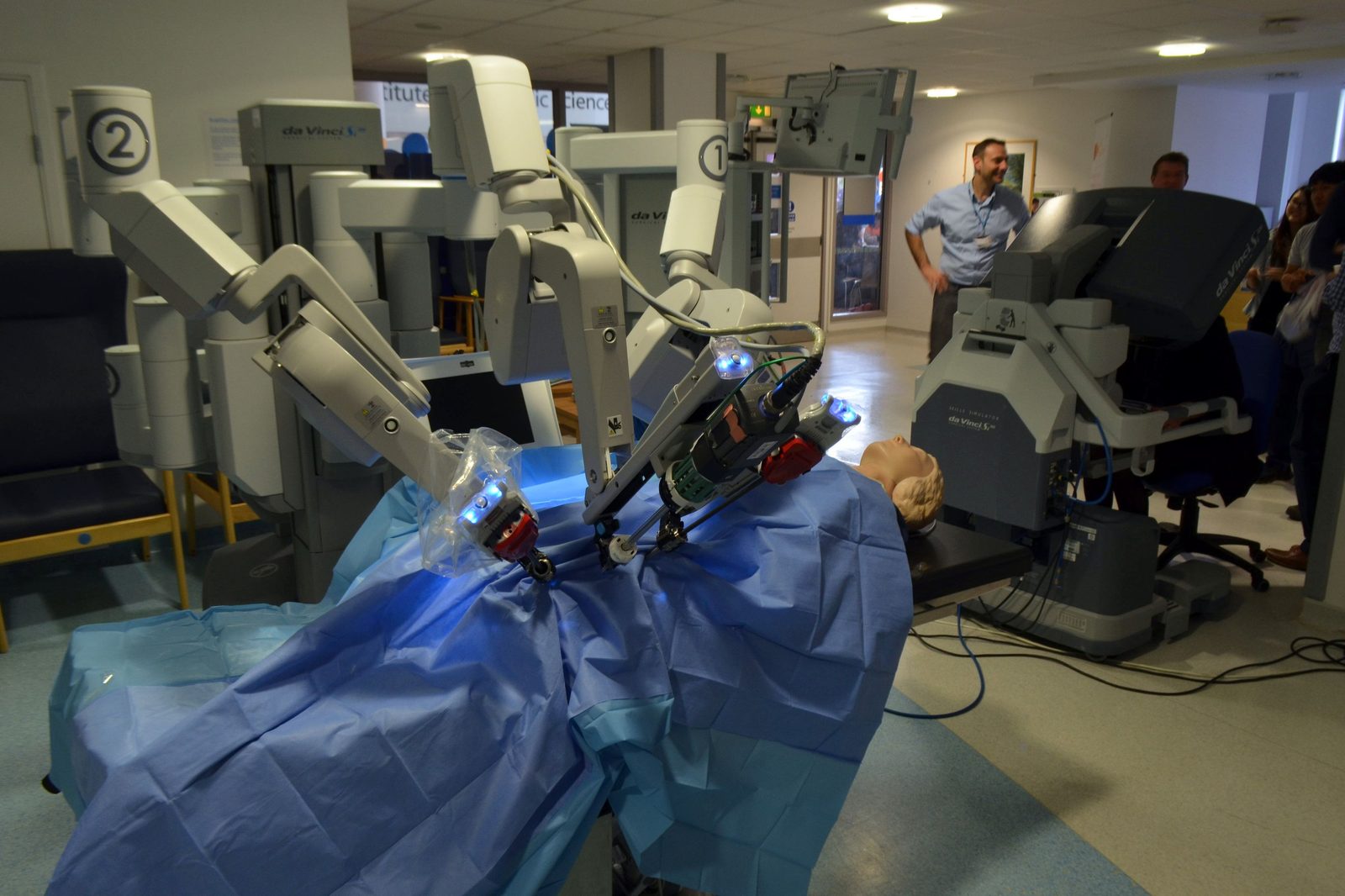
A da Vinci Surgical System on public exhibit, showing the full patient-side cart with its jointed arms — the FDA cleared the first version of this platform in 2000.
Photo: Cmglee, CC BY-SA 3.0, via Wikimedia Commons06Challenges ahead
The open question for this segment isn't whether robotic surgery keeps growing — procedure counts have grown every year for two decades, through multiple economic cycles. It's whether Intuitive Surgical's business model, not just its technology, can be replicated by challengers who are years behind on installed base and procedure volume. A newly cleared system can win a hospital's first purchase; matching decades of accumulated instrument, service, and training revenue on top of it is a different, slower fight — one that's only just begun.
07Timeline at a glance
| Year | Region | Event |
|---|---|---|
| 1980s | US | SRI International develops the underlying prototype with NIH/DARPA interest |
| 1995 | US | Intuitive Surgical incorporated |
| 1999 | EU | da Vinci Surgical System launches in Europe |
| 2000 | US | da Vinci becomes the first robotic surgery system cleared by the FDA; Intuitive IPOs |
| 2023 | US | 1,370 da Vinci systems placed for the year |
| 2024 | US | 1,526 da Vinci systems placed; procedures near 2.7M (+17%) |
| 2025 | US | 1,721 da Vinci systems placed; procedures top 3.2M (+19%) |
| 2025-12 | US | Medtronic's Hugo becomes the first major medtech challenger cleared by the FDA in the US |
08FAQ
How big is the surgical robot market?
Precedence Research estimates $12.5 billion globally in 2025, growing to $14.5 billion in 2026 and $50.3 billion by 2035 — though other research firms scope the market differently and arrive at different figures.
What share of the market does Intuitive Surgical control?
Roughly 60% of the broader surgical-robotics market (which includes orthopedic systems), or closer to 70–80% of soft-tissue robotic surgery specifically — da Vinci's actual category and the more directly comparable figure.
Is Intuitive Surgical's monopoly over robotic surgery ending?
It's just starting to be challenged, not ended. Medtronic's Hugo received its first US FDA clearance (for urologic procedures) in December 2025 — the first time in over two decades a major medtech company has cleared a direct US competitor to da Vinci — but Intuitive still placed more than 1,700 systems in 2025 alone, versus challengers' installed bases that remain far smaller.
09Sources
01. How the market formed
Related articles
Segment Deep Dives
All Segment Deep Dives articles →Humanoid & Mobility
Industrial & Field Applications
- ›Robotic Arms: Market Size, Players, and Installations
- ›Warehouse & Logistics Automation: Market Size and Players
- ›Exoskeletons: Market Size, Players, and a Wave of Financial Distress
- ›Surgical Robots: Market Size, Players, and Procedure Growth(this article)