Segment Deep Dives
Robot Foundation Models: Market Size, Players, and the Funding Boom
01What a robot foundation model is
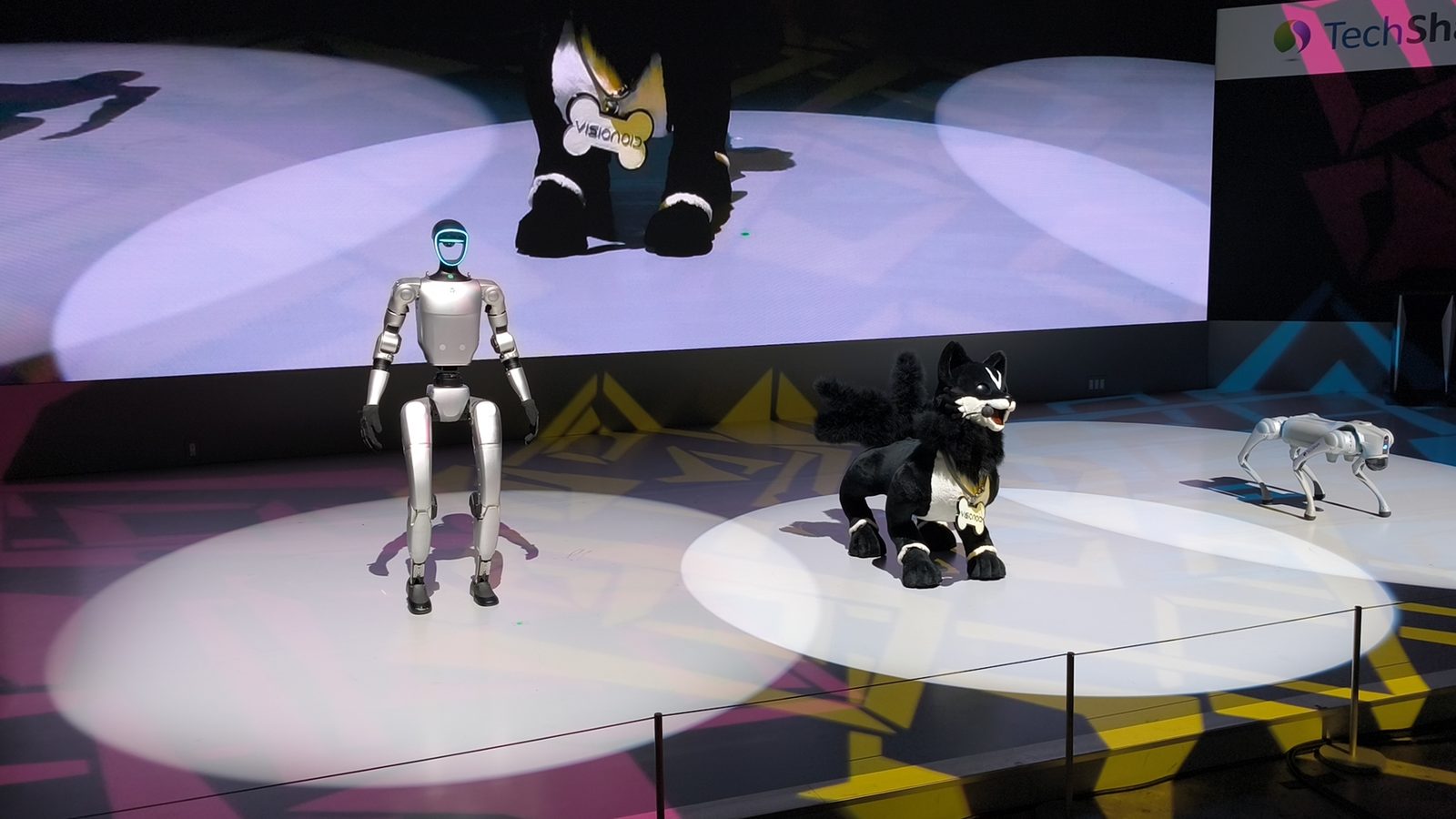
A Unitree G1 humanoid and Go2 quadruped on stage at the Japan Mobility Show 2025 — the kind of live public demo increasingly used to showcase foundation-model-driven robot behavior.
Photo: RuinDig / Yuki Uchida, CC BY 4.0, via Wikimedia CommonsFor most of robotics history, a robot ran hand-coded logic or a model trained for one narrow task on one specific machine — a warehouse picker's grasping model didn't transfer to a different robot arm, let alone a humanoid. A robot foundation model, usually built as a vision-language-action (VLA) model, aims to do what large language models did for text: train one large model on data from many robots and tasks, then fine-tune or prompt it for a new one instead of starting over. Whether that transfer actually works as well in the physical world as it did in language is the open question this entire segment is a bet on.
02How the market formed
Google's RT-1, published in December 2022, was among the first models trained across a genuinely large, multi-task robot dataset rather than one narrow behavior. RT-2, published by Google DeepMind in July 2023, went further — built on a vision-language model backbone, the same category of model behind chatbots, repurposed to output robot actions directly. That research result helped set off a wave of new companies built specifically around the VLA idea: Skild AI (founded May 2023, by Carnegie Mellon researchers Deepak Pathak and Abhinav Gupta) and Physical Intelligence (founded 2024) both raised their first funding within about a year of each other. Physical Intelligence shipped its own model, π0, in October 2024 and open-sourced a version of it as "openpi" in February 2025 — the same month Figure AI launched its Helix model, and one month before NVIDIA unveiled Isaac GR00T N1 at its March 2025 GTC conference and Google DeepMind announced Gemini Robotics. Four independently developed foundation models, from four different companies, all launched within about six weeks of each other — less a coincidence than a sign the underlying research approach had matured enough for multiple teams to ship at once.
NVIDIA's Isaac GR00T N1 introduction (Mar 2025) — one of four independently launched robot foundation models that spring.
03Market size
MarketsandMarkets estimates the global "Embodied AI" market at $4.44 billion in 2025, growing to $23.06 billion by 2030 — a 39% compound annual growth rate. That number should be read cautiously: research firms label this category "Embodied AI," "Physical AI," "Robotic Software," or "VLA/VLM for robotics" more or less interchangeably, and published growth-rate estimates for what's nominally the same market range from roughly 15% to 55% depending on what each firm counts. No two firms appear to be measuring quite the same thing.
Global Embodied AI market size, MarketsandMarkets estimate (USD)
Data note: Market-size estimates for this segment vary enormously by scope — research firms label it "Embodied AI," "Physical AI," "Robotic Software," or "VLA/VLM for robotics," with published compound annual growth rates ranging from roughly 15% to 55% depending on what's counted. The series above uses MarketsandMarkets' "Embodied AI" estimate specifically because it's a clean, internally consistent two-point series from one firm — it shouldn't be read as more authoritative than the other scopes, just more comparable across its own two years. `marketShare` here uses each company's last disclosed private-funding-round valuation, not a units-shipped or revenue-share metric, since foundation-model providers don't yet report either — read it as a funding leaderboard, not a market-share ranking. Physical Intelligence's two largest rounds (Nov 2024 and Nov 2025) are known only through trade press; the company has not issued its own press release confirming either transaction or its resulting valuation, and different outlets report different figures for the same round (see the Physical Intelligence entry).
Market data as of 2026-07
04The funding leaderboard
With no shipped product generating comparable revenue yet, the closest thing this segment has to a leaderboard is private-funding valuation. Figure AI leads at a $39 billion post-money valuation after a Series C that raised more than $1 billion in September 2025. Skild AI followed with a Series C in January 2026 that pushed its valuation over $14 billion. Physical Intelligence trails both at a reported $5.6 billion following a $600 million round in November 2025 — though even that figure is contested: Bloomberg reported $5.6 billion for the round, while The Information separately reported $5 billion, and Physical Intelligence itself has not issued a press release confirming either the amount or the valuation for either of its two largest rounds.
Foundation-model leaders by last disclosed valuation
| Company | Country | Metric | Valuation |
|---|---|---|---|
| Figure AI | US | Valuation (2025-09) | $39.0B Figure AI, Series C funding announcement (company-confirmed) |
| Skild AI | US | Valuation (2026-01) | $14.0B Skild AI, Series C funding announcement (company-confirmed) — valuation "over $14B" |
| Physical Intelligence | US | Valuation (2025-11) | $5.6B Bloomberg, reported — no Physical Intelligence press release confirms this round; The Information separately reported $5B for the same round |
05The open-source counterweight
Running alongside the well-funded private labs is an open-source ecosystem trying to make robot foundation models a shared commodity rather than each startup's proprietary moat. Hugging Face's LeRobot library, launched in 2024, had accumulated roughly 25,700 GitHub stars and hosted 56 models and 187 datasets as of mid-2026. Physical Intelligence's openpi release had drawn about 12,700 stars. Both build on the Open X-Embodiment dataset, an academic-industry collaboration spanning 22 robot platforms across 21 institutions with more than 1 million recorded trajectories — the kind of cross-robot training data a single company's own robots can't generate alone. NVIDIA has positioned GR00T as an open foundation model too, naming ABB, AgiBot, Agility Robotics, Fanuc, Figure, KUKA, Skild AI, Universal Robots, and Yaskawa among its named ecosystem partners as of March 2026; NVIDIA and Hugging Face jointly claimed in July 2026 to reach "3 million robotics developers" through the combined ecosystem — a company-stated figure, not independently audited.
Open-source ecosystem, in numbers
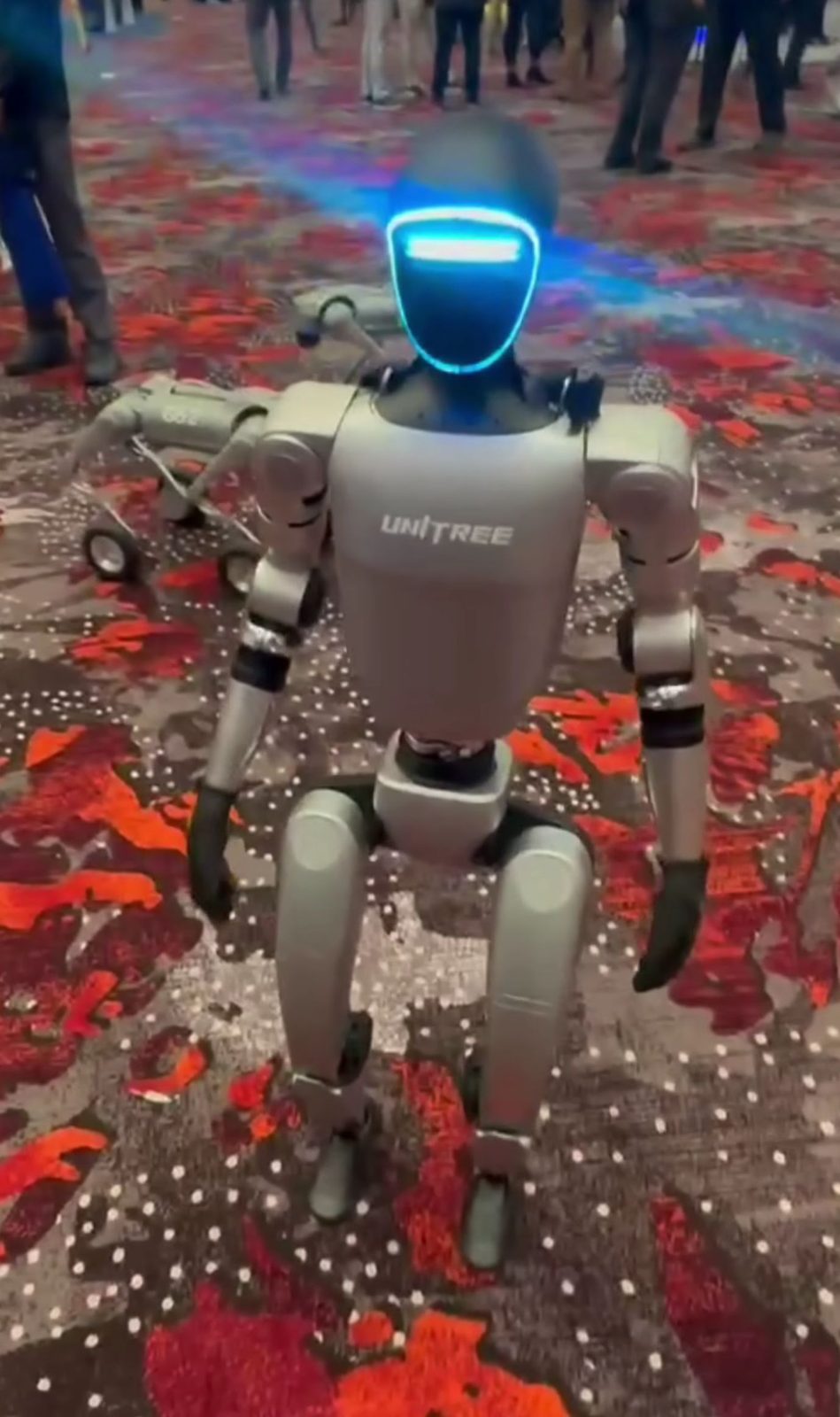
A Unitree G1 humanoid — one of the hardware platforms that ecosystem partners like NVIDIA target when releasing open robot foundation models such as Isaac GR00T N1.
Photo: Sayanesy, CC0, via Wikimedia Commons06Challenges ahead
Two questions sit underneath every number in this article. The first is technical: does a model trained across many robots and tasks actually transfer as reliably in the physical world as a language model transfers across text tasks, or does every new robot body still need enough of its own fine-tuning data to make the "foundation" framing more marketing than reality? The second is financial: Figure AI and Skild AI's valuations already run into the tens of billions of dollars against essentially no product revenue, a gap this site hasn't seen at this scale in any other segment — including humanoid hardware makers with actual (if small) shipment volumes. Whether the underlying technology generalizes the way its backers are betting, and whether revenue ever catches up to valuation, are both questions this segment's next couple of years will have to answer.
07Timeline at a glance
| Year | Region | Event |
|---|---|---|
| 2022-12 | US | Google publishes RT-1 |
| 2023-05 | US | Skild AI founded |
| 2023-07 | US | Google DeepMind publishes RT-2 |
| 2024 | US | Physical Intelligence founded |
| 2024-10 | US | Physical Intelligence releases π0 |
| 2025-02 | US | Physical Intelligence open-sources π0 as "openpi"; Figure AI launches Helix |
| 2025-03 | US | NVIDIA unveils Isaac GR00T N1 at GTC; Google DeepMind announces Gemini Robotics |
| 2025-09 | US | Figure AI raises $1B+ Series C at a $39B valuation |
| 2025-11 | US | Physical Intelligence raises $600M, reportedly at a $5.6B valuation |
| 2026-01 | US | Skild AI raises a $1.4B Series C at a $14B+ valuation |
08FAQ
What's a vision-language-action (VLA) model?
A model that takes in camera images and a language instruction and outputs a sequence of robot joint/motor commands, built on the same kind of architecture as the vision-language models behind AI chatbots — repurposed to control physical actuators instead of generating text.
Who's the most valuable robot foundation model company?
Figure AI, at a $39 billion post-money valuation as of its September 2025 Series C — though Figure AI also builds humanoid hardware, unlike software-only labs like Skild AI ($14B+, January 2026) and Physical Intelligence (reportedly $5.6B, November 2025).
Is there an open-source alternative to these proprietary models?
Yes — Hugging Face's LeRobot library and Physical Intelligence's openpi release are both open-source, and NVIDIA has positioned its GR00T model as open as well, with named ecosystem partners spanning most major robot arm and humanoid makers.
09Sources
05. The open-source counterweight
Related articles
Articles
Company & Market Data
Segment Deep Dives
All Segment Deep Dives articles →Humanoid & Mobility
Industrial & Field Applications
Enabling Technology
- ›Robot Foundation Models: Market Size, Players, and the Funding Boom(this article)
- ›Actuators & Precision Reducers: Market Size and Players
- ›Sensors & Perception for Robots: Market Size and the LiDAR Race
- ›AI Compute & Chips for Robots: Market Size and Players